Birds
Cockatoos and parrots
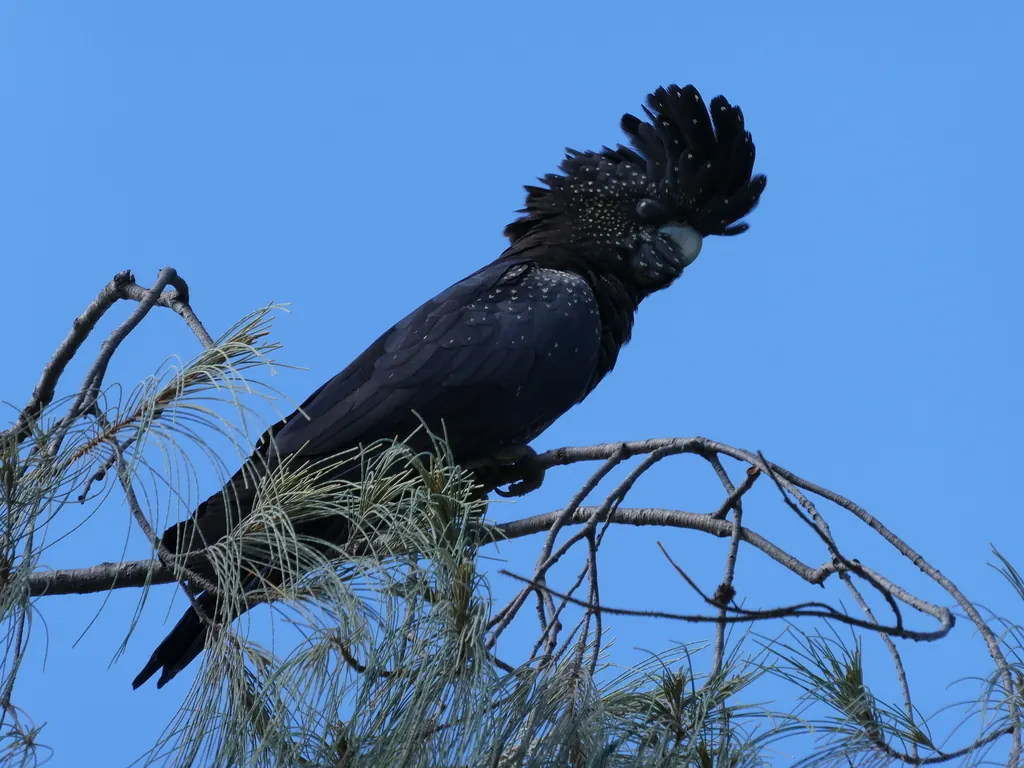
kadanji in Yalanji and kumurbina in Nyungkul is the black cockatoo, the red-tailed black cockatoo that cracks the bloodwood fruit in flocks of hundreds and screams across the river at evening; birrbirr is the rainbow lorikeet and any parrot; karrambil the 'king parrot', which here is the red-winged parrot; yinjul the fig parrot; and mirrimbal the cockatoo's crest and the hat made of its feathers[1][2]. All of them live in hollows and on seed and blossom, which makes them the birds of the old trees: 'seed eaters and cavity nesters, and as such depend on trees with fairly large diameters'[2]. Roth's cockatoo hunters swam out under a head of grass to the drinking log and pulled the birds under, threw light boomerangs into the flocks, climbed to the roost by a lawyer cane at night with a stick, or limed the branches with fig-sap[3]. The feathers went into the camp's ornaments and the children's games, and the cockatoo's crest into the men's hat[4][1].
Nothing is written for the Eastern coast on this page yet. What follows is true across the country.
Hann River Cape York
Possum People's country on the upper river and Thaypan (Kuku Thaypan) country downstream: stringybark and bloodwood woodland and a spring-fed sandy river that runs north-east from the Great Dividing Range, past the Peninsula Developmental Road, into Rinyirru (Lakefield) and the North Kennedy. Not Kuku Yalanji country: the Kuku Yalanji words on this page are the dictionary's, not the Hann's own languages. Place guide
The Hann country is parrot country. In a box of about 90 × 85 km around the middle Hann, Laura and western Rinyirru the Atlas of Living Australia holds 1,870 rainbow lorikeet records, 1,548 galah, 1,165 golden-shouldered parrot, 1,072 sulphur-crested cockatoo, 1,030 red-winged parrot, 818 red-tailed black cockatoo and 630 pale-headed rosella records, from 1948 to 2026, and two of the palm cockatoo[17]. The golden-shouldered parrot, Kuku Thaypan Arrmorral, is the one to know here: an endangered bird that matters to the people of this country[18][19].
Names here
The Kuku Thaypan (Awu Alaya) names recorded with the Elders are Arr, the black cockatoo; Nhye quin, the white cockatoo; and Arrmorral, the golden-shouldered parrot[18]. These are Kuku Thaypan words, not Kuku Yalanji ones.
The golden-shouldered parrot
An endangered parrot, listed among Rinyirru's threatened species[19][20]. It nests in termite mounds: the Elders' record speaks of 'the ant beds where the parrots nest'[18]. 'The Arrmorral golden shouldered parrot ... is an important species for Awu Laya speaking people and its management concerns being connected with responsibilities of kin and lore'[18]. Its story and places belong to its custodians.
Fire and food here
Fire keeps the parrot's country open. In the Elders' knowledge the golden-shouldered parrot 'requires a fire regime which maintains healthy age class Melaleuca viridiflora and prevents native woody weeds such as Acacia sp. from changing woodland structure', which also helps keep birds of prey, cats and other predators from ambushing its nests[18]. Where the broad-leaved tea-tree thickens, there are 'perches closer to the ant beds where the parrots nest, and fledgling parrots are preyed upon by the pied butcher birds'[18].
Black cockatoos on the burns. In the boxwood (Ku ronga) country of the Hann and Morehead floodplains, 'the smoked seed on the ground of the understory perennial species provides a valuable food resource for foraging bird and insects', and the Elders' research photographed black cockatoos coming in to land on a fresh burn[18].
How people used them here
No published record from the Possum, Thaypan or Kuku Warra people describes hunting cockatoos or parrots, or using their feathers. Roth's methods in the general sections come from other districts[3].
On country today
Rinyirru's joint managers name the red-tailed black cockatoo as a species of cultural significance, and keep a list of known traditional totem species: 'Any activity involving these species is considered a significant activity and needs approval from the land trust'[20]. Upstream, the upper Hann is Possum country and the middle and lower Hann Thaypan country[21][22]. Leave nesting mounds and hollows alone: the golden-shouldered parrot is endangered and protected[20][14].
Upper Mitchell Western Yalanji
Western Yalanji country west of the Great Dividing Range: dry open woodland cut by the sandy, paperbark-lined upper Mitchell River, around Karma Waters and Mount Carbine. Place guide
The rainbow lorikeet is the most-recorded bird within 30 km of Karma Waters, sixty-seven records, with the pale-headed rosella at fifty-two, the galah at thirty-six, the red-winged parrot at thirty-four, the red-tailed black cockatoo at thirty and the sulphur-crested cockatoo at eighteen[23].
Which ones are here
The scaly-breasted lorikeet, four records, is its green cousin[23]. The cockatiel has three records[23].
On country today
The lorikeets, rosellas, galahs and black cockatoos are the loud life of the Karma Waters river camps, and the black cockatoos' evening flight along the river is the station's clock[23].
Everywhere
Names
kadanji 'black cockatoo (Yalanji)' and kumurbina 'black cockatoo (Nyungkul)'. birrbirr 'parrot, parakeet, lorikeet; rainbow lorikeet (parakeet)'. karrambil 'king parrot'; the Australian king parrot of the east coast does not reach the Mitchell, and the red-winged parrot, red and green, is the king parrot of the inland[1][5]. yinjul 'fig parrot', the tiny green parrot of the rainforest figs. mirrimbal 'cockatoo crest; the name of a hat made from cockatoo feathers'[1]. In English the galah's name 'is derived from gilaa, a word from the Yuwaalaraay and neighbouring Aboriginal languages spoken in north-western New South Wales'[6].
The cockatoos and parrots
Red-tailed black cockatoo (Calyptorhynchus banksii, kadanji). 'A large black cockatoo native to Australia. Adult males have a characteristic pair of bright red panels on the tail that gives the species its name.' 'Around 60 centimetres in length ... The male's plumage is all black with a prominent black crest made up of elongated feathers from the forehead and crown. The bill is dark grey. The tail is also black with two lateral bright red panels. Females are black with yellow-orange stripes in the tail and chest'. 'The species is usually found in eucalyptus woodlands, or along water courses. In the more northerly parts of the country, these cockatoos are commonly seen in large flocks. They are seed eaters and cavity nesters, and as such depend on trees with fairly large diameters, generally Eucalyptus'[2]. The split bloodwood fruit under a tree is its work; see bloodwood.
Sulphur-crested cockatoo (Cacatua galerita). 'A relatively large white cockatoo', '44–55 cm long ... Their plumage is overall white, while the underwing and tail are tinged yellow', with the yellow crest; 'distinctive, raucous calls can be very loud'; 'naturally curious, as well as very intelligent'; photographed 'feeding on Pandanus fruit' in the Territory[7].
Galah (Eolophus roseicapilla). 'About 35 cm in length, and weighs 270–350 g. It has a pale silver to grey back, a pale grey rump, a pink face and breast, and a light pink mobile crest'; 'often found in flocks of 10 to 1,000 individuals', sometimes mixed with corellas and sulphur-crested cockatoos[6]. The cockatiel (Nymphicus hollandicus) is the smallest cockatoo, 'found largely in arid or semi-arid country but always close to water. Largely nomadic, the species will move to where food and water is available'[8].
Rainbow lorikeet (Trichoglossus moluccanus, birrbirr). 'A medium-sized parrot, with the length ranging from 25 to 30 cm, including the tail, and the weight varies from 75 to 157 g ... The head is deep blue with a greenish-yellow nuchal collar'; it feeds on nectar, pollen and fruit with a brush-tipped tongue, in screaming flocks at the blossom[9].
Pale-headed rosella (Platycercus adscitus). 'A moderate-size parrot with a pale yellow head, predominantly white cheeks, scalloped black and gold back and pale blue underparts'; 'found in open woodland, it feeds on seeds and fruit. As with other rosellas, the pale-headed rosella nests in hollows of large trees'; '33 cm long, which includes the 15 cm length of its tail'; the northern form 'is found from the Cape York Peninsula south through to Cardwell'[10].
Red-winged parrot (Aprosmictus erythropterus, karrambil). 'Typically about 30 to 33 cm in length. Both sexes have bright red wings and a bright green body. The male birds have a black nape, lower blue back and rump'. 'A hollow space in a tree at a height of 11 m from the ground usually acts as nest'; 'their diet typical consists of seeds from eucalyptus, acacia, berries, flowers, and insects. The birds' call are ching-ching, chink-chink or thin screeching'[5].
Roth's cockatoo hunting, 1901. 'Corellas, galahs, and white cockatoos are entrapped on the water in the late afternoon in the upper Georgina River District. The hunter, after tying numerous grass twigs and leafy boughs round his head, neck, and face, which are thus completely concealed, will swim out to some log or snag projecting just out of the water, on which he has learnt, from previous observation, these birds have been accustomed to alight: here he supports himself, with only his head above the surface. As the birds come down to drink, they fly around the bushes, and resting on the log, etc., are easily caught by the legs, pulled under the water, their necks wrung, and stuck one after another in the hunter's waist-belt. Another and very common method throughout the North-West Central Districts of catching these and other birds which fly in mobs is to throw a light boomerang into their very midst when on the wing. On the lower Tully River the capture of the white cockatoo is somewhat of a difficult undertaking, but is mastered as follows: Having noticed the particular branch and tree on which these birds are wont to camp, the native will, during the daytime, climb the tree and fix a lawyer-cane to the branch in question: the cane is of such length that it reaches to the ground. At night-time he will climb it hand-over-hand fashion, fixing his feet as he progresses by grasping with the big and second toes; at the same time he carries with him a long, thin stick hanging down behind and attached to a ring of lawyer-cane round his forehead or neck. Having reached the branch singled out, he very stealthily crawls along it, and, sneaking up very carefully, knocks the birds over with the stick. This method of capture is somewhat of a hazardous one for the hunter, but is commonly and successfully employed.' The lower Tully people also used a bird-lime, chimbun, from the sap of a fig, 'for catching smaller birds, peewits, small parrots, and even young cockatoos ... spread not only along the branches where they roost, but also in and among the young blossoms'[3].
Feathers. At Bloomfield the children's spear-target wheel was 'decorated with parrot, pigeon or cockatoo feathers', and senior men wore a head ornament of 'cockatoo top-knot feathers stuck into beeswax', the dictionary's mirrimbal[4][1].
Telling them
- Red-tailed black cockatoo: all black, a slow heavy flight, red tail panels on the male, barred orange on the female; a wailing creak[2].
- Sulphur-crested cockatoo: white, yellow crest, screaming[7].
- Galah: pink and grey, in tumbling flocks[6].
- Cockatiel: small, grey, a yellow face and a long tail, in pairs near water[8].
- Rainbow lorikeet: blue head, orange breast, green back, a fast screeching flight; the scaly-breasted lorikeet green with yellow scales[9].
- Pale-headed rosella: yellow head, blue belly, scalloped back, a whistle[10].
- Red-winged parrot: green with red shoulders, a slow deep flight, 'ching-ching'[5].
- Fig parrot (yinjul): tiny, green, in the rainforest figs to the east[1].
Signs
- Split bloodwood and gum fruit under a tree: black cockatoos[2].
- A tree in blossom roaring with lorikeets by day[9].
- Chewed hollow entrances and a bird's head looking out in the breeding season[10].
- Galahs on the ground at a dam, and cockatoos on the pandanus fruit by the river[6][7].
- A drinking log where the birds come down in the late afternoon: Roth's ambush[3].
Where they live
The hollow-bearing woodland, the river's gums and paperbarks, the pandanus and the figs; the black cockatoo 'in eucalyptus woodlands, or along water courses', the rosella 'in open woodland', the cockatiel and the galah on the open flats and at the dams[2][10][8][11]. Every one of them nests in a hollow, which only an old tree has.
The seed and blossom birds
The cockatoos and parrots are what the woodland's seed and blossom turn into: the black cockatoo's year is the bloodwood's crop, the lorikeet's the gum blossom's, the rosella's and galah's the grass seed on the ground[2][9][10]. They share the blossom with the native bees, the honeyeaters and, at night, the flying foxes, and the hollows with the possums, the ducks and the kookaburras[2]. The brown goshawk 'often hunt[s] near farmland or wetlands, where birds such as ducks, cockatoos and pigeons' gather; the carpet python takes them in the hollow[12][13].
Seasons
Flocks gather wherever a crop is heavy; the black cockatoos on the bloodwoods in the late dry, the lorikeets on whichever gum is flowering; nesting in the hollows with the build-up and the wet; the galahs and cockatiels on the dry flats and dams when the inland dries[2][8]. See the year on country.
Uses
- Meat: the big birds, taken at the drinking log, with a boomerang, or at the roost[3].
- Feathers: the cockatoo's crest in beeswax for the men's hat, parrot and cockatoo feathers on the children's target wheel[4][1].
- Finding the blossom and the fruit: the lorikeets' noise and the cockatoos' split fruit[9][2].
Taking cockatoos the old way
From Roth[3]:
- Find the drinking log the birds use in the late afternoon.
- Tie grass and leafy boughs round the head and face, swim out and hold the log with only the head above water; as the birds settle, catch them by the legs and pull them under[3].
- Or a light boomerang thrown into the flock on the wing[3].
- Or the night climb: fix a lawyer cane from the roost branch to the ground by day, climb it hand over hand at night with a long stick hung from a cane ring round the neck, crawl along the branch and knock the birds down; 'somewhat of a hazardous one for the hunter'[3].
- Or bird-lime on the roost branches and in the blossom[3].
- Keep the crest feathers and the red tail panels; see native bees for the beeswax[4].
Safety
- Native birds are protected wildlife in Queensland under the Nature Conservation Act 1992; native title holders hunting for personal, domestic or non-commercial communal needs are covered by section 211 of the Native Title Act 1993, recognised in the Western Yalanji determinations[14][15][16].
- A cockatoo's bill takes a finger off; handle by the legs as Roth's hunters did[3].
- The night climb is Roth's 'hazardous' method and belongs to people who climbed lawyer canes barefoot[3].
- A hollow tree with birds in it is worth more standing than for the one bird in it[2].
On Country today
The dictionary's names are the coast's; the Western Yalanji words for the galah, the rosella and the cockatiel are for the contribution box below[1].
Language
kadanji, kumurbina 'black cockatoo'; birrbirr 'parrot, lorikeet'; karrambil 'king parrot'; yinjul 'fig parrot'; mirrimbal 'cockatoo crest'; dikal 'bird'[1].
References
- Hershberger, H. D. & Hershberger, R. (1982). Kuku-Yalanji Dictionary. Work Papers of SIL-AAB, Series B, Volume 7. With Toby Bloomfield, Roy Friday, Billy Roberts, Hector and Doris Sykes, Joe Walker and others. www.sil.org/resources/archives/18038
- Wikipedia. Red-tailed black cockatoo. en.wikipedia.org/wiki/Red-tailed_black_cockatoo
- Roth, W. E. (1901). North Queensland Ethnography, Bulletin No. 3: Food — its search, capture, and preparation. Brisbane: Government Printer. Bloomfield River information from the Hislops. — Sect. 6 'Cooking'; plant list ('Castanospermum australe', 'Dioscorea sativa', 'Elettaria Scottiana', 'Nymphaea') archive.org/details/northqueensland00landgoog
- Anderson, C. (1996). Traditional material culture of the Kuku-Yalanji of Bloomfield River, North Queensland. Records of the South Australian Museum 29(1): 63–83. Based on fieldwork at Wujal Wujal in the late 1970s and early 1980s. — Hunting (spears, spear-throwers, harpoons); fishing (stupefacients); manufacturing (gums and resins); post-contact bush component archive.org/details/RecordsSouthAus29Sout
- Wikipedia. Red-winged parrot (Aprosmictus erythropterus). en.wikipedia.org/wiki/Red-winged_parrot
- Wikipedia. Galah (Eolophus roseicapilla). en.wikipedia.org/wiki/Galah
- Wikipedia. Sulphur-crested cockatoo (Cacatua galerita). en.wikipedia.org/wiki/Sulphur-crested_cockatoo
- Wikipedia. Cockatiel (Nymphicus hollandicus). en.wikipedia.org/wiki/Cockatiel
- Wikipedia. Rainbow lorikeet. en.wikipedia.org/wiki/Rainbow_lorikeet
- Wikipedia. Pale-headed rosella. en.wikipedia.org/wiki/Pale-headed_rosella
- Queensland Herbarium, Regional Ecosystem 9.11.26 (Einasleigh Uplands): Eucalyptus leptophleba and/or E. cullenii and/or Corymbia clarksoniana +/- E. platyphylla woodland on undulating terrain to rolling hills. Fire management guidelines. Queensland Government Regional Ecosystem Description Database. apps.des.qld.gov.au/regional-ecosystems/details/?re=9.11.26
- Wikipedia. Brown goshawk (Tachyspiza fasciata). en.wikipedia.org/wiki/Brown_goshawk
- Wikipedia. Morelia spilota (carpet python). en.wikipedia.org/wiki/Morelia_spilota
- Queensland Government, State of the Environment. Nature Conservation Act 1992. www.stateoftheenvironment.des.qld.gov.au/biodiversity/management-responses/legislation/nature-conservation-act-1992
- Australian Law Reform Commission. Review of the Native Title Act 1993 (DP 82), ch. 8: Relevant provisions in the Native Title Act (s 211). www.alrc.gov.au/publication/review-of-the-native-title-act-1993-dp-82/8-the-nature-and-content-of-native-title/relevant-provisions-in-the-native-title-act/
- Western Yalanji Aboriginal Corporation & CRC for Developing Northern Australia (2020). Western Yalanji Land Use and Economic Diversification Plan. CC BY 4.0. — Native Title Determinations 1–4 (pp. 13–18); ‘Fire Management and Carbon Farming’ (pp. 32–33); ‘Pastoralists’ crcna.com.au/wp-content/uploads/2024/05/westernyalanjilanduseplan_nov2020.pdf
- Atlas of Living Australia. Occurrence records of Psittaciformes, among them Trichoglossus moluccanus (1,870 records), Eolophus roseicapilla (1,548), Psephotellus chrysopterygius (1,165), Cacatua galerita (1,072), Aprosmictus erythropterus (1,030), Calyptorhynchus banksii (818), Platycercus adscitus (630) and Probosciger aterrimus (2), 1948–2026 in a box of about 90 × 85 km around the middle Hann River, Laura and western Rinyirru (lat −15.6 to −14.8, long 143.5 to 144.3), queried 28 October 2026. biocache.ala.org.au/occurrences/search?q=order%3APsittaciformes&fq=decimalLatitude%3A%5B-15.6%20TO%20-14.8%5D&fq=decimalLongitude%3A%5B143.5%20TO%20144.3%5D
- Standley, P.-M. (2019). The importance of campfires to effective conservation. PhD thesis, James Cook University. Records the fire and country knowledge of Kuku Thaypan Elders Dr Tommy George and Dr George Musgrave. researchonline.jcu.edu.au/64274/
- Queensland Parks and Wildlife Service. Nature, culture and history: Rinyirru (Lakefield) National Park (CYPAL) (web page, last updated 1 July 2024; accessed 28 October 2026). parks.qld.gov.au/parks/rinyirru-lakefield/about/culture
- Queensland Parks and Wildlife Service (2013). Rinyirru (Lakefield) Aggregation Management Statement 2013. parks.desi.qld.gov.au/__data/assets/pdf_file/0027/165771/rinyirru.pdf
- Ross on behalf of the Cape York United #1 Claim Group v State of Queensland (No 21) (Possum determination) [2023] FCA 1316 (Federal Court of Australia, 2 November 2023). — Determination area (upper Hann and Kennedy rivers); prescribed body corporate; affidavit evidence on hunting and fishing www.judgments.fedcourt.gov.au/judgments/Judgments/fca/single/2023/2023fca1316
- Ross on behalf of the Cape York United #1 Claim Group v State of Queensland (No 20) (Thaypan determination) [2023] FCA 1315 (Federal Court of Australia, 2 November 2023). — Determination area and waters; prescribed body corporate (Awu-Laya Indigenous Corporation); affidavit evidence on hunting www.judgments.fedcourt.gov.au/judgments/Judgments/fca/single/2023/2023fca1315
- Atlas of Living Australia. Bird (Aves) occurrence records within 30 km of the Karma Waters homestead (16.62° S, 144.60° E), species counts (accessed 10 October 2026). biocache.ala.org.au/occurrences/search?q=*:*&lat=-16.62&lon=144.60&radius=30&fq=class:Aves
From the community
Know this one? Add the words you use for it, what it is for, how it is done, a correction, or a photo from country. It shows here straight away with your name on it. Please keep anything restricted or sacred off the site.
Loading…