Shellfish & crustaceans
Freshwater mussels (mukirr)
mukirrVelesunio angasi
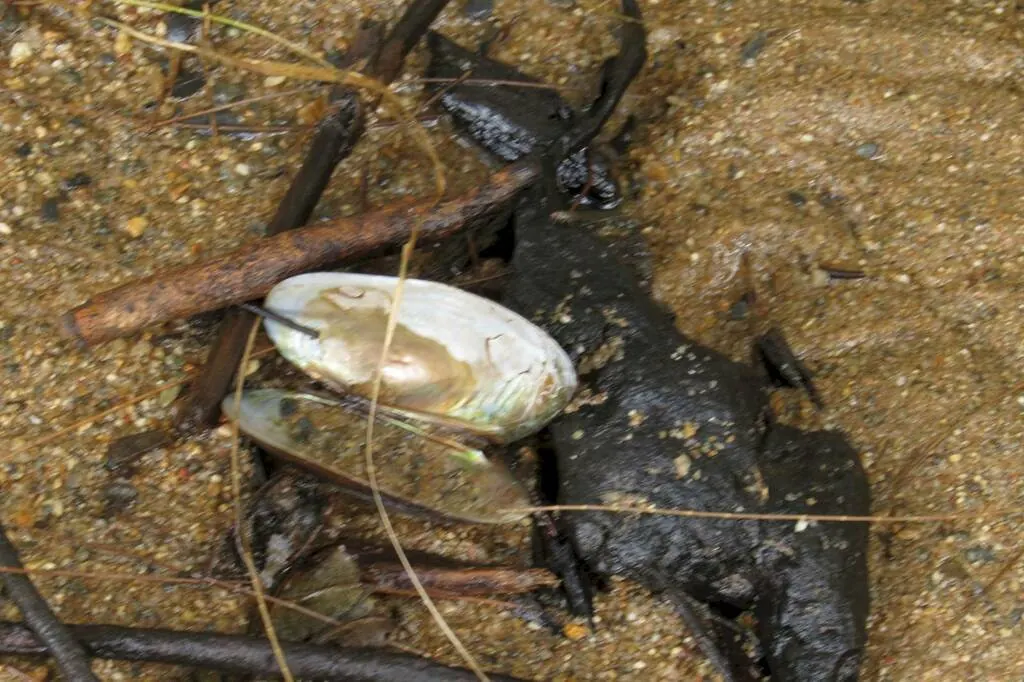
mukirr is the mussel: 'found in fresh and brackish water. There are many up the Daintree near Bairds, some up Granite Creek. Has to be cleaned from the black stuff that tastes like tobacco. First roast it, then clean the "ear" out, then boil it or else eat it right away without boiling'[1]. The river mussel of the north is Velesunio angasi, 'a shallow burrower in silty sand/mud in streams, billabongs, and slow-flowing rivers', a suspension feeder that breeds through the year and broods its larvae in its gills[2]. It is the easiest meat in the river, dug by hand from the sand of the pools and roasted in the ashes, which is how Roth says 'the large majority of these shell-fish' were cooked, by the women who 'generally' prepared 'yams, roots, nuts, and shell-fish'[3]. The shell was a tool as well: a scoop and spoon, an ash-scraper and a cutter, and on the Mitchell the blade that scraped the bloodwood manna and the inner bark of the string plants[4][5][6].
Hann River Cape York
Possum People's country on the upper river and Thaypan (Kuku Thaypan) country downstream: stringybark and bloodwood woodland and a spring-fed sandy river that runs north-east from the Great Dividing Range, past the Peninsula Developmental Road, into Rinyirru (Lakefield) and the North Kennedy. Not Kuku Yalanji country: the Kuku Yalanji words on this page are the dictionary's, not the Hann's own languages. Place guide
Mussels are a food of the Hann's country. A Thaypan man told the Federal Court that on Thaypan country, which takes in the Hann, 'We get wallaby, barramundi, freshwater fish and turtles and mussels'[16]. The written record of the animal itself is thin: the Atlas of Living Australia holds one freshwater mussel record, Velesunio angasi in 2000, in a box of about 90 × 85 km around the middle Hann, Laura and western Rinyirru[17].
Where they live here
The Hann is a sandy, spring-fed river that has not had a day without flow since its gauge was put in in 1968[18][19]. The mussel lives in 'silty sand/mud in streams, billabongs, and slow-flowing rivers'[2], so look in the sandy pools and backwaters, not the fast runs. Lagoons and swamps are one of the nine kinds of country the Kuku Thaypan Elders name[20].
Its year here
From December to March the rivers flood out over the plains[21]. The Hann runs lowest from September to November, a low, clear run between deep holes[19]. That is when the sandy shallows are easiest to reach, and when crocodiles are in the same holes; see crocodiles.
How people dealt with them here
Mussels and law. In the Kuku Thaypan Elders' law there are story places where girls must not eat mussels, 'as to do so may harm the health of their babies'[20]. The places and their stories belong to the Elders' families and are not named here.
Fewer and smaller. The Elders say mussels 'were once larger and in high number across the entire wetland complex'. In their plan for a lagoon on Kuku Thaypan country, the signs of healthy country include the 'Return of mussel numbers and size', along with keeping cattle and pigs out to stop the 'trampling and muddying of edge of lagoon'[20]. Feral pigs 'occur in large numbers' in Rinyirru[22].
On country today
The middle and lower Hann are Thaypan country and the upper Hann is the Possum People's country. Their November 2023 determinations recognise rights to hunt, fish and gather on the land and waters[16][23]. Others need the Traditional Owners' permission.
Upper Mitchell Western Yalanji
Western Yalanji country west of the Great Dividing Range: dry open woodland cut by the sandy, paperbark-lined upper Mitchell River, around Karma Waters and Mount Carbine. Place guide
In the Mitchell at Karma Waters the mussel is Velesunio angasi, and the Australian Museum has specimens from the river near the homestead[24].
Where they live here
The sandy pools and backwaters of the Mitchell, not the fast rock runs[2]. The Australian Museum holds specimens from the Mitchell River just below the Karma Waters homestead, and the Atlas has four records within 30 km[24][25].
On country today
The mussels are in the Mitchell at Karma Waters now, recorded within a few kilometres of the homestead, and the dictionary's cooking note is complete enough to follow this afternoon[24][1]. The station's river camps are on the pools where the beds are[26].
Eastern coast Eastern Kuku Yalanji
Eastern Kuku Yalanji country: rainforest, beaches, mangroves, reef and the short steep rivers from the Daintree to the Bloomfield and the Annan.
On the coast the dictionary records mukirr in the rivers of the Daintree side[1].
Where they live here
The dictionary puts them 'in fresh and brackish water', up the Daintree and Granite Creek on the east side[1].
Everywhere
Names
mukirr 'mussel'[1]. Roth recorded the river mussel (Unio) as wambiram on the Pennefather and the Cape Bedford scoop made from it as warboparka; his list of edible molluscs runs to pages, nearly all of them sea shells with Pennefather, Cape Bedford and Bloomfield names[3][5]. The shell tools have their own words: warkal the bailer shell billy and jurungurr 'spoon made in old time'[1].
The mussel
Velesunio angasi was named Unio angasi by Sowerby in 1867 from the Strangways River in the Northern Territory. 'The shell is compressed, relatively elongate, the posterior expanded, usually winged'. It is a 'shallow burrower in silty sand/mud in streams, billabongs, and slow-flowing rivers', a 'suspension feeder'; 'reproduction occurs throughout the year', and the larvae, glochidia, 'are brooded in the marsupia', the gill pouches, before they attach to a host fish[2]. 'This species is widely distributed, occurring from north-eastern Queensland throughout tropical northern Australia, and extending south to the Pilbara region of Western Australia'[2].
The one long study of the animal was done on Magela Creek in Kakadu, 'a seasonally flowing stream of tropical northern Australia' like the Mitchell: 'shell shape and environment, distribution, abundance, population dynamics, reproduction, food ingestion, physiological condition, production, and seasonal changes in any of these'[7]. Because it filters the water and lives for years in one place, the same mussel is used across the north as a monitor of metals and radium in the water, which is also a reason to be careful what water you take it from[2].
The dictionary's note that it 'has to be cleaned from the black stuff that tastes like tobacco' is the one piece of cooking advice recorded in Kuku Yalanji: roast, open, clean out the 'ear', then boil or eat[1].
Mussel, cockle, baler
- The river mussel (mukirr, Velesunio): dark, elongate, winged at the back, in fresh water sand and mud[2][1].
- The mangrove cockle (Geloina coaxans), which Anderson's informants used the same way as scrapers and cutters, is a thick estuary shell[4].
- Cyrena, the thick estuary cockle whose edge cut bark[5].
- The baler (warkal): the sea volute that became a pot; see bailer shells[1].
- Empty shells on the bottom are turtle work, not a sign of a dead bed[8].
Signs
- Slits in the sand of a pool's shallows, the mussel's siphons showing; a hand run through the sand finds them[2].
- Piles of opened shells on a bank are birds and water rats; shells opened on the bottom are turtles; see the waterhole page[9][8].
- Middens of mussel shell on an old camp terrace are heritage and are left[10].
- A shrinking pool in the late dry concentrates the mussels into the last wet sand[7].
Where they live
'Silty sand/mud in streams, billabongs, and slow-flowing rivers': the sandy pools and backwaters, not the fast rock runs[2]. The waterhole page gives the pools' year.
The mussel in the pool
The mussel filters the pool, lives in it for years, and is eaten by the freshwater turtles, the water rat and the birds; its larvae ride the gills of the pool's fish, so a pool without fish has no young mussels[2][8]. It is the dry-season food of the shrinking pool, with the lilies, the cherabin and the catfish that share the bottom[3].
Seasons
Mussels breed through the year and are there in every season, but they are gathered when the water is low and warm and the sand is within reach: the dry, from the end of the wet to the first storms[2][11]. See the year on country.
Uses
- Food, roasted in the ashes, then cleaned and boiled or eaten[1][3].
- Scoops and spoons from the unmodified valve[4][5].
- Scrapers, 'to remove ashes from cooked meat', and cutters; only from live shells, 'as dead ones cracked unevenly when worked'[4].
- Manna and bark scrapers on the Mitchell[6].
- A pelican lure at Boulia: empty shells thrown onto the water to mimic jumping fish[3].
- Bait for the lines.
Gathering and cooking mukirr
From the dictionary and Roth[1][3]:
- Find the bed in the sandy shallows of a pool or backwater; feel through the sand with your fingers or toes for the shells standing on edge[2].
- Gather into a bag or trough; take the bigger ones and leave the small[4].
- Roast them in the ashes until they open[1][3].
- Clean out the 'ear', the black part 'that tastes like tobacco'[1].
- Boil the cleaned meat, or eat it 'right away without boiling'[1].
- Keep the shells: a live-taken valve is a scoop, a scraper and a knife[4].
Safety
- A filter feeder takes up what is in the water; mussels from a fouled, stagnant or mine-affected pool are a bad idea, which is why they are used as pollution monitors[2].
- Crocodile water: feel for mussels in the daytime in open shallows, with someone watching[12][13].
- Middens are heritage; take live shells only[10].
On Country today
Mussels are still in the rivers on both sides of the range; see each place below for where they are recorded. Freshwater shellfish on native title country are covered by section 211 of the Native Title Act 1993 and the Aboriginal-use provisions of the Fisheries Act 1994[14][15]. Everyone else needs the Traditional Owners' permission.
Language
mukirr 'mussel'; warkal 'bailer shell'; jurungurr 'spoon made in old time'; bana 'water'; yarru 'deep water hole'[1].
References
- Hershberger, H. D. & Hershberger, R. (1982). Kuku-Yalanji Dictionary. Work Papers of SIL-AAB, Series B, Volume 7. With Toby Bloomfield, Roy Friday, Billy Roberts, Hector and Doris Sykes, Joe Walker and others. www.sil.org/resources/archives/18038
- Australian Freshwater Molluscs (Lucid key, online). Velesunio angasi (Sowerby, 1867): description, habitat and references. keys.lucidcentral.org/keys/v3/freshwater_molluscs/key/australian_freshwater_molluscs/Media/Html/entities/velesunio_angasi.htm
- Roth, W. E. (1901). North Queensland Ethnography, Bulletin No. 3: Food — its search, capture, and preparation. Brisbane: Government Printer. Bloomfield River information from the Hislops. — Sect. 6 'Cooking'; plant list ('Castanospermum australe', 'Dioscorea sativa', 'Elettaria Scottiana', 'Nymphaea') archive.org/details/northqueensland00landgoog
- Anderson, C. (1996). Traditional material culture of the Kuku-Yalanji of Bloomfield River, North Queensland. Records of the South Australian Museum 29(1): 63–83. Based on fieldwork at Wujal Wujal in the late 1970s and early 1980s. — Hunting (spears, spear-throwers, harpoons); fishing (stupefacients); manufacturing (gums and resins); post-contact bush component archive.org/details/RecordsSouthAus29Sout
- Roth, W. E. (1904). North Queensland Ethnography, Bulletin No. 7: Domestic implements, arts, and manufactures. Brisbane: Government Printer. — Sect. 10 'Fire-tongs' archive.org/details/northqueensland00landgoog
- Palmer, E. (1883). On plants used by the natives of North Queensland, Flinders and Mitchell Rivers, for food, medicine, &c., &c. Journal and Proceedings of the Royal Society of New South Wales 17: 93–113. Palmer's Mitchell River names come from the lower and middle Mitchell, not from Kuku Yalanji speakers. archive.org/details/journalandproce16walegoog
- Humphrey, C. L. (1985). Biology and ecology of the freshwater mussel Velesunio angasi (Bivalvia: Hyriidae) in the Magela Creek, Alligator Rivers Region, Northern Territory. PhD thesis, University of New England (abstract). rune.une.edu.au/web/handle/1959.11/19326
- Petrov, K. et al. The risk of inter-specific competition in Australian short-necked turtles (Emydura, Myuchelys): omnivory, benthic invertebrates in clear water, algae and terrestrial invertebrates in turbid water. researchers.westernsydney.edu.au/en/publications/the-risk-of-inter-specific-competition-in-australian-short-necked/
- Wikipedia. Azure kingfisher (Ceyx azureus). en.wikipedia.org/wiki/Azure_kingfisher
- Aboriginal Cultural Heritage Act 2003 (Qld), sections 23–25 (cultural heritage duty of care; harming, excavating, relocating or taking away Aboriginal cultural heritage). www.legislation.qld.gov.au/view/html/inforce/current/act-2003-079
- Bureau of Meteorology. Climate statistics for Australian locations: Palmerville (station 028004), records from 1889 (accessed 5 October 2026). www.bom.gov.au/climate/averages/tables/cw_028004.shtml
- Queensland Government. Be Crocwise top tips; Be Crocwise in Croc Country (web pages, accessed 5 October 2026). www.qld.gov.au/environment/plants-animals/animals/living-with/crocodiles/becrocwise/be-crocwise-top-tips
- Karma Waters Station. About: location, native title (web page, accessed 5 October 2026). www.karmawatersstation.com/about.html
- Australian Law Reform Commission. Review of the Native Title Act 1993 (DP 82), ch. 8: Relevant provisions in the Native Title Act (s 211). www.alrc.gov.au/publication/review-of-the-native-title-act-1993-dp-82/8-the-nature-and-content-of-native-title/relevant-provisions-in-the-native-title-act/
- Fisheries Act 1994 (Qld), current as at 27 April 2026: s 14 (defence for Aboriginal peoples and Torres Strait Islander peoples). www.legislation.qld.gov.au/view/html/inforce/current/act-1994-037
- Ross on behalf of the Cape York United #1 Claim Group v State of Queensland (No 20) (Thaypan determination) [2023] FCA 1315 (Federal Court of Australia, 2 November 2023). — Determination area and waters; prescribed body corporate (Awu-Laya Indigenous Corporation); affidavit evidence on hunting www.judgments.fedcourt.gov.au/judgments/Judgments/fca/single/2023/2023fca1315
- Atlas of Living Australia. Occurrence records of freshwater mussels (Hyriidae) in a box of about 90 × 85 km around the middle Hann River, Laura and western Rinyirru (15.6–14.8° S, 143.5–144.3° E), queried 28 October 2026: 1 record, Velesunio angasi, 2000. biocache-ws.ala.org.au/ws/occurrences/search?q=family:Hyriidae&fq=decimalLatitude:%5B-15.6%20TO%20-14.8%5D&fq=decimalLongitude:%5B143.5%20TO%20144.3%5D
- Queensland Government, WetlandInfo. Normanby catchment story: physical features (springs and base flow). wetlandinfo.detsi.qld.gov.au/wetlands/ecology/processes-systems/water/catchment-stories/normanby/norm-physical.html
- Bureau of Meteorology, Water Data Online. Station 105001B, Hann River at Sandy Creek: daily and monthly mean discharge 1968–2026 (recent data provisional), retrieved 28 October 2026. No day of zero mean flow in 20,711 days of record; mean flow highest in February–March, lowest in September–November. www.bom.gov.au/waterdata/
- Standley, P.-M. (2019). The importance of campfires to effective conservation. PhD thesis, James Cook University. Records the fire and country knowledge of Kuku Thaypan Elders Dr Tommy George and Dr George Musgrave. researchonline.jcu.edu.au/64274/
- Queensland Parks and Wildlife Service. Nature, culture and history: Rinyirru (Lakefield) National Park (CYPAL) (web page, last updated 1 July 2024; accessed 28 October 2026). parks.qld.gov.au/parks/rinyirru-lakefield/about/culture
- Queensland Parks and Wildlife Service (2013). Rinyirru (Lakefield) Aggregation Management Statement 2013. parks.desi.qld.gov.au/__data/assets/pdf_file/0027/165771/rinyirru.pdf
- Ross on behalf of the Cape York United #1 Claim Group v State of Queensland (No 21) (Possum determination) [2023] FCA 1316 (Federal Court of Australia, 2 November 2023). — Determination area (upper Hann and Kennedy rivers); prescribed body corporate; affidavit evidence on hunting and fishing www.judgments.fedcourt.gov.au/judgments/Judgments/fca/single/2023/2023fca1316
- Australian Museum specimen, Velesunio angasi, Mitchell River at about 16.65° S, 144.68° E, collected 1916. Atlas of Living Australia. biocache.ala.org.au/occurrences/5f751ec4-88f1-4b7f-be38-9d915a49c5ff
- Atlas of Living Australia. Plant occurrence records within 30 km of the Karma Waters homestead (16.62°S, 144.60°E), queried 10 October 2026: 832 records of 266 species. biocache.ala.org.au/occurrences/search?q=kingdom:Plantae&lat=-16.62&lon=144.60&radius=30
- Karma Waters Station. Bush Camping at Karma Waters Station (web page, accessed 5 October 2026). www.karmawatersstation.com/bush-camping.html
From the community
Know this one? Add the words you use for it, what it is for, how it is done, a correction, or a photo from country. It shows here straight away with your name on it. Please keep anything restricted or sacred off the site.
Loading…