Reptiles
Pythons (carpet snake)
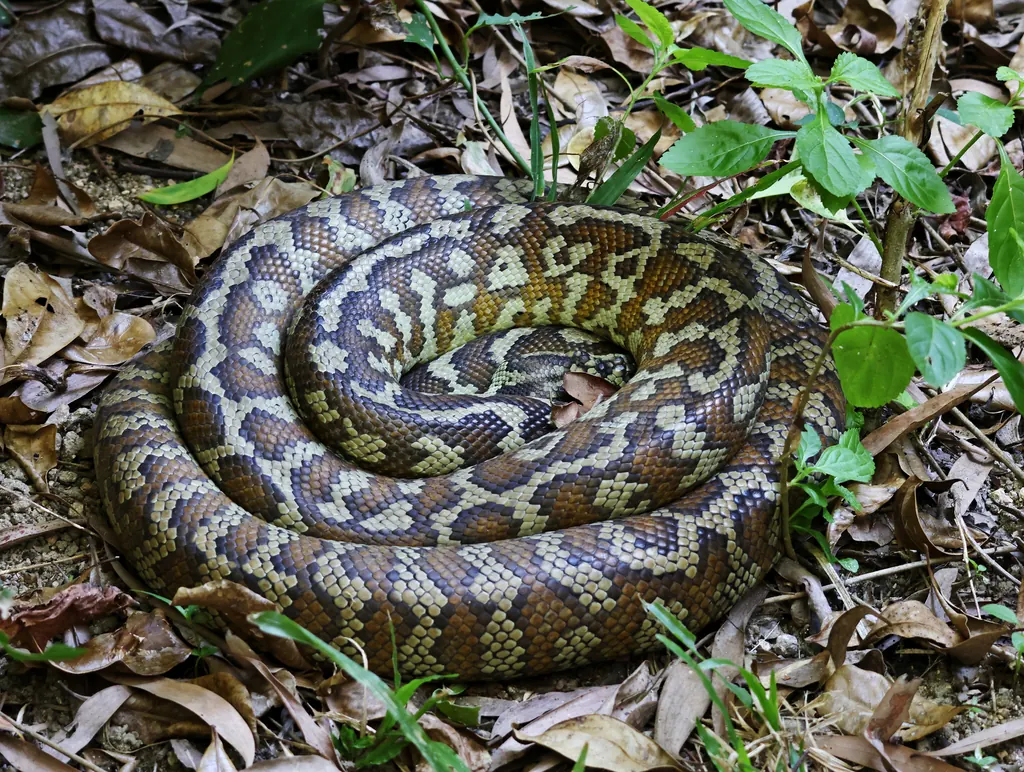
The pythons are the snakes that were eaten. kungkun and kurriyala are 'carpet snake, North Queensland python', kabul a 'rock python', and bajalji a rock python with 'a white head', 'not many at Bloomfield, but many at Helenvale, Rossville and Shipton's Flat'[1]. Roth's note from the lower Tully is the one record of how a python was found: 'the large carpet-snake is commonly discovered by its messmate, Broadbent's black butcher-bird, these two being nearly always found together here. The bird flies over the snake with a "clacky" chirp, and whenever the natives hear it in the dense scrubs they sneak in to discover the reptile, which is caught by being grabbed at the back of the head'; snakes were also 'often hunted for in iguana burrows'[2]. The pythons of these pages are the carpet python, the big scrub python of the rainforest, the black-headed python of the rocks, which eats other snakes, and the spotted python that hunts bats at cave mouths[3][4][5][6]. None is venomous; all of them bite[5].
Nothing is written for the Eastern coast on this page yet. What follows is true across the country.
Hann River Cape York
Possum People's country on the upper river and Thaypan (Kuku Thaypan) country downstream: stringybark and bloodwood woodland and a spring-fed sandy river that runs north-east from the Great Dividing Range, past the Peninsula Developmental Road, into Rinyirru (Lakefield) and the North Kennedy. Not Kuku Yalanji country: the Kuku Yalanji words on this page are the dictionary's, not the Hann's own languages. Place guide
Five pythons are recorded around the Hann. The Atlas of Living Australia holds 29 python records (1994–2025) in a box of about 90 × 85 km around the middle Hann, Laura and western Rinyirru: the water python 9, the black-headed python 8, the spotted python 7, the carpet python 2 and the children's python 1[16]. The Kuku Thaypan Elders count two of them among the species of cultural significance in their country: the black-headed python, Nhye arsteuide, and the water python, Alcaan[17].
The python of the river
The water python (Liasis fuscus) is the one python here that the general sections of this page do not cover, and the commonest in the Atlas records[16]. 'Despite its common name, many individuals are found far from water for most of the year. They are usually nocturnal, seeking shelter during the day in hollow logs, in riverbank dens, and in vegetation. When surprised, most attempt to flee into any available water.' It is 'an opportunistic feeder' on a variety of vertebrates, and 'like all other pythons, it is not venomous'[18].
How people used them here
Snakes were food in this country. Roth, about 1900: '"Poisonous" snakes are eaten at Princess Charlotte Bay, but avoided on the Bloomfield'[2]. 'At the back of Princess Charlotte Bay, presumably to stop all reflex action when roasted in a coil over the fire, I have seen the snake previously and forcibly stretched, length by length, over the flames'[2]. See cooking meat.
The Kuku Thaypan Elders say the species they name 'have relationships in story which relate to their characteristics and biology including to each other and place'[17]. Those stories belong to their custodians.
Safety here
In Rinyirru: 'Be alert for snakes when exploring the area. Wear protective clothing such as long trousers and closed-in shoes.' 'Use lights when walking around at night and keep tents closed at all times'[19]. If you are not sure a snake is a python, treat it as venomous; see snakes.
On country today
The upper Hann is the Possum People's country and the middle and lower Hann are Thaypan country, under native title determinations of November 2023[20][21]. Pythons are protected; native title holders may hunt for personal, domestic and non-commercial communal needs without the licences others need[22].
Upper Mitchell Western Yalanji
Western Yalanji country west of the Great Dividing Range: dry open woodland cut by the sandy, paperbark-lined upper Mitchell River, around Karma Waters and Mount Carbine. Place guide
Within 60 km of Karma Waters the Atlas has five pythons: the carpet python, the big scrub python of the ranges, the black-headed python of the rocks, the spotted python and the children's python[7].
Where they live here
Atlas of Living Australia records within 60 km of Karma Waters: the spotted python 21, the commonest; the black-headed python 7, one of them within 30 km; the scrub python 6, from the rainforest side to the east; the carpet python 5; the children's python 3[7].
On country today
The spotted python at the rock overhangs and the black-headed python on the stony rises are the pythons you are most likely to meet at Karma Waters, and the carpet python in a shed roof[7].
Everywhere
Names
kungkun 'carpet snake, North Queensland python (no distinction)'; the same word is also glossed 'brown tree snake'. kurriyala 'carpet snake, python', a word that also means a grunter fish. kabul 'rock python'. bajalji 'species of rock python. Not many at Bloomfield, but many at Helenvale, Rossville and Shipton's Flat. They have a white head and will chase bald-headed people not wearing a hat because they think they are being copied', which the dictionary's second entry calls a 'poisonous snake' of the same country; which snake it is, this page cannot say[1]. jarba is any snake[1].
The pythons
Carpet python (Morelia spilota). 'A large species of python ... reaching between 2 and 4 m in length and weighing up to 15 kg'; the north Queensland form 'regularly attaining lengths of 2.7–3.0 m'. 'The species is oviparous, with females laying 10–50 eggs at a time. Afterward, females coil around the eggs to protect them and keep them warm through using muscular contractions to generate heat.' 'Generally active during both daytime and nighttime', the northern form 'primarily nocturnal'; 'carpet pythons favor arboreal living conditions, although they can also be found on the ground'. 'Carpet pythons kill prey by constriction. Their diet consists mainly of small mammals, birds, and lizards'; in Darwin they come into the suburbs in the dry season, May to July, 'in search of prey or mates'[3].
Scrub python (Simalia kinghorni), a python of the rainforest. Australia's longest snake, 'commonly considered arboreal', with 'an ornate dorsal pattern consisting of browns and tans'; 'males usually growing a third longer and twice as heavy than females. Females reach sexual maturity with a snout-to-vent length of about 2.27 m while males reach sexual maturity with an SVL of 1.34 m'[4].
Black-headed python (Aspidites melanocephalus), a strong candidate for the dictionary's rock python. 'Adults typically grow to 1.5–2 m in length, but can grow to a maximum length of 3.5 m. The body is muscular with a flattened profile'. 'Terrestrial and is often found amongst rocks and loose debris. If disturbed, it hisses loudly, but is unlikely to bite unless hunting prey. It sometimes strikes with a closed mouth, but generally can be handled easily. It is a strong swimmer, but is almost never found in water. It is not venomous.' 'The diet consists mainly of reptiles, including snakes, but it will eat mammals and some birds if available. Skinks are the primary prey'. 'Adult females lay five to 10 eggs per clutch. The females stay coiled about the eggs and incubate them until they hatch, which is usually after 2–3 months.' 'Adults have no natural predators other than dingos and humans'[5].
Spotted python (Antaresia maculosa). 'Adults average about 100–140 centimetres in length', 'an irregular, blotched color pattern throughout its life. The blotches have ragged edges'; 'one of its favorite foods are the insectivorous bats that it catches at the entrance of their caves', and it takes geckos[6]. The children's python (A. childreni) is its smaller plainer relative[7].
Python or something worse
- Pythons have a blocky head wider than the neck, with heat pits along the lip, a patterned back, and a slow, heavy way of moving; they constrict[3][5].
- The black-headed python is the one that gets mistaken for a venomous snake: a cream-and-brown banded body with a shining black head and neck. It hisses and strikes closed-mouthed; it is harmless[5].
- A dark carpet python in the grass and a mulga snake look alike at a glance; the python's head and pattern settle it, but not at the distance you should keep; see snakes[8].
- Spotted and children's pythons: small, blotched, around rocks and caves; nothing venomous here is blotched like that[6].
- Brown tree snake (kungkun in its other sense): slender, big-eyed, banded, rear-fanged and mildly venomous, in the trees at night[1][7].
Signs
- A butcher-bird or a mob of small birds scolding one spot in the scrub: Roth's Tully method, the bird 'flies over the snake with a "clacky" chirp'[2].
- A wide belly-track across sand to a hollow log or a bank[3].
- A python coiled on eggs under a log or in a hollow in the warm months; she will not leave them[3][5].
- Spotted pythons at a cave or rock overhang at dusk, waiting for the bats[6].
- A goanna burrow was where snakes were 'often hunted for'[2].
Where they live
The carpet python in the trees and on the ground of the woodland and the river scrub, and around sheds and roofs where the possums and rats are; the scrub python in the rainforest of the ranges; the black-headed python 'amongst rocks and loose debris' on the stony rises; the spotted and children's pythons on the rocky ridges and at the caves[3][4][5][6]. The hollow-tree woodland and the goanna burrows are their dens[2].
What they eat and who eats them
The carpet python takes the possums, the rats and the birds of the hollows; the black-headed python takes the skinks and the other snakes, venomous ones included; the spotted python takes the bats at the cave mouth[3][5][6]. Young pythons are eaten by everything, kookaburras and goannas first; adults by dingoes and people[5]. The cane toad is a hazard to pythons as to the other snakes; see frogs[9].
Seasons
Mating and egg-laying come with the warm months, the mothers coiled on the clutch two to three months into the storm season; the Darwin carpet pythons move about most in the dry, May to July, after prey and mates[5][3]. In the cold dry nights a python lies up and is slow, which is when the old method of catching by hand worked best[10]. See the year on country.
Uses
Finding and taking a python
From Roth's Tully River note and the hunting pages[2]:
- Listen for the butcher-bird's 'clacky' chirp over one spot in the scrub, or watch where the small birds mob[2].
- Check goanna burrows, hollow logs and the rock piles; snakes 'are often hunted for in iguana burrows'[2].
- Be sure it is a python before anything else: the head, the pattern, the pits; if not sure, leave it[5].
- Grab it behind the head, as the Tully people did, with a stick pinning the neck first; a big carpet python bites hard and coils[2][3].
- Cook it on the coals or in the earth oven as the other meat was cooked[11].
- Leave a female on eggs and the big breeding females; a clutch is 10–50 young[3].
Safety
- Pythons are protected wildlife in Queensland; native title holders hunting for personal, domestic or non-commercial communal needs are covered by section 211 of the Native Title Act 1993[12][13][14].
- A python bite is a mouthful of curved teeth and a serious wound; a big one can hold a limb[3].
- The snake you are sure is a python is the one to be surest about; see snakes for the first aid if you were wrong[15].
On Country today
Which of them is kabul and which bajalji is for Kuku Yalanji speakers; the contribution box below is for that[1]. Pythons are protected wildlife, and native title holders' rights differ from place to place: see each place above[12].
Language
kungkun 'carpet snake, North Queensland python'; kurriyala 'carpet snake, python'; kabul 'rock python'; bajalji 'species of rock python'; jarba 'snake'; munyun 'snake scale'[1].
References
- Hershberger, H. D. & Hershberger, R. (1982). Kuku-Yalanji Dictionary. Work Papers of SIL-AAB, Series B, Volume 7. With Toby Bloomfield, Roy Friday, Billy Roberts, Hector and Doris Sykes, Joe Walker and others. www.sil.org/resources/archives/18038
- Roth, W. E. (1901). North Queensland Ethnography, Bulletin No. 3: Food — its search, capture, and preparation. Brisbane: Government Printer. Bloomfield River information from the Hislops. — Sect. 6 'Cooking'; plant list ('Castanospermum australe', 'Dioscorea sativa', 'Elettaria Scottiana', 'Nymphaea') archive.org/details/northqueensland00landgoog
- Wikipedia. Morelia spilota (carpet python). en.wikipedia.org/wiki/Morelia_spilota
- Wikipedia. Australian scrub python (Simalia kinghorni). en.wikipedia.org/wiki/Simalia_kinghorni
- Wikipedia. Black-headed python (Aspidites melanocephalus). en.wikipedia.org/wiki/Black-headed_python
- Wikipedia. Spotted python (Antaresia maculosa). en.wikipedia.org/wiki/Spotted_python
- Atlas of Living Australia. Occurrence records within 60 km of the Karma Waters homestead (16.62° S, 144.60° E), species counts for Animalia (accessed 10 October 2026). biocache.ala.org.au/occurrences/search?q=*:*&lat=-16.62&lon=144.60&radius=60
- Wikipedia. King brown snake / mulga snake (Pseudechis australis). en.wikipedia.org/wiki/Mulga_snake
- Wikipedia. Cane toads in Australia: effects on native predators (goannas, snakes, freshwater crocodiles) and on dogs. en.wikipedia.org/wiki/Cane_toads_in_Australia
- Bureau of Meteorology. Climate statistics for Australian locations: Palmerville (station 028004), records from 1889 (accessed 5 October 2026). www.bom.gov.au/climate/averages/tables/cw_028004.shtml
- Anderson, C. (1996). Traditional material culture of the Kuku-Yalanji of Bloomfield River, North Queensland. Records of the South Australian Museum 29(1): 63–83. Based on fieldwork at Wujal Wujal in the late 1970s and early 1980s. — Hunting (spears, spear-throwers, harpoons); fishing (stupefacients); manufacturing (gums and resins); post-contact bush component archive.org/details/RecordsSouthAus29Sout
- Queensland Government, State of the Environment. Nature Conservation Act 1992. www.stateoftheenvironment.des.qld.gov.au/biodiversity/management-responses/legislation/nature-conservation-act-1992
- Australian Law Reform Commission. Review of the Native Title Act 1993 (DP 82), ch. 8: Relevant provisions in the Native Title Act (s 211). www.alrc.gov.au/publication/review-of-the-native-title-act-1993-dp-82/8-the-nature-and-content-of-native-title/relevant-provisions-in-the-native-title-act/
- Western Yalanji Aboriginal Corporation & CRC for Developing Northern Australia (2020). Western Yalanji Land Use and Economic Diversification Plan. CC BY 4.0. — Native Title Determinations 1–4 (pp. 13–18); ‘Fire Management and Carbon Farming’ (pp. 32–33); ‘Pastoralists’ crcna.com.au/wp-content/uploads/2024/05/westernyalanjilanduseplan_nov2020.pdf
- healthdirect Australia (Australian Government). Snake bites: symptoms, first aid and the pressure immobilisation bandage (accessed 10 October 2026). www.healthdirect.gov.au/snake-bites
- Atlas of Living Australia. Occurrence records of Pythonidae: 29 records, 1994–2025 (Liasis fuscus 9, Aspidites melanocephalus 8, Antaresia maculosa 7, Morelia spilota 2, Antaresia childreni 1, unnamed 2) in a box of about 90 × 85 km around the middle Hann River, Laura and western Rinyirru (lat −15.6 to −14.8, long 143.5 to 144.3), queried 28 October 2026. biocache.ala.org.au/occurrences/search?q=*:*&fq=decimalLatitude:%5B-15.6%20TO%20-14.8%5D&fq=decimalLongitude:%5B143.5%20TO%20144.3%5D
- Standley, P.-M. (2019). The importance of campfires to effective conservation. PhD thesis, James Cook University. Records the fire and country knowledge of Kuku Thaypan Elders Dr Tommy George and Dr George Musgrave. — Table 6.1, Awu Alaya names of culturally significant species (p. 215) researchonline.jcu.edu.au/64274/
- Wikipedia. Water python (Liasis fuscus) (accessed 28 October 2026). en.wikipedia.org/wiki/Water_python
- Queensland Parks and Wildlife Service. Visiting Rinyirru (Lakefield) National Park (CYPAL) safely (web page, last updated 1 December 2025; Wayback Machine copy, accessed 28 October 2026). parks.qld.gov.au/parks/rinyirru-lakefield/visiting-safely
- Ross on behalf of the Cape York United #1 Claim Group v State of Queensland (No 21) (Possum determination) [2023] FCA 1316 (Federal Court of Australia, 2 November 2023). — Determination area (upper Hann and Kennedy rivers); prescribed body corporate; affidavit evidence on hunting and fishing www.judgments.fedcourt.gov.au/judgments/Judgments/fca/single/2023/2023fca1316
- Ross on behalf of the Cape York United #1 Claim Group v State of Queensland (No 20) (Thaypan determination) [2023] FCA 1315 (Federal Court of Australia, 2 November 2023). — Determination area and waters; prescribed body corporate (Awu-Laya Indigenous Corporation); affidavit evidence on hunting www.judgments.fedcourt.gov.au/judgments/Judgments/fca/single/2023/2023fca1315
- Native Title Act 1993 (Cth), section 211: preservation of certain native title rights and interests (hunting, fishing and gathering for personal, domestic or non-commercial communal needs). www.legislation.gov.au/C2004A04665/latest/text
From the community
Know this one? Add the words you use for it, what it is for, how it is done, a correction, or a photo from country. It shows here straight away with your name on it. Please keep anything restricted or sacred off the site.
Loading…