Trees
Kurrajongs
kuralbiBrachychiton albidus, B. diversifolius; Sterculia quadrifida
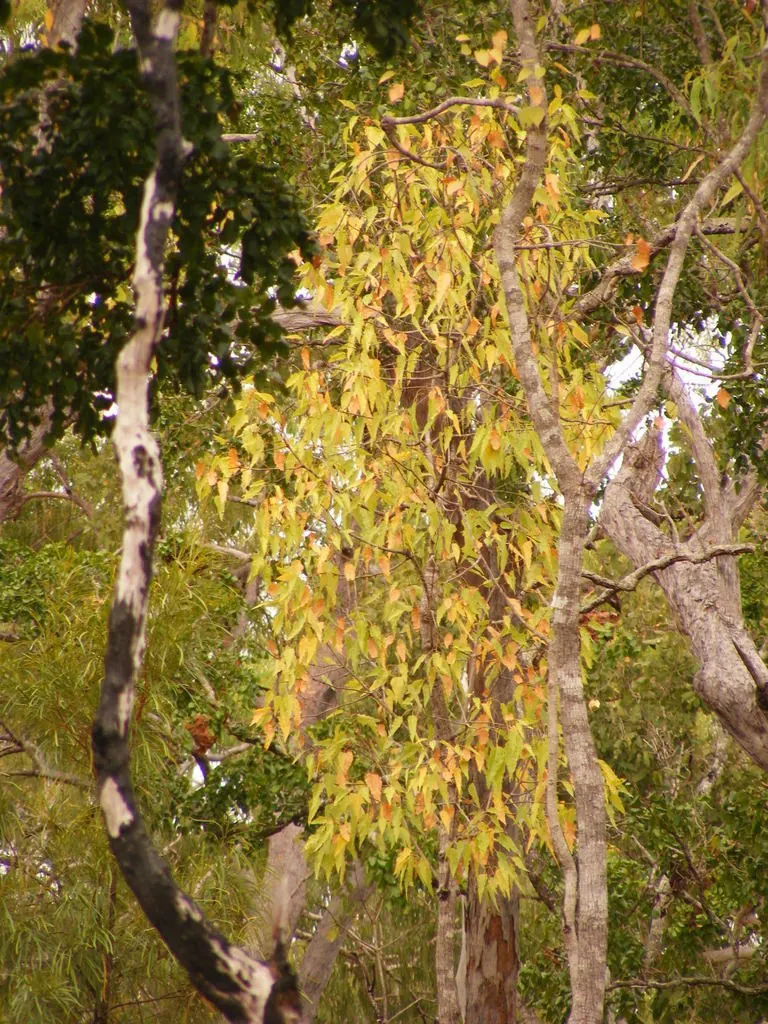
The kurrajong is the string tree. The word itself is Dharug, from Sydney, garrajung, 'fishing line', 'as fishing lines were made from kurrajong bark', and that is what the family did across Queensland: the inner bark of the kurrajongs and their relative the peanut tree, dried and drawn into shreds, was the twine of dilly bags, kangaroo nets, fishing lines and the turtle rope[1][2][3]. The dictionary has no word 'kurrajong', but it has kuralbi, 'species of tree (English name unknown)', the tree of the harpoon rope, which Anderson's Bloomfield informants made from the bark of Sterculia quadrifida, the peanut tree[4][3]. On the Mitchell the kurrajong was food as well: Palmer recorded a Cloncurry kurrajong whose 'seed-pods [were] eaten after roasting' and whose 'inside bark [was] worked up into strong cord for wallaby nets and bags', and the bottle-tree kurrajong whose young roots were eaten[5].
Hann River Cape York
Possum People's country on the upper river and Thaypan (Kuku Thaypan) country downstream: stringybark and bloodwood woodland and a spring-fed sandy river that runs north-east from the Great Dividing Range, past the Peninsula Developmental Road, into Rinyirru (Lakefield) and the North Kennedy. Not Kuku Yalanji country: the Kuku Yalanji words on this page are the dictionary's, not the Hann's own languages. Place guide
Four kurrajongs grow around the Hann. The Atlas of Living Australia holds 43 Brachychiton records (1962–2021) in a box of about 90 × 85 km around the middle Hann, Laura and western Rinyirru, most of them the northern kurrajong, B. diversifolius[11]. The Kuku Thaypan Elders name kurrajong among the trees of their country[12]. Roth's records from around Princess Charlotte Bay show the northern kurrajong as a string tree and a food tree here[2][13].
Names here
Roth wrote the northern kurrajong as Sterculia caudata, an old name now placed under Brachychiton diversifolius[14], and called it 'one of the "Flame trees"'[2]. He recorded its names around Princess Charlotte Bay as ui-alkal (Koko-rarmul) and kellan (Koko-warra)[13]. These are Roth's spellings from about 1900.
Where it grows here
The Atlas records in the box are B. diversifolius 16, B. vitifolius 13, B. garrawayae 11 and B. paradoxus 1[11]. The Kuku Thaypan Elders describe their mixed-tree country, on slightly raised light sandy soil, as having 'a diverse understory of brachychiton and yams', and their 'Debil Debil' country, on stony, lumpy ground, as containing 'Kurrajong Brachychiton sp.' among its trees[12].
How people used it here
Roth, about 1900:
- Dilly bags. 'In the country bordering around Princess Charlotte Bay, dilly-bags are manufactured from twines derived from' the cabbage palm, a wattle, the crow ash, Sterculia caudata and other plants. The reddish wattle twine 'may be used alternately with the Malaisia or Sterculia to produce a horizontally-striped red and white appearance'. 'It is apparently the women who alone manufacture both baskets and dilly-bags'[2].
- Fish nets. Its 'fibre-twine from the bark is used for dilly-bags or (on the Princess Charlotte Bay coast, among the Koko-lamalama) for fish-nets'[6].
- Food. 'Fruit, roasted and eaten'[13].
The making is on the string page and under How-to on this page.
On country today
In Rinyirru (Lakefield) National Park: 'Do not remove plant material, living or dead'[15]. Upstream, the native title determinations of November 2023 recognise the Possum and Thaypan peoples' rights to take the natural resources of their country[16][17]. Ask them before stripping bark.
Upper Mitchell Western Yalanji
Western Yalanji country west of the Great Dividing Range: dry open woodland cut by the sandy, paperbark-lined upper Mitchell River, around Karma Waters and Mount Carbine. Place guide
Within 30 km of Karma Waters two Brachychiton kurrajongs are recorded: B. albidus, a Queensland tree described only in 1988, and the northern kurrajong B. diversifolius[18][7][8].
Where it grows here
The two Brachychiton records near Karma Waters put the kurrajongs in the open woodland on the rises[18]. Brachychiton albidus is the commoner of the two here[18].
Safety here
Two kurrajongs are recorded here and neither has a documented Kuku Yalanji use[18]. Cutting on the station is a matter for the lessee's permission[19].
On country today
Which of the two Karma Waters kurrajongs gives the better fibre, and what either is called, is for the contribution box below. Gathering on native title country is protected by section 211 of the Native Title Act 1993[20][21].
Eastern coast Eastern Kuku Yalanji
Eastern Kuku Yalanji country: rainforest, beaches, mangroves, reef and the short steep rivers from the Daintree to the Bloomfield and the Annan.
On the coast the rope tree is the peanut tree, Sterculia quadrifida, the dictionary's probable kuralbi[3][4].
How people used it here
- Lines and rope at Bloomfield: freshwater fishing lines and the turtle harpoon rope from Sterculia bark[3].
Everywhere
Names
The dictionary records no word glossed 'kurrajong'. kuralbi is 'species of tree (English name unknown)'; the sea turtle and string pages give the reasons for taking it as the peanut tree, Sterculia quadrifida, whose bark made the harpoon rope at Bloomfield[4][3]. Roth's Koko-minni (middle Palmer) name for the black kurrajong, Sterculia diversifolia, now Brachychiton populneus, was kalan; on the Tablelands the peanut tree's fibre was pu-kuru and ke-wan, 'same names as the Cochlospermum'[2][6]. Palmer's Cloncurry kurrajong was Eendurah[5]. 'Kurrajong comes from the Dharuk language garrajuŋ "fishing line", as fishing lines were made from kurrajong bark'[1].
The trees
Brachychiton 'is a genus of 31 species of trees and large shrubs, native to Australia'. 'They grow to 4–30 m tall, and some are dry-season deciduous. Several species (though not all) are pachycaul plants with a very stout stem for their overall size, used to store water during periods of drought', the bottle trees. The leaves vary on one tree, from entire to deeply lobed; the flowers are bell-shaped, the coloured cup being the calyx, with male and female flowers on the same tree; the fruit is a set of up to five woody boat-shaped follicles that split along one seam to show the seeds[1].
Brachychiton albidus 'is a tree of the genus Brachychiton native to Queensland, Australia. It was described in 1988' by Gordon Guymer in his revision of the genus, and that is all the public record says of it[7].
The northern kurrajong, B. diversifolius, is a small tree of northern Australia with heart-shaped to egg-shaped leaves 6–16 cm long on long slender stalks, hairless fruits 6–10 cm long, and seeds 'covered with a yellow mealy layer'[8].
The peanut tree, Sterculia quadrifida, the rope tree of the coast, is on the string page; its seeds are edible and its bark is the twine[9][3].
Kurrajong, peanut tree, cotton tree
- Kurrajong (Brachychiton): bell flowers, boat-shaped woody pods that split along one side, often a stout trunk, bark that strips in long tough fibrous strands[1].
- Peanut tree (Sterculia quadrifida): the same family, a coastal and scrub tree with red leathery pods that open to show black seeds; the Bloomfield rope tree[9][3].
- Cotton tree and the kapok bushes: also the same family, with cotton in the pod instead of mealy seeds[10].
- The flame tree, ngakun, is a Brachychiton too, the Illawarra flame tree's northern relatives[1][4].
Signs
- Long fibrous strips hanging from a damaged trunk; a kurrajong's bark peels in ribbons[1].
- Boat-shaped pods on the ground, split along one seam, with the mealy seeds gone to the cockatoos[1][8].
- A leafless tree in the dry on a stony rise with a thickened trunk[1].
- Bark strips drying at a camp, and the shredded fibre, are the start of a net[2][5].
Where they grow
The peanut tree is a tree of the coast and the scrubs, Bloomfield rather than the Mitchell[9]. Palmer's kurrajongs were on the Cloncurry and 'mostly over all North Queensland'[5]. The Dharug kurrajong is a Sydney tree; the name travelled with the settlers to every tree of the family[1].
The string tree in the toolkit
Kurrajong fibre sits where the kurrajong's relatives sit: in the string that made the nets, the dilly bags and the lines, and the rope that held the harpoon to the turtle and the canoe[2][3]. On the Palmer the Koko-minni's dilly bags were woven from black kurrajong fibre, alternated with wattle fibre 'so as to produce a horizontally-striped appearance'; at Atherton the big kangaroo nets were peanut-tree twine[2]. The seeds feed cockatoos and people; the stout trunk stores water through the dry[1][5].
Seasons
Bark 'at the end of the wet season when the sap is up and the bark slips'[2]; some kurrajongs drop their leaves in the dry[1]; seed pods in the dry, roasted[5]; young roots dug when the ground is soft. See the year on country.
Uses
- Twine from the inner bark 'dried in the sun, and drawn into shreds', for dilly bags on the Palmer; for the big kangaroo nets at Atherton; for fish nets at Princess Charlotte Bay; 'strong cord for wallaby nets and bags' on the Cloncurry[2][5].
- Seeds roasted: Palmer's Cloncurry kurrajong 'seed-pods eaten after roasting'; the peanut tree's seeds are eaten raw or roasted[5][9].
- Roots of young bottle-tree kurrajongs eaten[5].
- Water in the swollen trunk of the bottle trees[1].
Kurrajong string
From Roth's Palmer River and Palmer's Cloncurry accounts[2][5]; the twisting is on the string page:
- Strip the bark from a limb or a young trunk when the sap is up, in long ribbons.
- Take the inner bark, peeling away the outer; scrape it clean with a mussel shell[5].
- Dry it in the sun[2].
- Draw it into shreds with the fingers, as fine as the job needs[2].
- Twist two strands on the thigh into twine; for a rope, twist twines together[3].
- Dye with the red root of the bloodroot Haemodorum if the bag is to be striped, as on the Bloomfield[2].
Seeds: roast the pods in the ashes and eat the seeds; handle the pods carefully, the inside of a kurrajong pod is lined with fine hairs[5].
Safety
On Country today
The kurrajong is the tree to learn by making one thing from it: a length of two-ply string, the way the string page shows, from bark stripped after the storms[2][3]. Native title holders' rights to gather differ from place to place: see each place above.
Language
kuralbi 'species of tree (English name unknown)', the rope tree; ngakun 'flame tree'; wawuburra 'cottontree'; the string words are on the string page[4].
References
- Wikipedia. Brachychiton (kurrajongs and bottle trees): the genus, its 31 species, and the Dharug origin of the name. en.wikipedia.org/wiki/Brachychiton
- Roth, W. E. (1904). North Queensland Ethnography, Bulletin No. 7: Domestic implements, arts, and manufactures. Brisbane: Government Printer. — Sect. 10 'Fire-tongs'; dilly-bags of the country around Princess Charlotte Bay (Sterculia caudata twine) archive.org/details/northqueensland00landgoog
- Anderson, C. (1996). Traditional material culture of the Kuku-Yalanji of Bloomfield River, North Queensland. Records of the South Australian Museum 29(1): 63–83. Based on fieldwork at Wujal Wujal in the late 1970s and early 1980s. — Hunting (spears, spear-throwers, harpoons); fishing (stupefacients); manufacturing (gums and resins); post-contact bush component archive.org/details/RecordsSouthAus29Sout
- Hershberger, H. D. & Hershberger, R. (1982). Kuku-Yalanji Dictionary. Work Papers of SIL-AAB, Series B, Volume 7. With Toby Bloomfield, Roy Friday, Billy Roberts, Hector and Doris Sykes, Joe Walker and others. www.sil.org/resources/archives/18038
- Palmer, E. (1883). On plants used by the natives of North Queensland, Flinders and Mitchell Rivers, for food, medicine, &c., &c. Journal and Proceedings of the Royal Society of New South Wales 17: 93–113. Palmer's Mitchell River names come from the lower and middle Mitchell, not from Kuku Yalanji speakers. archive.org/details/journalandproce16walegoog
- Roth, W. E. (1901). North Queensland Ethnography, Bulletin No. 1: String, and other forms of strand: basketry-, woven bag-, and net-work. Brisbane: Government Printer. — Sects. 1–9: animal and vegetable string, plant list ('Ficus', 'Hibiscus', 'Panicum trachyrachis', 'Sterculia quadrifida'), manufacture of fibre-twine, knots, colouring; sect. 22 hour-glass nets; plant list 'Sterculia caudata' (Koko-lamalama fish-nets) archive.org/details/northqueensland00landgoog
- Wikipedia. Brachychiton albidus (kurrajong). en.wikipedia.org/wiki/Brachychiton_albidus
- Australian Tropical Rainforest Plants (RFK8), Brachychiton diversifolius subsp. diversifolius (northern kurrajong). CSIRO / Lucidcentral. apps.lucidcentral.org/rainforest/text/entities/brachychiton_diversifolius_subsp._diversifolius.htm
- Australian Tropical Rainforest Plants (RFK8), Sterculia quadrifida. CSIRO / Lucidcentral. apps.lucidcentral.org/rainforest/text/entities/sterculia_quadrifida.htm
- Australian Tropical Rainforest Plants (RFK8), Bombax ceiba var. leiocarpum (northern cottonwood, red silk-cotton tree). CSIRO / Lucidcentral. apps.lucidcentral.org/rainforest/text/entities/bombax_ceiba_var._leiocarpum.htm
- Atlas of Living Australia. Occurrence records of Brachychiton: 43 records, 1962–2021 (B. diversifolius 16, B. vitifolius 13, B. garrawayae 11, B. paradoxus 1, unnamed 2) in a box of about 90 × 85 km around the middle Hann River, Laura and western Rinyirru (lat −15.6 to −14.8, long 143.5 to 144.3), queried 28 October 2026. biocache.ala.org.au/occurrences/search?q=*:*&fq=decimalLatitude:%5B-15.6%20TO%20-14.8%5D&fq=decimalLongitude:%5B143.5%20TO%20144.3%5D
- Standley, P.-M. (2019). The importance of campfires to effective conservation. PhD thesis, James Cook University. Records the fire and country knowledge of Kuku Thaypan Elders Dr Tommy George and Dr George Musgrave. — Kuku Thaypan country types: mixed-tree country (p. 413) and 'Debil Debil' stony country (p. 421) researchonline.jcu.edu.au/64274/
- Roth, W. E. (1901). North Queensland Ethnography, Bulletin No. 3: Food — its search, capture, and preparation. Brisbane: Government Printer. — Food plants: 'Sterculia caudata' (Koko-rarmul and Koko-warra names) archive.org/details/northqueensland00landgoog
- Atlas of Living Australia, species search: Sterculia caudata, a heterotypic synonym of Brachychiton diversifolius R.Br. subsp. diversifolius (Australian Plant Name Index), accessed 28 October 2026. bie.ala.org.au/search?q=Sterculia+caudata
- Queensland Parks and Wildlife Service. About Rinyirru (Lakefield) National Park (CYPAL) (web page, last updated 1 July 2024; accessed 28 October 2026). Park rules for visitors. parks.qld.gov.au/parks/rinyirru-lakefield/about
- Ross on behalf of the Cape York United #1 Claim Group v State of Queensland (No 21) (Possum determination) [2023] FCA 1316 (Federal Court of Australia, 2 November 2023). — Determination area (upper Hann and Kennedy rivers); prescribed body corporate; affidavit evidence on hunting and fishing www.judgments.fedcourt.gov.au/judgments/Judgments/fca/single/2023/2023fca1316
- Ross on behalf of the Cape York United #1 Claim Group v State of Queensland (No 20) (Thaypan determination) [2023] FCA 1315 (Federal Court of Australia, 2 November 2023). — Determination area and waters; prescribed body corporate (Awu-Laya Indigenous Corporation); affidavit evidence on hunting www.judgments.fedcourt.gov.au/judgments/Judgments/fca/single/2023/2023fca1315
- Atlas of Living Australia. Plant occurrence records within 30 km of the Karma Waters homestead (16.62°S, 144.60°E), queried 10 October 2026: 832 records of 266 species. biocache.ala.org.au/occurrences/search?q=kingdom:Plantae&lat=-16.62&lon=144.60&radius=30
- Karma Waters Station. About: location, native title (web page, accessed 5 October 2026). www.karmawatersstation.com/about.html
- Australian Law Reform Commission. Review of the Native Title Act 1993 (DP 82), ch. 8: Relevant provisions in the Native Title Act (s 211). www.alrc.gov.au/publication/review-of-the-native-title-act-1993-dp-82/8-the-nature-and-content-of-native-title/relevant-provisions-in-the-native-title-act/
- Western Yalanji Aboriginal Corporation & CRC for Developing Northern Australia (2020). Western Yalanji Land Use and Economic Diversification Plan. CC BY 4.0. — Native Title Determinations 1–4 (pp. 13–18); ‘Fire Management and Carbon Farming’ (pp. 32–33); ‘Pastoralists’ crcna.com.au/wp-content/uploads/2024/05/westernyalanjilanduseplan_nov2020.pdf
From the community
Know this one? Add the words you use for it, what it is for, how it is done, a correction, or a photo from country. It shows here straight away with your name on it. Please keep anything restricted or sacred off the site.
Loading…