Plants, vines & grasses
Wild ginger (jidu)
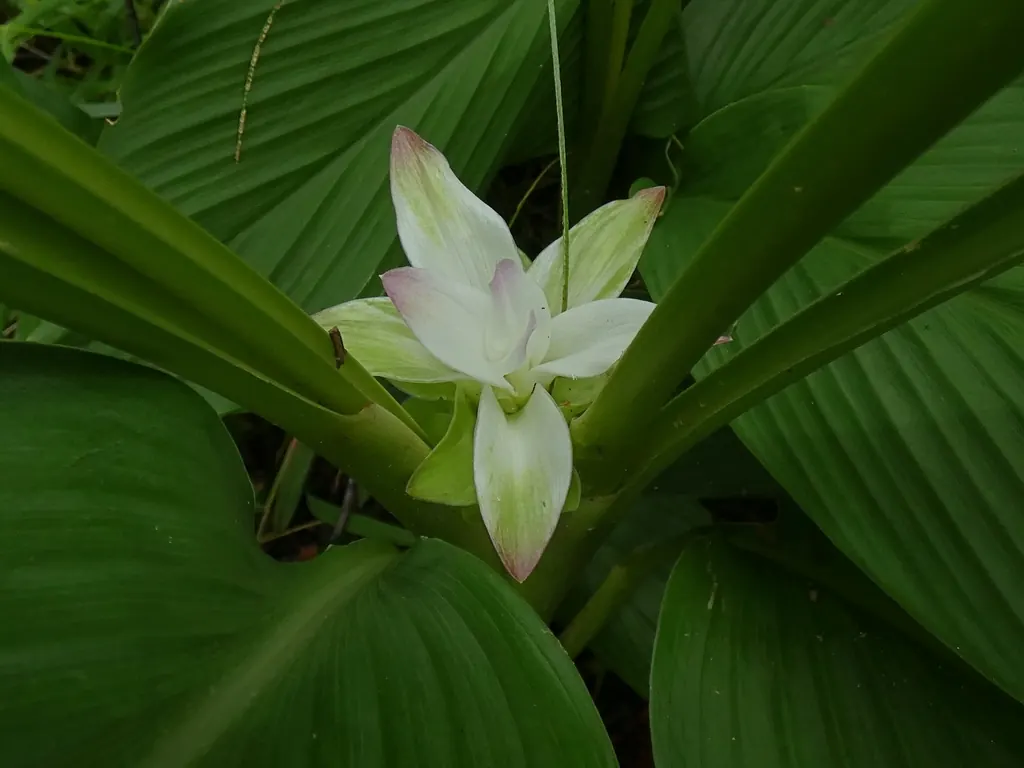
jidu is the wild ginger, Scott's ginger, Hornstedtia scottiana, which Roth wrote as jeddo and English still calls jiddo: a big ginger 'about 2–4 m tall' with the flowers and the red fruit 'raised only slightly above ground level' at its base, in the lowland rainforest of the Bloomfield and Daintree[1][2][3]. Its leaves are the kitchen's foil: at Bloomfield the meat went into the earth oven 'with Eucalyptus, Acacia or wild ginger leaves for flavouring'; the Bloomfield ovens were lined with 'various species of ginger'; the junda nut cakes were 'wrapped up in wild-ginger leaves, and baked in the ashes'; the Tully people baked green-ant larvae 'rolled up, in the dry, in "wild-ginger" leaves'; and the small fish of the flood run were 'tied up in wild-ginger leaves ready for baking'[4][2]. The leaves also made the trough that led water into the leaching bag, and the fruit is eaten and feeds the cassowary[4][3]. This is a plant of the Eastern Kuku Yalanji rainforest, the Bloomfield and Daintree coast; it is on this page because the words, the trade and the tools reach inland. Each place below says what grows there.
Hann River Cape York
Possum People's country on the upper river and Thaypan (Kuku Thaypan) country downstream: stringybark and bloodwood woodland and a spring-fed sandy river that runs north-east from the Great Dividing Range, past the Peninsula Developmental Road, into Rinyirru (Lakefield) and the North Kennedy. Not Kuku Yalanji country: the Kuku Yalanji words on this page are the dictionary's, not the Hann's own languages. Place guide
No wild ginger is recorded on the Hann. The Atlas of Living Australia holds no record of any plant of the ginger family in a box of about 90 × 85 km around the middle Hann, Laura and western Rinyirru[6], and Scott's ginger is a plant of lowland rainforest[3]. Around Princess Charlotte Bay, Roth's 'wild ginger' was a different plant, the native turmeric Curcuma australasica, eaten for its roots[2].
Not on the Hann
Along the Hann grow 'stringybark, bloodwood, Moreton Bay ash and ironbark trees with a ground cover of coarse grasses such as speargrass'[7], with a paperbark fringe on the big streams[8]. The closest thing to rainforest in this country is closed forest and vine thicket, 'very restricted' in Rinyirru[9], and the Atlas box holds no ginger of any kind[6].
Ginger and oven leaves here
Wild ginger of the Bay. Roth lists Curcuma australasica as '"Wild ginger"': 'Tuberous roots either roasted or boiled', with names in the Koko-rarmul and Koko-wara languages of Princess Charlotte Bay[2]. It is a root food, not an oven leaf, and the Atlas has no record of it near the Hann either[6].
Covering the oven. No published record says what leaves the people of the Hann laid in an earth oven. On the Morehead River, which runs like the Hann to Princess Charlotte Bay, Roth saw yams 'baked in a hot ant-bed covered with tea-tree bark and earth'[2]. See paperbark and earth oven.
Upper Mitchell Western Yalanji
Western Yalanji country west of the Great Dividing Range: dry open woodland cut by the sandy, paperbark-lined upper Mitchell River, around Karma Waters and Mount Carbine. Place guide
Karma Waters on the upper Mitchell is a long way from the ginger's rainforest. The river at Karma Waters has no wild ginger; the paperbark is the wrapping there.
Not here
Wild ginger grows in lowland rainforest[3], not the dry woodland of the upper Mitchell.
Eastern coast Eastern Kuku Yalanji
Eastern Kuku Yalanji country: rainforest, beaches, mangroves, reef and the short steep rivers from the Daintree to the Bloomfield and the Annan.
This is jidu's country: the Bloomfield and Daintree scrubs and creek gullies, where it is the oven leaf[3][4].
Where it grows here
'Disturbed areas in lowland rain forest': the Bloomfield and Daintree scrubs and creek gullies[3].
On country today
Jiddo grows in the Bloomfield scrubs and is still the oven leaf; the Eastern Kuku Yalanji country it grows on was handed back in 2021[3][10].
Everywhere
Names
jidu and junjun are the dictionary's gingers: jidu with fruit ripe in March, and junjun 'a rainforest plant with fruit ripe in March to May', which Roth identified as Amomum dallachyi; the scrub turkey, the dictionary says, comes down to the junjun in its season[1][2]. Roth's Bloomfield name for Elettaria scottiana, now Hornstedtia scottiana, was jeddo; the rainforest key gives 'Scott's ginger; jiddo; native cardamom' as its common names[2][3].
The plant and its uses
'Usually flowers and fruits as a shrubby plant about 2–4 m tall but it should be noted that only the leaves are above ground level. The true stem is below the soil surface.' 'Inflorescences produced on short shoots from the base of the plant and are raised only slightly above ground level ... sterile bracts often bright red'. 'Grows as an understory shrub in disturbed areas in lowland rain forest', from near sea level to 200 m, on Cape York and in the Wet Tropics; 'fruit eaten by cassowaries'[3].
In the oven. Anderson's Bloomfield informants: 'the meat, along with Eucalyptus, Acacia or wild ginger leaves for flavouring, was then put into a bark trough which was placed on the rocks in the hole'[4]. Roth: the Bloomfield ovens were lined with 'various species of ginger'; the Pygeum nut, junda, pounded and sifted, was 'kneaded into cakes, wrapped up in wild-ginger leaves, and baked in the ashes'; on the Tully the green-ant larvae were 'rolled up, in the dry, in "wild-ginger" leaves and baked', and the fry taken in the flood were 'tied up in wild-ginger leaves ready for baking'[2]. In the yam processing, 'with the help of leaves [pandanus or wild ginger] acting as a trough, water is allowed to' run into the bag[4].
Ginger, cardamom, lily
- Scott's ginger (jidu): tall leafy shoots, the red-bracted flowers and the fruit at the base, a ginger smell when the leaf is crushed[3].
- Amomum (junjun): another ginger of the same scrubs, fruit March to May[1][2].
- Cunjevoi and the big arum lilies: broad leaves, no ginger smell, and poisonous; see leaching[5].
- Paperbark is the inland wrapping; see paperbark[4].
Signs
Where it grows
'Disturbed areas in lowland rain forest', from near sea level to 200 m, on Cape York and in the Wet Tropics[3].
The oven leaf
Wild ginger is the rainforest kitchen's leaf: lining, wrapping, flavouring and trough, around the earth oven, the leaching pits and the ashes; its fruit feeds the cassowary and the scrub turkey and people in March[4][2][3][1].
Seasons
Fruit in March (jidu) and March to May (junjun), the end of the wet; leaves all year[1]. See the year on country.
Uses
Cooking in ginger leaves
- Cut the big leaves from the clump; they are long and tough enough to tie[3].
- Line the oven with them under the meat, and lay more over it, with gum and wattle leaves if you want that flavour[4][2].
- Wrap small things: a cake of pounded nut, a handful of fry, a ball of ant larvae, tied up in a leaf and put in the ashes[2].
- Make a trough of leaves to lead water from a stream into a leaching bag[4].
- The earth oven page has the whole method.
Safety
On Country today
Wild ginger is gathered on someone's country: each place below says whose.
Language
jidu wild ginger; junjun a ginger with fruit ripe March–May[1].
References
- Hershberger, H. D. & Hershberger, R. (1982). Kuku-Yalanji Dictionary. Work Papers of SIL-AAB, Series B, Volume 7. With Toby Bloomfield, Roy Friday, Billy Roberts, Hector and Doris Sykes, Joe Walker and others. www.sil.org/resources/archives/18038
- Roth, W. E. (1901). North Queensland Ethnography, Bulletin No. 3: Food — its search, capture, and preparation. Brisbane: Government Printer. Bloomfield River information from the Hislops. — Sect. 6 'Cooking'; plant list ('Castanospermum australe', 'Dioscorea sativa', 'Elettaria Scottiana', 'Nymphaea'); 'Curcuma australasica' (wild ginger, with Koko-rarmul and Koko-wara names, Princess Charlotte Bay); 'Dioscorea sativa var. rotunda' (Morehead River) archive.org/details/northqueensland00landgoog
- Australian Tropical Rainforest Plants (RFK8), Hornstedtia scottiana. CSIRO / Lucidcentral. apps.lucidcentral.org/rainforest/text/entities/hornstedtia_scottiana.htm
- Anderson, C. (1996). Traditional material culture of the Kuku-Yalanji of Bloomfield River, North Queensland. Records of the South Australian Museum 29(1): 63–83. Based on fieldwork at Wujal Wujal in the late 1970s and early 1980s. — Hunting (spears, spear-throwers, harpoons); fishing (stupefacients); manufacturing (gums and resins); post-contact bush component archive.org/details/RecordsSouthAus29Sout
- Palmer, E. (1883). On plants used by the natives of North Queensland, Flinders and Mitchell Rivers, for food, medicine, &c., &c. Journal and Proceedings of the Royal Society of New South Wales 17: 93–113. Palmer's Mitchell River names come from the lower and middle Mitchell, not from Kuku Yalanji speakers. archive.org/details/journalandproce16walegoog
- Atlas of Living Australia. Occurrence records of the ginger family (Zingiberaceae; including Hornstedtia, Alpinia, Amomum, Curcuma and Zingiber) in a box of about 90 × 85 km around the middle Hann River, Laura and western Rinyirru (lat −15.6 to −14.8, long 143.5 to 144.3), queried 28 October 2026: no records. biocache.ala.org.au/occurrences/search?q=family%3AZingiberaceae
- Wikipedia. Hann River (Queensland) (accessed 28 October 2026). en.wikipedia.org/wiki/Hann_River_(Queensland)
- Queensland Herbarium. Regional ecosystem descriptions, Cape York Peninsula bioregion: 3.3.10a (Melaleuca fluviatilis fringing woodland), 3.3.24 (Eucalyptus leptophleba woodland on riverine levees, Laura area), 3.10.6 and 3.10.10 (Darwin stringybark woodland on sandstone), 3.3.66 (lakes and lagoons). apps.des.qld.gov.au/regional-ecosystems/
- Queensland Parks and Wildlife Service (2013). Rinyirru (Lakefield) Aggregation Management Statement 2013. parks.desi.qld.gov.au/__data/assets/pdf_file/0027/165771/rinyirru.pdf
- Australian Geographic (29 September 2021). Daintree handed back to Traditional Owners. www.australiangeographic.com.au/news/2021/09/daintree-handed-back-to-traditional-owners/
From the community
Know this one? Add the words you use for it, what it is for, how it is done, a correction, or a photo from country. It shows here straight away with your name on it. Please keep anything restricted or sacred off the site.
Loading…