Birds
Pigeons and doves
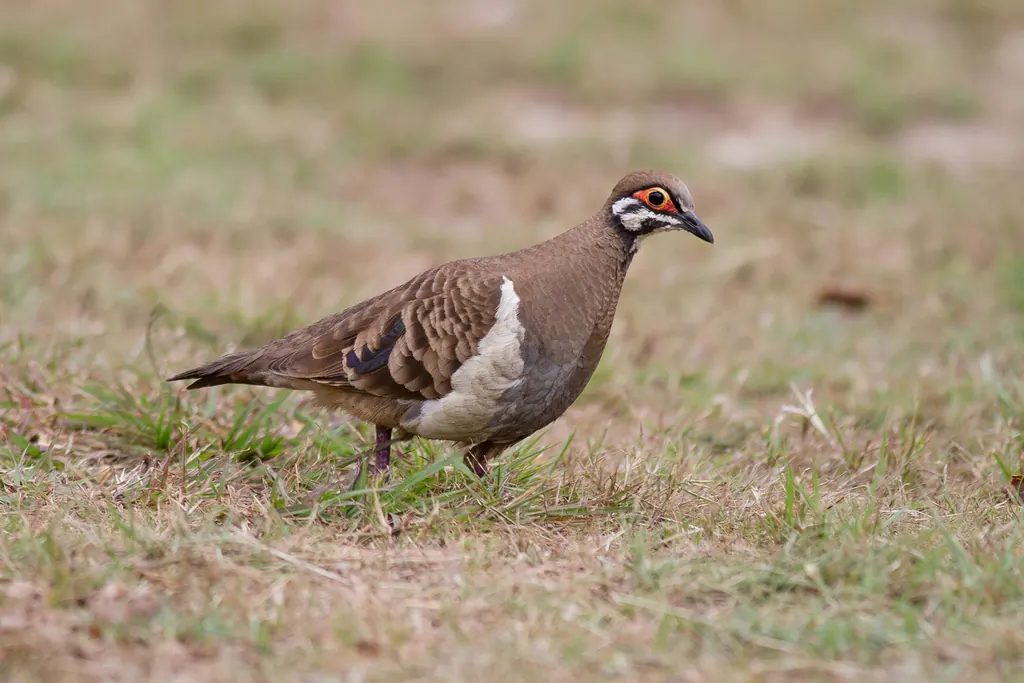
The pigeons are the birds that walk, and the dictionary names them by where they walk: munungkul and munwingkul the 'ground pigeon', karunkurr the 'crested pigeon', kurungka and juku-juku the bronzewing, kuludu the 'small grey' dove, kujuway the 'brown and green pigeon', bakamu the 'green pigeon' and wabul the Torres Strait pigeon of the coast[1]. The bronzewing carries a warning: 'if the jukujuku sings out alone the people know that a stranger is coming or that someone may have died'[1]. Which ones live where differs from place to place: see each place. The inland ones all eat seed and all must drink, which was the hunter's handle: Roth's western pigeon-netters dug a little pool of clear water beside the creek and flipped a net over the birds that came to it in the late afternoon[2].
Hann River Cape York
Possum People's country on the upper river and Thaypan (Kuku Thaypan) country downstream: stringybark and bloodwood woodland and a spring-fed sandy river that runs north-east from the Great Dividing Range, past the Peninsula Developmental Road, into Rinyirru (Lakefield) and the North Kennedy. Not Kuku Yalanji country: the Kuku Yalanji words on this page are the dictionary's, not the Hann's own languages. Place guide
Pigeons and doves are among the commonest birds of the Hann River country. The Atlas of Living Australia holds 3,516 records of the pigeon family, from 1896 to 2026, in a box of about 90 × 85 km around the middle Hann, Laura and western Rinyirru; most are the bar-shouldered dove and the peaceful dove[14]. No published record says how the Possum, Thaypan or Lama Lama peoples hunted them; the methods in the general sections come from other districts.
Names in Kuku Thaypan
The Hann's own languages are not Kuku Yalanji. In Kuku Thaypan the Hunter-Gatherer Language Database records aperrawng for the crested pigeon, with the linguist's note 'uncertain segmentation', and athuku-athuku for the peaceful dove, a doubled-up word like the Kuku Yalanji juku-juku[15][1].
Which ones are here
In the Atlas box around the middle Hann[14]:
- Bar-shouldered dove: 1,431 records, 1964–2026.
- Peaceful dove: 1,342 records, 1972–2025.
- Common bronzewing: 208 records, 1976–2025.
- Diamond dove: 202 records, 1963–2025.
- Squatter pigeon: 164 records, 1982–2025.
- Torresian imperial pigeon (Ducula spilorrhoa): 128 records, 1987–2024.
- Crested pigeon: only 7 records, 1998–2025.
The Torresian imperial pigeon is also called the 'Torres Strait pigeon', the same English name the dictionary gives for wabul. It feeds 'almost exclusively on fruit', not seed[16][1].
Their year here
The seed doves must drink every day. Here the last water is never far: the Hann has not stopped flowing on any day since its gauge began in 1968, even in the late dry when the plains are 'brown and parched'[17][18]. The white imperial pigeons come and go: 'The population in Queensland leaves for New Guinea in February–April and returns in July–August'[16].
How people used them here
Nothing is published on pigeon hunting by the peoples of the Hann. Roth's pigeon nets are from the western rivers and his Torres Strait pigeon hunting is from the lower Tully[2]. The Possum People's evidence to the Federal Court names 'plain turkeys' among the birds hunted on the upper Hann, not pigeons[19]. See the general sections.
Upper Mitchell Western Yalanji
Western Yalanji country west of the Great Dividing Range: dry open woodland cut by the sandy, paperbark-lined upper Mitchell River, around Karma Waters and Mount Carbine. Place guide
On the Karma Waters flats the squatter pigeon, fifty-four records within 30 km, is the ground pigeon, 'mainly a grey-brown, with distinctive black and white facial markings and a white stripe up each of its sides'; the peaceful dove, forty-five, and the bar-shouldered dove, twenty-two, are the small doves of the river scrub; the crested pigeon, fourteen, whistles up from the dams; the diamond dove, nine, and the common bronzewing, five, come to the water[20][3][4][5][6][8][7].
Grass and fire here
The northern squatter pigeons here depend on the grass being burnt cool and left to seed[3][9].
On country today
The squatter pigeons and peaceful doves walk the Karma Waters tracks ahead of every vehicle, and the crested pigeons whistle up from every dam[20]. Native title holders' hunting rights under section 211 are recognised in the Western Yalanji determinations[21].
Eastern coast Eastern Kuku Yalanji
Eastern Kuku Yalanji country: rainforest, beaches, mangroves, reef and the short steep rivers from the Daintree to the Bloomfield and the Annan.
The dictionary's pigeon words were recorded on the Eastern Kuku Yalanji coast, and some of them are coast and rainforest birds: kujuway the 'brown and green pigeon', bakamu the 'green pigeon' and wabul the 'Torres Strait Island pigeon'[1].
How people used them here
Everywhere
Names
karunkurr 'crested pigeon'. kurungka 'bronze wing pigeon'; juku-juku and jukujuku 'bronzewing dove', with the note that 'if the jukujuku sings out alone the people know that a stranger is coming or that someone may have died'. kuludu 'dove, small grey'. munungkul 'ground pigeon' and munwingkul 'species of dove (ground pigeon)'. kujuway 'brown and green pigeon'. bakamu 'green pigeon'. wabul 'Torres Strait Island pigeon', the white pied imperial pigeon of the coast and islands[1].
The inland pigeons and doves
Squatter pigeon (Geophaps scripta), the ground pigeon of the flats. 'It measures approximately 30 cm in length, weighing between 190 g and 250 g. Adults are mainly a grey-brown, with distinctive black and white facial markings and a white stripe up each of its sides. Blue-grey skin around the eyes'; it squats and freezes before it flies, which is its name[3]. The woodland page has it walking the same seed ground as the finches.
Peaceful dove (Geopelia placida). 'A relatively small pigeon and varies in length from 19 to 21 centimetres. The peaceful dove has a pink-grey breast with chequered grey-brown wings. Thin striations of black appear around the neck'; 'calls of the peaceful dove are high-pitched "doodle-doo", "co-co-coo"'; 'breeding occurs ... from March to June in northern Australia. Nests are built on horizontal branches of trees. Two white eggs are laid'[4].
Bar-shouldered dove (G. humeralis). 'A blue-grey breast with chequered brown-bronze wings', a copper nape; 'often found in pairs, groups or large loose flocks and are seen commonly feeding on the ground feeding on seeds. Flight is direct and swift and wings whistle while the birds are in flight'; 'usually found in thick vegetation where water is present, damp gullies ... mangroves ... swamps'[5].
Crested pigeon (Ocyphaps lophotes, karunkurr). '30 to 34 cm ... grey with tinges of brown, pink and green. It has a feathered, but slender, black spike on top of the head. It runs with the crest erect'; 'if startled, the crested pigeon takes to the air with a distinctive whistling', the sound of air over a modified wing feather; 'found in lightly wooded grasslands', at watercourses and homesteads, and 'their habitat has expanded rapidly since settlement'[6].
Common bronzewing (Phaps chalcoptera, kurungka). 'A medium-sized, heavily built pigeon', 'between 30 and 36 centimetres in length', with the bronze wing patch; 'rarely found far from a source of water, common bronzewings either travel alone or in pairs or in flocks, and are usually cautious, making approach by humans or other animals difficult'; 'since the pigeon must drink frequently, it utilizes watering holes'; it nests low in a bush and both parents feed the young on crop milk[7].
Diamond dove (G. cuneata). The tiny dove of the dry country, 'weighing only about 35 g', with white spots on the wings and a red eye-ring; 'often seen on the ground, where it runs with a waddling gait'; 'the wings can make a whistling "frrr" noise when flying'; it feeds 'off seed mostly from grasses' near water[8].
Roth's pigeon hunting, 1901. In the west the flock pigeons, 'where they can be met with in thousands, are caught in small-mesh nets of a particular shape. The upper edge of this net is attached along its whole length to a long thin curved stick, the handle of which is free, and held by the hunter ... its lower edge, about 10 feet or 12 feet in length ... fixed along its entire extent into the ground by means of little forked twigs. A small artificial water-hole, about 6 feet long and 2 feet or 3 feet wide, is made parallel with, and at a little distance from, the main channel where the birds have been noticed to usually alight; this miniature lake is effected by a scooping up with the hands, and, what with the sandy formation of the soil, it quickly fills with beautiful clear water. When in the late afternoon the birds come down to drink, they will in all probability make for it, thinking it to be a new hole and its water fresher. The hunter knows this, and lays his net quite flat upon the ground ... he hides himself in a crouching position under some bushes and sand close enough to have full control of the long handle. The pigeons settle down in time, walk on and over the net, and collect on the miniature lake, where they "sit" the water like ducks. As soon as the individual in ambush thinks the opportunity suitable, he revolves the net around its fixed axis by a very swift movement of the arm and wrist, thus enclosing the unsuspecting birds beneath'. A smaller version at Cloncurry took galahs and other birds at a hole 'usually anywhere in the open ... especially in the summer months when all the natural water-channels have dried up'; on the Georgina a hook-boomerang was thrown into the flock[2]. On the Tully coast the Torres Strait pigeons were knocked out of their low evening flight home to the islands with a thrown stick, 'as many as four birds on occasion with the one throw', or struck from a tree-top with a fifteen-foot switch, the hunter tied to the tree by a cane round his waist[2].
Telling them
- Squatter pigeon: a plump grey-brown pigeon with a black-and-white face, on the ground, freezing then exploding into flight[3].
- Peaceful dove: small, barred neck, blue eye-ring, 'doodle-doo'[4].
- Bar-shouldered dove: bigger, a copper nape, in the damp scrub, 'cook-a-wook'[5].
- Crested pigeon: the spike on the head, the whistling take-off[6].
- Bronzewing: heavy, a bronze flash on the wing, a pale forehead on the male, wary[7].
- Diamond dove: tiny, white-spotted, a red eye-ring[8].
- Torres Strait pigeon (wabul): big, white with black wingtips, the pigeon of the coast and islands[1].
Signs
- A whistle of wings from the ground: a crested pigeon or a bronzewing going up[6][7].
- Birds walking in to water at evening along the same line each day: the pigeons' drinking time, Roth's time[2].
- Two white eggs on a few sticks on a branch, from March to June[4].
- A bronzewing calling alone: the dictionary's warning[1].
- Seed-husk scratchings under the grass seed-heads: the flock has fed[3].
Where they are
The squatter pigeon and the diamond dove on the open grassy woodland and the flats; the peaceful dove everywhere; the bar-shouldered dove in the damp scrub of the river; the crested pigeon at the dams and the homestead; the bronzewing in any cover near water[3][8][5][6][7][9]. All of them at the water's edge in the late afternoon.
The seed birds and the water
The pigeons turn the grass seed of the flats into meat, and the daily walk to water is the thing that made them catchable and makes them hawk food: the goshawk 'often hunt[s] near farmland or wetlands, where birds such as ducks, cockatoos and pigeons' gather, and the pythons and goannas take the flimsy nests[10][4]. The squatter pigeon's southern form has declined with grazing and the loss of seeding grass[3].
Seasons
The doves breed from March to June in the north, after the wet when the grass has seeded; the pigeons concentrate at the last water in the late dry, which was the western netters' season, 'especially in the summer months when all the natural water-channels have dried up'[4][2]. See the year on country.
Uses
The flip-net at the water
From Roth's western account, which works on any pigeon that walks to water[2]:
- Watch where the birds come to drink in the late afternoon, and which side they land on.
- Scoop a little pool in the sand beside the creek, a couple of metres long, which fills clear from below; the birds take it for fresher water[2].
- Make the net: fine mesh, the top edge tied along a long curved stick with a free handle, the bottom edge longer than the top and pegged to the ground with forked twigs along the far side of the pool[2].
- Lay the net flat on the ground, hide crouched under bushes and sand within reach of the handle[2].
- When the birds have walked over the net and settled on the water, flip the net over on its pegged edge with 'a very swift movement of the arm and wrist'[2].
- Pluck and cook on the coals; a pigeon is a mouthful each.
- Leave the nesting birds from March to June[4].
Safety
- Native birds are protected wildlife in Queensland under the Nature Conservation Act 1992; native title holders hunting for personal, domestic or non-commercial communal needs are covered by section 211 of the Native Title Act 1993[11][12].
- The water-hole where the pigeons drink is where the snakes and the crocodile wait too[13].
- The dictionary's bronzewing warning is a thing to know, not a thing to fear[1].
On Country today
Matching the dictionary's nine pigeon words to the species is a job for Kuku Yalanji speakers; the contribution box below is for that[1].
Language
karunkurr 'crested pigeon'; kurungka, juku-juku, jukujuku 'bronzewing'; kuludu 'dove, small grey'; munungkul, munwingkul 'ground pigeon'; kujuway 'brown and green pigeon'; bakamu 'green pigeon'; wabul 'Torres Strait Island pigeon'; dikal 'bird'[1].
References
- Hershberger, H. D. & Hershberger, R. (1982). Kuku-Yalanji Dictionary. Work Papers of SIL-AAB, Series B, Volume 7. With Toby Bloomfield, Roy Friday, Billy Roberts, Hector and Doris Sykes, Joe Walker and others. www.sil.org/resources/archives/18038
- Roth, W. E. (1901). North Queensland Ethnography, Bulletin No. 3: Food — its search, capture, and preparation. Brisbane: Government Printer. Bloomfield River information from the Hislops. — Sect. 27 'Flock pigeons'; sect. 28 'Torres Strait pigeons'; sect. 30 'Other small birds' archive.org/details/northqueensland00landgoog
- Wikipedia. Squatter pigeon. en.wikipedia.org/wiki/Squatter_pigeon
- Wikipedia. Peaceful dove (Geopelia placida). en.wikipedia.org/wiki/Peaceful_dove
- Wikipedia. Bar-shouldered dove (Geopelia humeralis). en.wikipedia.org/wiki/Bar-shouldered_dove
- Wikipedia. Crested pigeon (Ocyphaps lophotes). en.wikipedia.org/wiki/Crested_pigeon
- Wikipedia. Common bronzewing (Phaps chalcoptera). en.wikipedia.org/wiki/Common_bronzewing
- Wikipedia. Diamond dove (Geopelia cuneata). en.wikipedia.org/wiki/Diamond_dove
- Queensland Herbarium, Regional Ecosystem 9.11.26 (Einasleigh Uplands): Eucalyptus leptophleba and/or E. cullenii and/or Corymbia clarksoniana +/- E. platyphylla woodland on undulating terrain to rolling hills. Fire management guidelines. Queensland Government Regional Ecosystem Description Database. apps.des.qld.gov.au/regional-ecosystems/details/?re=9.11.26
- Wikipedia. Brown goshawk (Tachyspiza fasciata). en.wikipedia.org/wiki/Brown_goshawk
- Queensland Government, State of the Environment. Nature Conservation Act 1992. www.stateoftheenvironment.des.qld.gov.au/biodiversity/management-responses/legislation/nature-conservation-act-1992
- Australian Law Reform Commission. Review of the Native Title Act 1993 (DP 82), ch. 8: Relevant provisions in the Native Title Act (s 211). www.alrc.gov.au/publication/review-of-the-native-title-act-1993-dp-82/8-the-nature-and-content-of-native-title/relevant-provisions-in-the-native-title-act/
- Queensland Government. Be Crocwise top tips; Be Crocwise in Croc Country (web pages, accessed 5 October 2026). www.qld.gov.au/environment/plants-animals/animals/living-with/crocodiles/becrocwise/be-crocwise-top-tips
- Atlas of Living Australia. Occurrence records of pigeons and doves (Columbidae) in a box of about 90 × 85 km around the middle Hann River, Laura and western Rinyirru (lat −15.6 to −14.8, long 143.5 to 144.3), queried 28 October 2026: 3,516 records, 1896–2026. biocache.ala.org.au/occurrences/search?q=family%3AColumbidae&fq=decimalLatitude%3A%5B-15.6%20TO%20-14.8%5D&fq=decimalLongitude%3A%5B143.5%20TO%20144.3%5D
- Hunter-Gatherer Language Database (University of Texas at Austin). Kuku-Thaypan: lexical features 'crested pigeon' and 'peaceful dove' (accessed 28 October 2026). huntergatherer.la.utexas.edu/languages/language/227
- Wikipedia. Torresian imperial pigeon (Ducula spilorrhoa) (accessed 28 October 2026). en.wikipedia.org/wiki/Torresian_imperial_pigeon
- Bureau of Meteorology, Water Data Online. Station 105001B, Hann River at Sandy Creek: daily and monthly mean discharge 1968–2026 (recent data provisional), retrieved 28 October 2026. No day of zero mean flow in 20,711 days of record; mean flow highest in February–March, lowest in September–November. www.bom.gov.au/waterdata/
- Queensland Parks and Wildlife Service. Nature, culture and history: Rinyirru (Lakefield) National Park (CYPAL) (web page, last updated 1 July 2024; accessed 28 October 2026). parks.qld.gov.au/parks/rinyirru-lakefield/about/culture
- Ross on behalf of the Cape York United #1 Claim Group v State of Queensland (No 21) (Possum determination) [2023] FCA 1316 (Federal Court of Australia, 2 November 2023). — Determination area (upper Hann and Kennedy rivers); prescribed body corporate; affidavit evidence on hunting and fishing www.judgments.fedcourt.gov.au/judgments/Judgments/fca/single/2023/2023fca1316
- Atlas of Living Australia. Bird (Aves) occurrence records within 30 km of the Karma Waters homestead (16.62° S, 144.60° E), species counts (accessed 10 October 2026). biocache.ala.org.au/occurrences/search?q=*:*&lat=-16.62&lon=144.60&radius=30&fq=class:Aves
- Western Yalanji Aboriginal Corporation & CRC for Developing Northern Australia (2020). Western Yalanji Land Use and Economic Diversification Plan. CC BY 4.0. — Native Title Determinations 1–4 (pp. 13–18); ‘Fire Management and Carbon Farming’ (pp. 32–33); ‘Pastoralists’ crcna.com.au/wp-content/uploads/2024/05/westernyalanjilanduseplan_nov2020.pdf
- Anderson, C. (1996). Traditional material culture of the Kuku-Yalanji of Bloomfield River, North Queensland. Records of the South Australian Museum 29(1): 63–83. Based on fieldwork at Wujal Wujal in the late 1970s and early 1980s. — Hunting (spears, spear-throwers, harpoons); fishing (stupefacients); manufacturing (gums and resins); post-contact bush component archive.org/details/RecordsSouthAus29Sout
From the community
Know this one? Add the words you use for it, what it is for, how it is done, a correction, or a photo from country. It shows here straight away with your name on it. Please keep anything restricted or sacred off the site.
Loading…