Plants, vines & grasses
Water lilies
kababinaNymphaea violacea, N. gigantea; also Nelumbo and Nymphoides
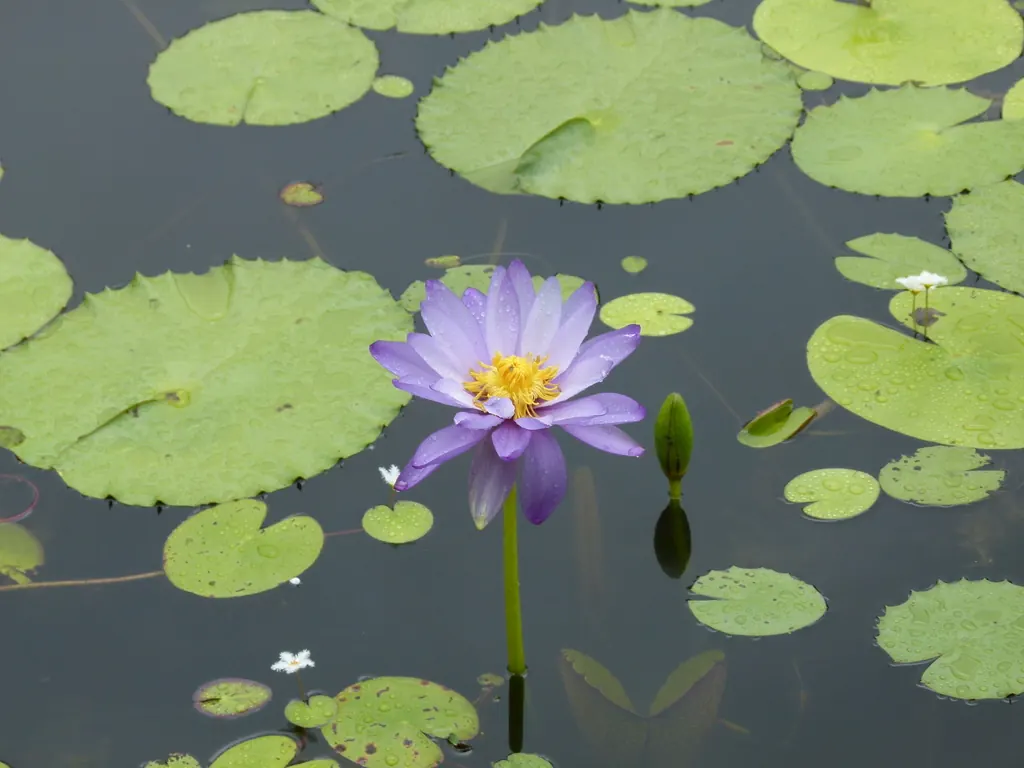
kababina is the freshwater lily, and in Roth's 1901 list of foods the lilies belong to the dry season, with honey, while 'roots and fruits' belong to the wet[1][2]. The blue lily of the north, Nymphaea, is eaten whole: the tuber in the mud, roasted 'not unlike a potato, but yellow and dry'; the porous flower stalk, peeled and eaten raw or roasted; the flower; and the apple-sized seed pod with up to three thousand seeds, which Roth saw baked in ovens of stones or ant-bed under teatree bark, then husked by rinsing and grinding 'until such time as the water from the pasty mass is comparatively clear'[3][4][2]. Roth gave the Bloomfield name of the roasted rhizome as de-kir, the same word used at Cooktown and Cape Bedford; Palmer, on the Mitchell, gave Amuma for the plant and separate names for the root, the stalk and the seed head[2][3]. The deep still lagoons the lilies need are where the magpie geese, the jacana and, on the lower rivers, the crocodile also come, which is why Roth's lily-gatherers at Princess Charlotte Bay dived with a watcher on the bank[5][6].
Nothing is written for the Eastern coast on this page yet. What follows is true across the country.
Hann River Cape York
Possum People's country on the upper river and Thaypan (Kuku Thaypan) country downstream: stringybark and bloodwood woodland and a spring-fed sandy river that runs north-east from the Great Dividing Range, past the Peninsula Developmental Road, into Rinyirru (Lakefield) and the North Kennedy. Not Kuku Yalanji country: the Kuku Yalanji words on this page are the dictionary's, not the Hann's own languages. Place guide
Lilies need still water, so in the Hann country they are in the lagoons and swamps, above all in Rinyirru's wetlands, rather than in the running sandy river. The Atlas of Living Australia holds 45 water-lily records, 127 of the little water snowflakes and 10 of the pink lotus around the middle Hann[13]. Roth wrote down lily names from the Morehead River and the Palmer, and today feral pigs dig the bulbs on Rinyirru[2][14].
Where they grow here
The Atlas of Living Australia holds 45 Nymphaea records from a box of about 90 × 85 km around the middle Hann, Laura and western Rinyirru, from 1971 to 2026: N. immutabilis 14, N. atrans 13, the blue lily N. violacea 4, and one each of the giant waterlily N. gigantea, N. carpentariae and N. macrosperma, with 11 not named to species. It also holds 127 records of the water snowflakes (Nymphoides, 1965–2026) and 10 of the pink lotus (Nelumbo nucifera, 1999–2024)[13]. The box takes in Rinyirru's lagoons, so read it as 'these lilies grow in this country', not as a map. Lagoons and swamps are one of the nine kinds of country the Kuku Thaypan Elders name, and in their lagoon country 'Nelumbo nucifera, water lilies Nymphaea sp., Eleocharis sp. and Oryza spp. also occur'[15].
Their year here
In the wet (December to March) the rivers flood over the plains; from about April the floodplains and wetlands dry out, and by October 'the land is brown and parched'[16]. The lagoons shrink with them. On Rinyirru 'Feral pigs Sus scrofa occur in large numbers' and 'eat the bulbs of water lilies and turtle eggs'[14]: a rooted-up lagoon edge in the dry is pig work. See pigs.
How people used them here
Morehead River and middle Palmer, c. 1900. Roth's food list gives the blue lily under its local names: the Koko-rarmul of the Morehead River had two names for the rhizome, 'according as they are young or old specimens', taro-uma and andu-emma, and called the seeds yarbadtha and the giant waterlily ducha-ra; the Koko-minni of the middle Palmer called the rhizome alkar-ma and the seeds acha-ra[2]. He gives no separate method for these districts; his roasting and seed-baking method is in the general section above.
Princess Charlotte Bay, c. 1900. Lily seed was dived for in crocodile water, 'there always being some friend of his or hers watching, either from the banks or an overhanging tree'[6]. Both crocodiles live in the Hann country: see crocodiles.
Today's evidence. The 2023 Thaypan and Possum evidence to the Federal Court lists bush foods but does not mention lilies[17][18]. A Koko-warra story Roth recorded at Princess Charlotte Bay has lily roots roasting in the ashes; it belongs to its custodians and is not retold here[19].
On country today
The upper Hann is the Possum People's country and the middle and lower Hann are Thaypan country, both determined in November 2023[18][17]. Rinyirru is jointly managed by the Rinyirru Aboriginal Corporation and the Queensland Government, and its Traditional Owners are the Lama Lama and Kuku Thaypan peoples[16]. Gathering for personal, domestic and non-commercial communal needs is part of native title[20].
Upper Mitchell Western Yalanji
Western Yalanji country west of the Great Dividing Range: dry open woodland cut by the sandy, paperbark-lined upper Mitchell River, around Karma Waters and Mount Carbine. Place guide
At Karma Waters the blue lily N. violacea is in the records, in the lagoons and backwaters off the sandy river rather than in it[21].
On the record here
The blue lily, Nymphaea violacea, is the water lily recorded within 30 km of Karma Waters[21].
Where to look here
The Mitchell at Karma Waters is mostly sand and rock pools, which is not lily ground; the blue lily record within 30 km is from the lagoons and backwaters off the river, and that is where to look[21][22].
Safety here
- Crocodiles. At Karma Waters the resident is the freshwater crocodile, which is smaller and shyer but not harmless[23].
On country today
The blue lily is still in the lagoons of the Mitchell catchment and is a staple across the north wherever people still gather; the Bloomfield name Roth wrote down, de-kir, is a word to check against Western Yalanji speakers, as is kababina[5][2][1]. Which lagoons near Karma Waters carry it, and in what months the pods are full, is for the contribution box below[21].
Everywhere
Names
kababina 'fresh water lily; flora and fauna belonging to the rain forest area'[1]. jakari 'spiderlily' is a Crinum of the sand and swamp edges, a different plant[1]. Roth's food bulletin gives the Nymphaea rhizome as de-kir at the Bloomfield (KYE), at Cooktown and at Cape Bedford, with the seeds nguri at Cape Bedford and nganka at Cooktown; for the giant waterlily he gives nga-wuro for the tuber and mumba for the seed at Cooktown and Cape Bedford; on the Morehead River young and old plants had different names[2]. Palmer's Mitchell River names: Amuma for the blue lily, Thoongon for the roots, Urgullathy for the seed stalk and Irrpa for the round seed head, in a language he does not name; his Cloncurry names were Thindah, Thoolambool and Mille[3]. Water words: bana 'water'; yarru 'deep water hole'; dajali 'deep water'; mala-kural 'good diver'[1].
The lilies
The blue lily, Nymphaea violacea, 'is found in Australia, particularly in the Western Australian Kimberley region and in northern parts of Queensland and the Northern Territory'; 'the flowers are violet, blue or white'; 'the waterlily is a bush tucker of the Aboriginal people in northern Australia. The tuber, stem, flowers and seeds are all edible'[5]. The giant waterlily, N. gigantea, is the big one of the east and north. 'The giant waterlily has a rhizomatous growth habit, that is, the main stem of the plant grows horizontally under the ground (in this case in the mud at the bottom of a lake or pond) and only the leaves and flowers are seen above the surface. The rhizome is globose, the large floating leaves are orbicular'. 'The large flowers are solitary and up to 25 cm diameter. They are held on a rigid, upright peduncle that may extend up to 50 cm above the water surface'. 'After fertilisation of the flower it is drawn underwater by the contraction of the peduncle, where the fruit ripens just below the surface. They are roughly the size of an apple and may contain up to 3,000 seeds'. 'Flowering occurs throughout the year, but is more common in warmer months. The flowers are open during the day and closed at night'. 'The habitat is permanent and semi-permanent waters of lakes, billabongs, and sluggish rivers where the bottom is deep mud and the water depth is at least 1.5 m'. 'Various parts of Nymphaea gigantea are edible and the plant was an important staple food for indigenous Australians across the northern parts of Australia. The golfball-sized tubers were collected from the muddy bottoms of water bodies by indigenous women and roasted before eating'[4].
Roth's account, 1901. 'Nymphaea caerulea: (1.) Rhizome roasted. (2.) The seeds are baked in their pods, in "ovens" made of stones or pieces of ant-bed, covered with strips of tea-tree bark, over which ashes and sand are placed. When the pods become soft, the seeds are ready for eating (with their husks). The husks, however, may be removed by baking somewhat longer, rinsing the seeds in water (when some of the husks will float to the surface), pouring off the water, and grinding the mass between two stones. The mass is rinsed again, and ground again, and so alternately rinsed and ground, until such time as the water from the pasty mass is comparatively clear.' And of the giant lily: 'Rhizome and seed eaten: prepared like N. caerulea. E. Palmer says that the porous seed-stalk is peeled and eaten raw, also roasted'[2].
Palmer's account, 1883, on the Mitchell. 'The blue water-lily. Large broad leaf, floating on the surface of the water, green on the upper and blue on the under surface ... Flowers large and bluish, or blue, or white; grows in large lagoons on the Mitchell and Norman Rivers. The porous seed-stalk is peeled and eaten raw, also roasted, as well as the round seed-head, making a distinction between those containing brown or black seeds, rejecting those with light-coloured seeds. The large rough tubers growing in the mud with the floating leaves attached are roasted, being not unlike a potato, but yellow and dry when cooked'[3].
The other water plants. The pink lotus, Nelumbo, whose twenty to thirty-five seeds in a flat-topped head 'are broken with a stone, and eaten raw', grew in 'large permanent lagoons, near King's Plains, Cooktown'[3][2]. The small fringed yellow water-snowflake (Nymphoides) has 'small round tubers roasted for food', and the Aponogeton of shallow lagoons on the Cloncurry and Mitchell has spherical bulbs an inch across 'eaten raw and roasted'[3].
Lily, lotus, snowflake
- Blue lily (Nymphaea): round floating leaves with a notch, flowers blue, violet or white held above the water, the pod pulled under to ripen; tuber, stalk, flower and seed all food[4][5].
- Pink lotus (Nelumbo): leaves held up on stalks out of the water, big pink flowers, a flat-topped seed head like 'a wasp's nest'; seeds eaten raw[3].
- Water snowflake (Nymphoides): small heart-shaped floating leaves and small fringed yellow flowers; small roasted tubers[3].
- Spider lily (jakari): a land plant of the sand with long strap leaves and white spidery flowers; not a water lily[1].
- Pale-seeded pods were rejected on the Mitchell; the brown and black seeds are the ripe ones[3].
Signs
- A lagoon covered in round leaves with flowers standing above them by day and closed at night[4].
- Flowers gone and stalks curled under: the pods are ripening below the surface[4].
- Jacanas walking on the pads, the 'lilytrotter', eating seeds and insects off the floating leaves; magpie geese grazing the margins[7][8].
- Dug mud and floating torn leaves at the edge of a lagoon where tubers have been pulled[4].
- 'The shadow or long streaky film of fine bubbles' that Roth's watchers looked for: a crocodile moving under the pads[6].
Where they grow
Still, deep, muddy water: 'permanent and semi-permanent waters of lakes, billabongs, and sluggish rivers where the bottom is deep mud and the water depth is at least 1.5 m' for the giant lily; Palmer's blue lily grew 'in large lagoons on the Mitchell and Norman Rivers'[4][3]. The lotus is a coastal-lagoon plant in Palmer's record[3].
The lily lagoon
A lily lagoon feeds everything. The magpie goose eats 'dry grass blades, grass seeds, spike rush' and the bulbs and seeds of the wetland, and swims its goslings through the pads; the comb-crested jacana 'eats seeds and aquatic insects gleaned from floating vegetation'; the freshwater turtles graze the stems and open the mussels in the mud; the catfish and the cherabin work the bottom under the leaves[8][7][9]. The pod sinks to ripen, so the seed is harvested from under the water, which is where the crocodile comes in: at Princess Charlotte Bay, when diving for lily seed in a suspected pool, 'there always being some friend of his or hers watching, either from the banks or an overhanging tree', who splashed the water with a stick at the first sign and 'so gives the signal to the individual below'[6]. The waterhole page sets the lagoon's year out in full.
Seasons
'Lilies and honey in the dry season; roots and fruits in the wet season', Roth wrote of the north generally[2]. The lilies flower through the year and most in the warm months, the pods follow the flowers, and the lagoons shrink through the dry until the tubers are within reach of a wading woman[4]. Palmer: the Mitchell lagoons held the blue lily, and the wild rice on the plains came with the wet[3]. See the year on country.
Uses
- Tubers roasted, 'not unlike a potato, but yellow and dry'[3][2].
- Flower stalks, porous, peeled and eaten raw or roasted[3].
- Flowers, eaten[5].
- Seed pods baked whole in an oven of stones or ant-bed under teatree bark[2].
- Seeds, husked by rinsing and grinding into a paste[2].
- Lotus seeds broken with a stone and eaten raw; snowflake tubers and Aponogeton bulbs roasted[3].
Gathering and cooking lilies
- Check the lagoon for crocodile sign before anyone goes in, and keep a watcher on the bank or in a tree while people are in the water[6][10].
- Tubers: wade or dive to the mud, follow the leaf stalks down and pull the tubers; roast them in the ashes[4][3].
- Stalks: pull the flower stalks, peel them and eat raw, or roast[3].
- Pods: take the ripened pods from under the surface, choosing those with brown or black seeds and leaving the pale ones[3][4].
- Bake the pods in an oven of hot stones or ant-bed lumps, covered with strips of teatree bark, then ashes and sand, until the pods are soft; the seeds can be eaten then, husks and all[2].
- To husk, bake longer, then rinse the seeds in water so the husks float off, pour the water away, grind the mass between two stones, rinse and grind again 'until such time as the water from the pasty mass is comparatively clear'[2].
- Lotus: break the seeds out of the flat head with a stone and eat them raw[3].
Safety
- Crocodiles. Every lily lagoon on a northern river is crocodile water; Roth's rule was a watcher on the bank and never a swim on the surface 'when crocodiles are about'; the Queensland rule is to be Crocwise in croc country[6][10].
- Pale seeds were rejected on the Mitchell[3].
- Stagnant water: tubers from a drying, fouled lagoon are not worth it.
- Gathering on native title country is protected by section 211 of the Native Title Act 1993[11][12].
On Country today
The blue lily is a bush tucker across northern Australia wherever people still gather[5]. Roth's Bloomfield name, de-kir, and the dictionary's kababina are words to check with speakers in each place[2][1]; the place sections above have what is known locally.
Language
kababina 'fresh water lily'; jakari 'spiderlily'; bana 'water'; yarru 'deep water hole'; dajali 'deep water'; mala-kural 'good diver'; bilngkumu 'salt water crocodile'[1].
References
- Hershberger, H. D. & Hershberger, R. (1982). Kuku-Yalanji Dictionary. Work Papers of SIL-AAB, Series B, Volume 7. With Toby Bloomfield, Roy Friday, Billy Roberts, Hector and Doris Sykes, Joe Walker and others. www.sil.org/resources/archives/18038
- Roth, W. E. (1901). North Queensland Ethnography, Bulletin No. 3: Food — its search, capture, and preparation. Brisbane: Government Printer. Bloomfield River information from the Hislops. — Sect. 6 'Cooking'; plant list ('Castanospermum australe', 'Dioscorea sativa', 'Elettaria Scottiana', 'Nymphaea') archive.org/details/northqueensland00landgoog
- Palmer, E. (1883). On plants used by the natives of North Queensland, Flinders and Mitchell Rivers, for food, medicine, &c., &c. Journal and Proceedings of the Royal Society of New South Wales 17: 93–113. Palmer's Mitchell River names come from the lower and middle Mitchell, not from Kuku Yalanji speakers. archive.org/details/journalandproce16walegoog
- Wikipedia. Nymphaea gigantea (giant waterlily), citing Flora of Australia, Low (1991) and Isaacs (1987). en.wikipedia.org/wiki/Nymphaea_gigantea
- Wikipedia. Nymphaea violacea (blue lily). en.wikipedia.org/wiki/Nymphaea_violacea
- Roth, W. E. (1910). North Queensland Ethnography, Bulletin No. 14: Transport and Trade. Records of the Australian Museum 8(1). — Sects. 14–15, dug-out canoes from the Flinders Group to Cape Grafton archive.org/details/biostor-52863
- Wikipedia. Comb-crested jacana (lotusbird, lilytrotter). en.wikipedia.org/wiki/Comb-crested_jacana
- Wikipedia. Magpie goose: habitat and diet. en.wikipedia.org/wiki/Magpie_goose
- Petrov, K. et al. The risk of inter-specific competition in Australian short-necked turtles (Emydura, Myuchelys): omnivory, benthic invertebrates in clear water, algae and terrestrial invertebrates in turbid water. researchers.westernsydney.edu.au/en/publications/the-risk-of-inter-specific-competition-in-australian-short-necked/
- Queensland Government. Be Crocwise top tips; Be Crocwise in Croc Country (web pages, accessed 5 October 2026). www.qld.gov.au/environment/plants-animals/animals/living-with/crocodiles/becrocwise/be-crocwise-top-tips
- Australian Law Reform Commission. Review of the Native Title Act 1993 (DP 82), ch. 8: Relevant provisions in the Native Title Act (s 211). www.alrc.gov.au/publication/review-of-the-native-title-act-1993-dp-82/8-the-nature-and-content-of-native-title/relevant-provisions-in-the-native-title-act/
- Western Yalanji Aboriginal Corporation & CRC for Developing Northern Australia (2020). Western Yalanji Land Use and Economic Diversification Plan. CC BY 4.0. — Native Title Determinations 1–4 (pp. 13–18); ‘Fire Management and Carbon Farming’ (pp. 32–33); ‘Pastoralists’ crcna.com.au/wp-content/uploads/2024/05/westernyalanjilanduseplan_nov2020.pdf
- Atlas of Living Australia. Occurrence records of Nymphaea (45 records, 1971–2026: N. immutabilis 14, N. atrans 13, N. violacea 4, N. gigantea 1, N. carpentariae 1, N. macrosperma 1, 11 not named to species), Nymphoides (127 records, 1965–2026) and Nelumbo nucifera (10 records, 1999–2024) in a box of about 90 × 85 km around the middle Hann River, Laura and western Rinyirru (lat −15.6 to −14.8, long 143.5 to 144.3), queried 28 October 2026. biocache.ala.org.au/occurrences/search?q=genus%3ANymphaea&fq=decimalLatitude%3A%5B-15.6%20TO%20-14.8%5D&fq=decimalLongitude%3A%5B143.5%20TO%20144.3%5D
- Queensland Parks and Wildlife Service (2013). Rinyirru (Lakefield) Aggregation Management Statement 2013. parks.desi.qld.gov.au/__data/assets/pdf_file/0027/165771/rinyirru.pdf
- Standley, P.-M. (2019). The importance of campfires to effective conservation. PhD thesis, James Cook University. Records the fire and country knowledge of Kuku Thaypan Elders Dr Tommy George and Dr George Musgrave. researchonline.jcu.edu.au/64274/
- Queensland Parks and Wildlife Service. Nature, culture and history: Rinyirru (Lakefield) National Park (CYPAL) (web page, last updated 1 July 2024; accessed 28 October 2026). parks.qld.gov.au/parks/rinyirru-lakefield/about/culture
- Ross on behalf of the Cape York United #1 Claim Group v State of Queensland (No 20) (Thaypan determination) [2023] FCA 1315 (Federal Court of Australia, 2 November 2023). — Determination area and waters; prescribed body corporate (Awu-Laya Indigenous Corporation); affidavit evidence on hunting www.judgments.fedcourt.gov.au/judgments/Judgments/fca/single/2023/2023fca1315
- Ross on behalf of the Cape York United #1 Claim Group v State of Queensland (No 21) (Possum determination) [2023] FCA 1316 (Federal Court of Australia, 2 November 2023). — Determination area (upper Hann and Kennedy rivers); prescribed body corporate; affidavit evidence on hunting and fishing www.judgments.fedcourt.gov.au/judgments/Judgments/fca/single/2023/2023fca1316
- Roth, W. E. (1903). North Queensland Ethnography, Bulletin No. 5: Superstition, magic, and medicine. Brisbane: Government Printer. — Sect. 44, a Koko-warra story from Princess Charlotte Bay archive.org/details/northqueensland00landgoog
- Native Title Act 1993 (Cth), section 211: preservation of certain native title rights and interests (hunting, fishing and gathering for personal, domestic or non-commercial communal needs). www.legislation.gov.au/C2004A04665/latest/text
- Atlas of Living Australia. Plant occurrence records within 30 km of the Karma Waters homestead (16.62°S, 144.60°E), queried 10 October 2026: 832 records of 266 species. biocache.ala.org.au/occurrences/search?q=kingdom:Plantae&lat=-16.62&lon=144.60&radius=30
- Queensland Herbarium, Regional Ecosystem 9.3.14 (Einasleigh Uplands): Melaleuca fringing woodland on channels and levees. Fire management guidelines. Queensland Government Regional Ecosystem Description Database. apps.des.qld.gov.au/regional-ecosystems/details/?re=9.3.14
- Karma Waters Station. About: location, native title (web page, accessed 5 October 2026). www.karmawatersstation.com/about.html
From the community
Know this one? Add the words you use for it, what it is for, how it is done, a correction, or a photo from country. It shows here straight away with your name on it. Please keep anything restricted or sacred off the site.
Loading…