Foods & cooking
Damper, billy tea and camp cooking
damba · diyi · kalbanbina · jungkalu · juka · jandu · dunju · dirka
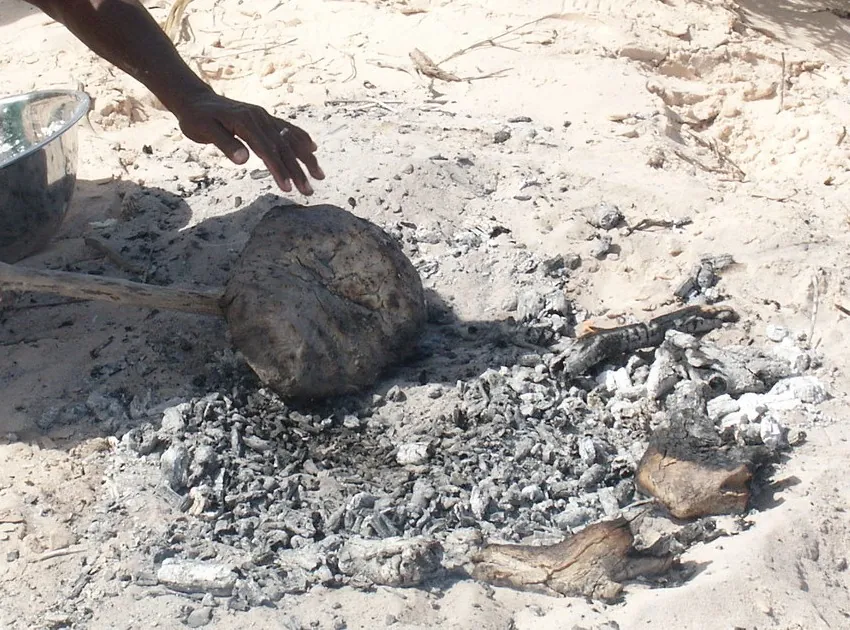

damba 'damper', diyi 'tea', kalbanbina 'tea leaves', jungkalu 'billycan', juka 'sugar', jandu 'starch, a food made from flour cooked in water, which is thick, not soupy', dunju 'soda bicard' and dirka 'cream of tartar' are the dictionary's words for the food that came with the stations and the missions, and they are Kuku Yalanji words now[1]. 'Damper is a thick home-made bread traditionally prepared by early European settlers in Australia', 'flour, salt and water, with some butter if available, is kneaded and baked in the coals of a campfire, either directly or within a camp oven', and it 'was eaten by stockmen who travelled in remote areas for long periods, with only basic rations of flour (much less bulky than baked bread), sugar and tea, supplemented by whatever meat was available'[2]. It is 'different from bush bread, which has been eaten by Indigenous Australians for thousands of years, traditionally made by crushing a variety of native seeds, nuts and roots, and mixing them into a dough baked in the coals of a fire', the breads of the zamia, grass seed and wattle pages[2][3]. This page is the camp kitchen as it is now on country: flour, tea, sugar and bicarb, the billy and the camp oven, the mango, the sweet potato and the taro the old people grew, and how each is made, with the fire rules that go with it.
Nothing is written for the Eastern coast on this page yet. What follows is true across the country.
Hann River Cape York
Possum People's country on the upper river and Thaypan (Kuku Thaypan) country downstream: stringybark and bloodwood woodland and a spring-fed sandy river that runs north-east from the Great Dividing Range, past the Peninsula Developmental Road, into Rinyirru (Lakefield) and the North Kennedy. Not Kuku Yalanji country: the Kuku Yalanji words on this page are the dictionary's, not the Hann's own languages. Place guide
The Hann has both kitchens. The old one: around 1900 Roth found people boiling food in the hinterland of Princess Charlotte Bay, and seed and root flours there 'cooked like a "damper"'[8]. The new one: Lakefield and Laura stations ran cattle on the lower rivers for almost a century, and 'Aboriginal people contributed significantly to the early success of the cattle industry'[20].
The old breads of this country
Roth recorded these around 1900, by district[8]:
- Wild rice (Oryza). Roth gives its Koko-wara names from the Princess Charlotte Bay hinterland, anbo-a and kwang-an (his spellings), and describes, without naming a district, how it was made into bread: the plants were tied in bundles and kept a long time under water, then dried and shaken; the seed was winnowed, 'ground between two stones, etc., and the pasty mass cooked like a "damper"'.
- Arrowroot (Tacca) on the Morehead and Musgrave rivers of the bay's hinterland: the tubers were grated on a rough stick into a bark trough of water, squeezed through a dilly bag, settled and washed, and the starch 'cooked in hot ashes like a "damper"'.
- Arrowroot on the Palmer: the same, but the settled starch was poured onto sand to drain, rolled into a ball and roasted, its hard skin peeled off and roasted again, until it made 'four or five "pancakes"'.
Kuku Thaypan Elders still mark the wild rice in their year: when the 'Knock em down' rain begins, about May, one of their signs is that Che giuill, the wild rice, is ready[21].
How people cooked here
Boiling. Roth thought boiling rare in the north, but wrote: 'I have met with the process in the hinterland of Princess Charlotte Bay', in a bark trough or a big bailer (Melo) shell[8].
Roasting. Behind the bay he saw snakes stretched over the flames before they were roasted in a coil, and tortoises killed with a wooden bristle before cooking[8].
Today's foods. A Thaypan man told the Federal Court of 'wallaby, barramundi, freshwater fish and turtles and mussels' and 'bush foods like lady apples, white apples, bally yams that grow on a long stem, bush carrot and bush potato'[22]. How families cook them now is theirs to tell.
On country today
The station kitchen. At Old Laura Homestead in Rinyirru, the kitchen was 'detached from the residence and built of timber slabs' with 'a dirt floor made from compacted termite mounds', and in the early 1940s a 'storage room for dry food and rations' was added[20].
Camping in Rinyirru. Rangers ask campers to bring a 'fuel or gas stove for cooking' and 'rubbish bags as no bins are provided', and to 'never leave food scraps, fish frames or bait at a camp site'[23]. The park and its camping areas close through the wet[23]. The upper Hann is Possum country and the middle and lower Hann Thaypan country; camp there only with the Traditional Owners' permission[24][22].
Upper Mitchell Western Yalanji
Western Yalanji country west of the Great Dividing Range: dry open woodland cut by the sandy, paperbark-lined upper Mitchell River, around Karma Waters and Mount Carbine. Place guide
On Karma Waters the billy is the station's own tradition: the family 'love their "smoko" and during a cattle muster on their property, we see that they are expert hands at swinging the billy', and 'tea made in a quart pot over an open fire never tasted so good'[9].
The station's quart pot
The station's cup is the quart pot: 'these quart pots you carry them on your saddle, the handles just fold up like that and go in a little pouch on your saddle', 'you fill this part up with water, boil it up like a billy and this is your cup, the other part is your cup', and 'they were originally called quart pots because they held a quart'[9].
Signs here
The old station camps on the Mitchell and the Palmer show these signs under the shade trees near water, with the bottles and the horseshoes.
Where the camp kitchen is here
On Karma Waters the camping is on the river: the station runs bush camping on the Mitchell with its own rules on fires, water and rubbish, and the muster camps are wherever the cattle are[11][9].
Seasons here
The camp kitchen runs all year, but the fire depends on the season: in the dry 'most of our country is burnt on a 3-4 year cycle' and the station's fire rules and any fire ban come first; in the wet the wood is wet and the river is up, and the camp moves to the verandah[25][11]. The muster camps are May and September; smoko on the muster is the billy 'under a tree' with 'your sandwiches and a quart pot of tea'[26][9].
Tea here
Tea. 'It is the bushman's beverage', the station's poem says, 'and no matter where you be, you can always come and join us with some good old billy tea'; on the muster 'if you've had a pretty long morning, it might go to one or later, and by then the old tongue is hanging out a bit for a cup of tea'[9]. Tea leaves and sugar in a tin, the billy on a hook, and a cup: the whole of hospitality on country[9].
Fire here
The station's fire rules come first: fires only where allowed, never on a fire-ban day, small, in a scraped ring with the grass cleared back, and out cold with water before you leave; 'fire management is probably one of the most critical areas in land management' on Karma Waters and a camp fire that gets away in the dry is a station fire[25][11].
On country today
The station's own tea tradition, a quart pot on the saddle and 'Bushells tea, mate', is shared ground: 'relax there as we share a joke and have our billy tea'[9]. How the Western Yalanji families made their damper and their tea on the Mitchell camps, what went in the camp oven, which trees and gardens were theirs, is for the contribution box below.
Everywhere
Names
damba 'damper'; jandu 'starch, a food made from flour cooked in water, which is thick, not soupy'; dumbul 'any hard covering such as bark of a tree, crust of bread, shell of turtle'; jirra 'burnt, as food. Sometimes also the crust of bread'; wubaji 'to swell up; to rise, as bread dough rising'; jani 'well cooked, done'[1]. diyi 'tea'; kalbanbina 'tea leaves'; juka 'sugar', the same word as 'back of ankle, back of heel'; jungkalu 'billycan'; warkal 'bailer shell used in the old time for a billy'; milkul 'soup'[1]. dunju 'soda bicard'; dirka 'cream of tartar; fur; finecut tobacco; powder'; nganyin 'onion (english loan word); sugar bag'; makaji 'onion plant'[1]. nyamal 'to boil'; dindal 'to roast on coals'; wayjul 'to cook food; to burn something'; jika 'any food if, when cooked, is not hard but squishy (like sweet potatoes, or pumpkin)'; bangkal 'tongs made from voya vine, used in cooking in a kurrma - an earth oven'[1]. The gear: naybu 'knife (english loan word)'; bulin 'a plate'; dakilji 'cup; panninkin, only rarely used now'; jurungurr 'spoon made in old time'; mayal 'bottle'; jamu 'cork from bottle'; maji 'matches (english loan word)'[1]. The garden: bangkamu 'sweet potato'; jarru 'taro'; jadamu 'bananas'; mayngku 'mango'; banabul 'pineapple'; kajinbur 'passionfruit'[1]. Smoke: bakul 'poison plant found at Rossville; tobacco. This is no longer in use for tobacco'; jika-birra 'tobacco leaf'; baybu 'pipe'; kadirangkal 'clay pipe'[1].
And the old flours the new ones replaced: kajimarra 'food which is ground up to make flour', marra 'zemia tree and the zemia nut which is roasted, ground and leaced to make flour', kawar 'honey bread of bees'[1]. The loan words, damba, diyi, jungkalu, naybu, maji, dunju, are the sound of the station and mission years in the language; the words for the old breads are older than any of them.
Description
Damper. 'Damper is a thick home-made bread', 'made from wheat-based dough', 'generally held to be unleavened and made without added rising agents, but historically, if the bread dough was left overnight, it could sometimes have leavened naturally, and this may have been a commonly understood technique in bush lore', and 'some recipes added portions of the previous night's dough, similar to a sourdough starter'[2]. 'When cooked as smaller, individually-sized portions, the damper may be known as "bush scones" or "johnnycakes"', which 'while often pan-fried, remain wheat-based'[2]. The stockman's version 'is made with self-raising flour, salt and water and is usually cooked in a camp oven over the embers of a fire'[4]. The dictionary's dunju and dirka, bicarb and cream of tartar, are the two halves of baking powder: with plain flour they make the rising[1].
The billy. 'A billycan is an Australian term for a lightweight cooking pot in the form of a metal bucket commonly used for boiling water, making tea/coffee or cooking over a campfire or to carry water', 'commonly known simply as a billy'; 'it is widely accepted that the term billycan is derived from bouilli can, the name given to the empty canisters used for preserving soup and bouilli and other foods', which 'with the addition of a handle' 'were re-purposed for boiling water'[5]. Before the tin, the dictionary says, the warkal was the 'bailer shell used in the old time for a billy', and the bailer shell page has it[1].
The camp oven. 'A Dutch oven, Dutch pot (US English), or casserole dish (international) is a thick-walled cooking pot with a tight-fitting lid', 'usually made of seasoned cast iron', 'related to the South African potjie, the Australian Bedourie oven and Spanish cazuela'[6]. The Australian camp oven is the flat-bottomed cast-iron kind with a lipped lid to hold coals, and the Bedourie is the pressed-steel one that does not crack when dropped[6].
The swag. 'In Australia, a swag is a portable sleeping unit', 'a bundle of belongings rolled in a traditional fashion to be carried by a foot traveller in the bush'; 'the modern swag is a waterproof canvas sleeping compartment that is sometimes insect-proof' with 'a mattress (usually high-density foam, 50 or 75 mm thick)'[7]. The muster camp is 'sleeping in a swag (bedroll) on the ground with limited food choices'[4].
Damper, bush bread, johnnycake
Damper and bush bread are different things. 'The bread is different from bush bread, which has been eaten by Indigenous Australians for thousands of years, traditionally made by crushing a variety of native seeds, nuts and roots, and mixing them into a dough baked in the coals of a fire', and 'there are studies into whether this technique of various Aboriginal peoples influenced the development of colonial-era damper, similarly cooked in the ashes of a camp fire'[2]. 'Bread-making was a woman's task', 'carried out by several women at once, due to its labour-intensive nature', involving 'collecting seasonal grains, legumes, roots or nuts, and preparing these into flour and then dough', with 'an Aboriginal millstone, vital in making flour or pastes for bread'; 'the seeds of the cycad palm, Cycas media, are highly carcinogenic when raw, and require elaborate treatment including shelling, crushing, leaching in running water for up to five days, then cooking. After this they are made into small loaves, which can keep for a number of weeks'[3]. That is the zamia and leaching of this country; the grass-seed page has the grain breads and the wattle page the wattleseed[3].
Damper, johnnycake, scone. One dough: a big loaf in the ashes is damper; 'smaller, individually-sized portions' are 'bush scones' or 'johnnycakes'; the same dough fried in the pan is a johnnycake too[2]. Camp oven or Dutch oven. The same pot with a different lid: the camp oven's lid is flat with a lip for coals[6].
Tea and the old drinks. Tea is the station's drink; the old sweet drinks were honey and water, the native bee page's 'sugar bag' washed out in a bark trough, and the dictionary keeps the word for the bees' 'honey bread'[1][8].
Signs of a camp kitchen
A bush kitchen leaves its signs: the ring of stones or the scraped hearth, the ash bed with a damper-sized hollow, the forked sticks and the cross-bar the billy hung from, a jam-tin or a quart pot blackened 'through a fire by the look of it', the camp oven's three-legged print in the ash[9]. The camps page has how to read an older camp, and the Cultural Heritage Act's duty of care covers any old Aboriginal camp whether or not it has a billy in it[10]. A fire scar still warm, a billy left on the coals and a swag rolled against a tree mean someone is close; a cold hearth with fresh ash and no rubbish is a camp made right[11].
Where the camp kitchen is
The kitchen wants shade, water, a flat place for the fire out of the wind, dead dry wood for coals, and a tree for the billy-hook; the camps page has the choosing of the place and the woods, and the firestick page the fire itself[11]. Flour, tea and sugar are bought; the fruit and roots are grown: the mango 'in Australia, commercial Kensington Pride mangoes grow predominantly in the Northern Territory and northern and central Queensland', 'the original tree emerged in Bowen, Queensland in the late 1880s', and the sweet potato and taro grow in any wet-season garden on the river[12][13][14].
The foods that came, and the ones that were here
Flour, tea and sugar. These were the rations of the stations and the missions, the 'basic rations of flour (much less bulky than baked bread), sugar and tea, supplemented by whatever meat was available' on which the stockman lived, and which Aboriginal workers were paid in when they were paid at all[2][15]. 'Traditional Indigenous Australians' use of bush foods has been severely affected by the colonisation of Australia beginning in 1788', 'the introduction of non-native organisms, together with the loss of and destruction of traditional lands and habitats, has resulted in reduced access to native foods', and 'especially in the more densely colonised areas of south-eastern Australia, the introduction of non-native foods to Aboriginal people resulted in an almost complete abandonment of native foods'[16]. In the north the two kitchens ran side by side, and the dictionary shows it: damba next to marra, diyi next to kawar[1].
Mango. 'The Kensington Pride mango is a named commercial mango cultivar that originated in Australia', 'sometimes called the KP, Bowen or Bowen special', and 'Australia's most popular mango'; it 'was possibly brought to Bowen from India between 1885 and 1889 by traders who were shipping horses for military use in India'[12]. Every old station, mission and camp in the north has its mango trees, and mayngku ripens in the hot season before the storms[1][12]. The flying-foxes and the cockatoos know the trees as well as the people do.
Sweet potato. 'The sweet potato or sweetpotato (Ipomoea batatas) is a dicotyledonous plant in the morning glory family', 'native to the tropical regions of South America', with 'sizeable, starchy, sweet-tasting, tuberous roots' and 'young shoots and leaves' that 'are eaten as greens'; 'the stems usually crawl on the ground and form adventitious roots at the nodes', so a cutting pushed into wet ground grows[13]. The dictionary's jika, 'squishy (like sweet potatoes, or pumpkin)', is the cooked texture[1].
Taro. 'Colocasia esculenta is a perennial, tropical plant primarily grown as a root vegetable for its edible, starchy corm', 'one of the most ancient cultivated crops', 'found widely in tropical and subtropical regions of South Asia, East Asia, Southeast Asia, and Papua New Guinea, and northern Australia'; it is cooked, never raw, and the leaves too[14]. It grows in the wet places, like the wild ginger, and the dictionary's jarru is the word[1].
Bananas, pineapple, passionfruit, onion are the mission garden's, and the words are the dictionary's; the fruit bats and the scrub turkeys take their share[1].
Seasons
The camp kitchen runs all year; when and where a fire may be lit depends on the place and the season (see each place above). The garden's year: sweet potato and taro planted with the first rains and dug through the dry, mangoes from the end of the dry into the storms, bananas whenever a bunch fills, and the old people's calendar on the seasons page alongside[12][13].
Uses
The staple. Damper is the bread when there is no bread, 'nowadays when the bread supply has been exhausted'; flour keeps for months in a sealed drum, tea and sugar for years, and a bag of each with a billy and a camp oven feeds a camp for a week with the river's fish and the station's beef[4].
Starch. jandu, 'a food made from flour cooked in water, which is thick, not soupy', is the mission porridge, flour boiled to a paste and sweetened; it is the same food as the old leached zamia paste, made of a new flour[1][3].
The camp oven's other jobs: a roast of beef or a scrub turkey, a stew of catfish or cherabin, a goanna or a wallaby tail cut up, bread; anything the earth oven did, the iron pot does faster, with the same coals[6][8].
Carrying and keeping. The billy carries water as well as boiling it; the flour drum and the tea tin keep the ants out; the dilly bag and the bark trough did the same jobs for the old kitchen[5][17].
Making it
Damper in the ashes. Two cups of plain flour, half a teaspoon of salt, half a teaspoon of bicarb and a teaspoon of cream of tartar, or two cups of self-raising flour and the salt; mix dry, make a well, add water a little at a time and work it to a soft dough that leaves the bowl clean; knead a minute, no more, and shape a round loaf an inch and a half thick[2][4]. Let the fire burn down to a bed of coals and ash; scrape the coals aside, lay the loaf on the hot ash, scrape ash and then coals over it, and leave it 30 to 40 minutes; brush it off and tap the bottom, and if it sounds hollow it is done; the crust comes off with the ash and the inside is clean[2]. The dictionary's wubaji is the dough rising, jirra the crust burnt, jani done[1].
Damper in the camp oven. Grease the oven, put the loaf in, lid on; set the oven on a shovelful of coals and put another shovelful on the lid, fewer underneath than on top; turn the oven a quarter every ten minutes so one side does not burn; 30 to 40 minutes, then the tap test[6][4]. Johnnycakes. Same dough, flattened to the size of a hand, on a greased pan or straight on the coals, turned once[2].
Billy tea. Fill the billy from the river or the tank, hang it or set it in the coals, and when it boils hard throw in a handful of leaves, lift it off, and let it stand a minute; the old trick of swinging the billy in a full circle to settle the leaves is the station's 'expert hands at swinging the billy', and a gum leaf on top is the bushman's habit; sugar goes in the cup, not the billy[9][5]. In the quart pot: 'you put your tea leaves in there, pour it into here and you drink it'[9].
Starch. A cup of flour mixed to a paste with cold water, stirred into a billy of boiling water until it thickens, sugar to taste; it is jandu, 'thick, not soupy'[1].
Sweet potato and taro. Sweet potato roasts whole in the ashes like a yam, 30 to 45 minutes, or boils; the shoots and leaves are 'eaten as greens'[13]. Taro is boiled or roasted until soft right through and never eaten raw; the corm and the leaves both[14]. The old people's way with a root is on the yam page: ashes, a stick to test, and the skin scraped off[8].
The camp oven roast. Meat in, a little water, lid on, coals under and on top, an hour for a joint, turned twice; the cooking-meat page has Roth's ways with the same meats[6][8].
Safety
Fire. The fire rules of the place come first: see each place above. The hunting-with-fire page has the law and the seasons of fire.
Burns. A camp oven lid, a billy handle and a hot ash bed burn; use a hooked stick or a glove for the lid, lift the billy by the handle with a stick, and keep children back from the hearth; cool a burn under running water for twenty minutes[18].
Water. River water for the billy is boiled hard, and that boiling is the only treatment it gets, so give it a full rolling boil; the finding-water page has the rest[5].
Food. Flour weevils are harmless; sour or mouldy damper is thrown out; meat is cooked through, 'jani', in the heat, and cooked once[1][19].
Taro must be cooked; the raw corm and leaves are acrid[14].
On Country today
The camp kitchen is where the two food traditions of this country meet every day: the billy and the damper from the station years, the fish, the turtle, the mussels and the fruit from before them, and now the garden[16][1]. The loan words in the dictionary, and the way jandu and marra sit together in it, are the record of that meeting[1].
Language
damba 'damper'; jandu 'starch'; diyi 'tea'; kalbanbina 'tea leaves'; juka 'sugar'; jungkalu 'billycan'; warkal 'bailer shell used in the old time for a billy'; dunju 'soda bicard'; dirka 'cream of tartar'; milkul 'soup'; naybu 'knife'; bulin 'plate'; dakilji 'cup'; jurungurr 'spoon made in old time'; mayal 'bottle'; jamu 'cork'; maji 'matches'; nyamal 'to boil'; dindal 'to roast on coals'; wayjul 'to cook'; jani 'well cooked'; jirra 'burnt'; wubaji 'rise, as bread dough'; dumbul 'crust of bread'; bangkamu 'sweet potato'; jarru 'taro'; jadamu 'bananas'; mayngku 'mango'; banabul 'pineapple'; kajinbur 'passionfruit'; nganyin 'onion'; bakul 'tobacco'; baybu 'pipe'[1].
References
- Hershberger, H. D. & Hershberger, R. (1982). Kuku-Yalanji Dictionary. Work Papers of SIL-AAB, Series B, Volume 7. With Toby Bloomfield, Roy Friday, Billy Roberts, Hector and Doris Sykes, Joe Walker and others. www.sil.org/resources/archives/18038
- Wikipedia. Damper (food). en.wikipedia.org/wiki/Damper_(food)
- Wikipedia. Bush bread. en.wikipedia.org/wiki/Bush_bread
- Wikipedia. Stockman (Australia). en.wikipedia.org/wiki/Stockman_(Australia)
- Wikipedia. Billycan. en.wikipedia.org/wiki/Billycan
- Wikipedia. Dutch oven. en.wikipedia.org/wiki/Dutch_oven
- Wikipedia. Swag (bedroll). en.wikipedia.org/wiki/Swag_(bedroll)
- Roth, W. E. (1901). North Queensland Ethnography, Bulletin No. 3: Food — its search, capture, and preparation. Brisbane: Government Printer. Bloomfield River information from the Hislops. — Sect. 6 'Cooking'; plant list ('Castanospermum australe', 'Dioscorea sativa', 'Elettaria Scottiana', 'Nymphaea') archive.org/details/northqueensland00landgoog
- Karma Waters Station. Outback Cuppa: transcript of a film of a muster on Karma Waters, with Alan, Karen and Ron Pedersen (web page, accessed 5 October 2026). www.karmawatersstation.com/outback-cuppa.html
- Aboriginal Cultural Heritage Act 2003 (Qld), s 23 (cultural heritage duty of care). www.legislation.qld.gov.au/view/whole/html/inforce/current/act-2003-079
- Karma Waters Station. Bush Camping at Karma Waters Station (web page, accessed 5 October 2026). www.karmawatersstation.com/bush-camping.html
- Wikipedia. Kensington Pride (mango). en.wikipedia.org/wiki/Kensington_Pride
- Wikipedia. Sweet potato (Ipomoea batatas). en.wikipedia.org/wiki/Sweet_potato
- Wikipedia. Taro (Colocasia esculenta). en.wikipedia.org/wiki/Taro
- Wikipedia. Stolen wages. en.wikipedia.org/wiki/Stolen_wages
- Wikipedia. Bush tucker. en.wikipedia.org/wiki/Bush_tucker
- Roth, W. E. (1904). North Queensland Ethnography, Bulletin No. 7: Domestic implements, arts, and manufactures. Brisbane: Government Printer. — Sect. 10 'Fire-tongs' archive.org/details/northqueensland00landgoog
- healthdirect Australia. Insect bites and stings (accessed 10 October 2026). www.healthdirect.gov.au/insect-bites-and-stings
- NSW Health. Brucellosis: fact sheet (accessed 10 October 2026). www.health.nsw.gov.au/Infectious/factsheets/Pages/brucellosis.aspx
- Queensland Parks and Wildlife Service. Nature, culture and history: Rinyirru (Lakefield) National Park (CYPAL) (web page, last updated 1 July 2024; accessed 28 October 2026). parks.qld.gov.au/parks/rinyirru-lakefield/about/culture
- Standley, P.-M. (2019). The importance of campfires to effective conservation. PhD thesis, James Cook University. Records the fire and country knowledge of Kuku Thaypan Elders Dr Tommy George and Dr George Musgrave. researchonline.jcu.edu.au/64274/
- Ross on behalf of the Cape York United #1 Claim Group v State of Queensland (No 20) (Thaypan determination) [2023] FCA 1315 (Federal Court of Australia, 2 November 2023). — Determination area and waters; prescribed body corporate (Awu-Laya Indigenous Corporation); affidavit evidence on hunting www.judgments.fedcourt.gov.au/judgments/Judgments/fca/single/2023/2023fca1315
- Queensland Parks and Wildlife Service. Visiting Rinyirru (Lakefield) National Park (CYPAL) safely (web page, last updated 1 June 2025; accessed 28 October 2026). parks.qld.gov.au/parks/rinyirru-lakefield/visiting-safely
- Ross on behalf of the Cape York United #1 Claim Group v State of Queensland (No 21) (Possum determination) [2023] FCA 1316 (Federal Court of Australia, 2 November 2023). — Determination area (upper Hann and Kennedy rivers); prescribed body corporate; affidavit evidence on hunting and fishing www.judgments.fedcourt.gov.au/judgments/Judgments/fca/single/2023/2023fca1316
- Karma Waters Station. Land management (web page, accessed 6 October 2026). www.karmawatersstation.com/land-management.html
- Karma Waters Station. Cattle (web page, accessed 5 October 2026). www.karmawatersstation.com/cattle.html
From the community
Know this one? Add the words you use for it, what it is for, how it is done, a correction, or a photo from country. It shows here straight away with your name on it. Please keep anything restricted or sacred off the site.
Loading…