Plants, vines & grasses
Yams
kawu · wukay · kalkurr · biyangkal · banjay · warrabuka · bambayal · wawukuna · ngakun · wubali · juwalDioscorea bulbifera, Tacca leontopetaloides, Typhonium brownii and other tubers
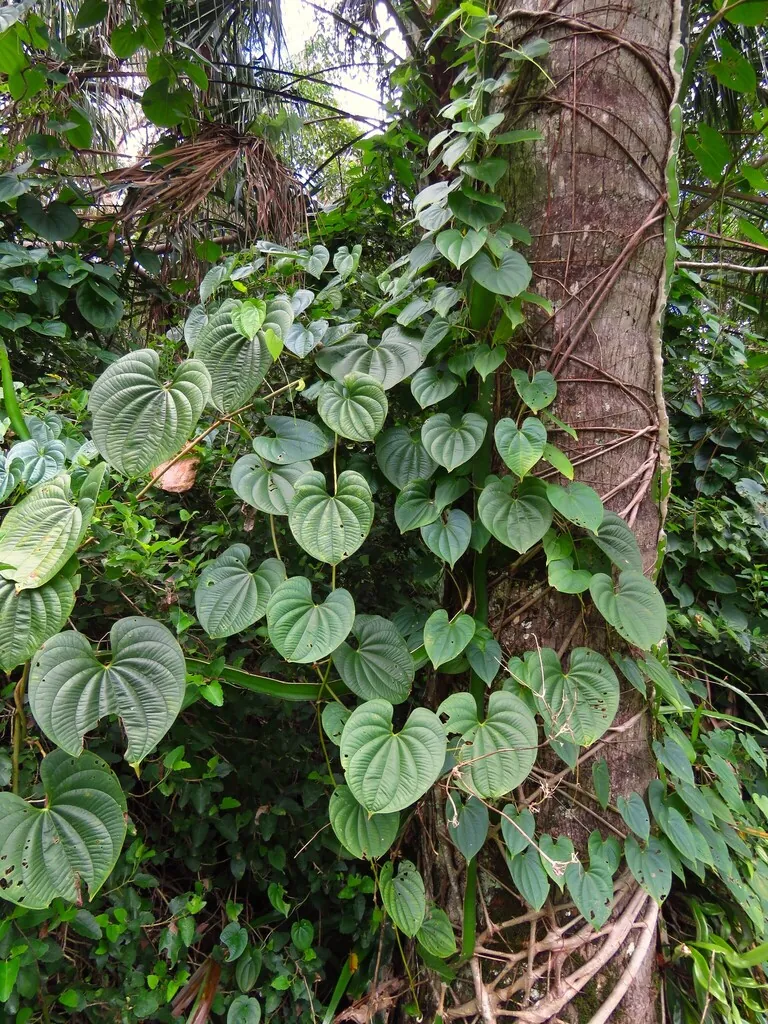
Kawu is the Kuku Yalanji word for yam, and the dictionary names about ten different kinds[1]. Tubers, bulbs and wild yams were 'the cornerstone of the Kuku-Yalanji diet, especially in the inland area', and the hairy yam, wukay, was probably the single most important vegetable food, the mainstay of meals for up to five months[2]. Some kinds only needed roasting. Others, like wukay and biyangkal, are bitter or poisonous raw and must be cooked, ground and leached first[1]. On the Bloomfield River, wukay was baked for four hours in a stone oven, mashed, and washed in seven or eight changes of water in a bark trough[3]. Yams were dug with the juwal, the digging stick[4].
Names
Kawu simply means 'yam'[1]. The dictionary also names particular kinds: kalkurr and warrabuka, each a 'species of wild yam'; bambayal, 'a long thin variety of yam'; wawukuna, 'long wild yam'; banjay, 'species of wild yam, small and round'; wukay, 'hairy yam'; biyangkal, a yam that must be roasted, ground and leached; and ngakun and wubali, each a 'species of yam'[1]. The dictionary notes that ngakun also names the flame tree[1]. Juwal means both 'yam' and 'digging stick'[1]; Roth's Bloomfield name for the digging stick, tchu-al, is the same word in his spelling[4].
Roth's 1901 Bloomfield list ties several of these names to plants[3]:
- kalkur and kau-u (kalkurr, kawu) are given for Dioscorea sativa var. elongata, a long-tubered yam;
- wo-kai (wukay) is given for Dioscorea sativa var. rotunda, a round one, with the same name at Cooktown;
- pi-anggal (biyangkal) is Tacca pinnatifida, the wild arrowroot;
- warabti-ga (warrabuka) is Microstemma tuberosum, a tuber eaten raw or roasted.
Anderson, working at Bloomfield in the late 1970s, also identifies the hairy yam as Dioscorea sativa var. rotunda[2]. Both of Bailey's Dioscorea sativa varieties are now placed in Dioscorea bulbifera[5], and Tacca pinnatifida is now called Tacca leontopetaloides[6]. Roth also lists bandjai, from the Koko-yellanji, for the tuber Typhonium brownii[3] — probably the dictionary's banjay. Bambayal, wawukuna, ngakun and wubali have not yet been matched to species.
Description
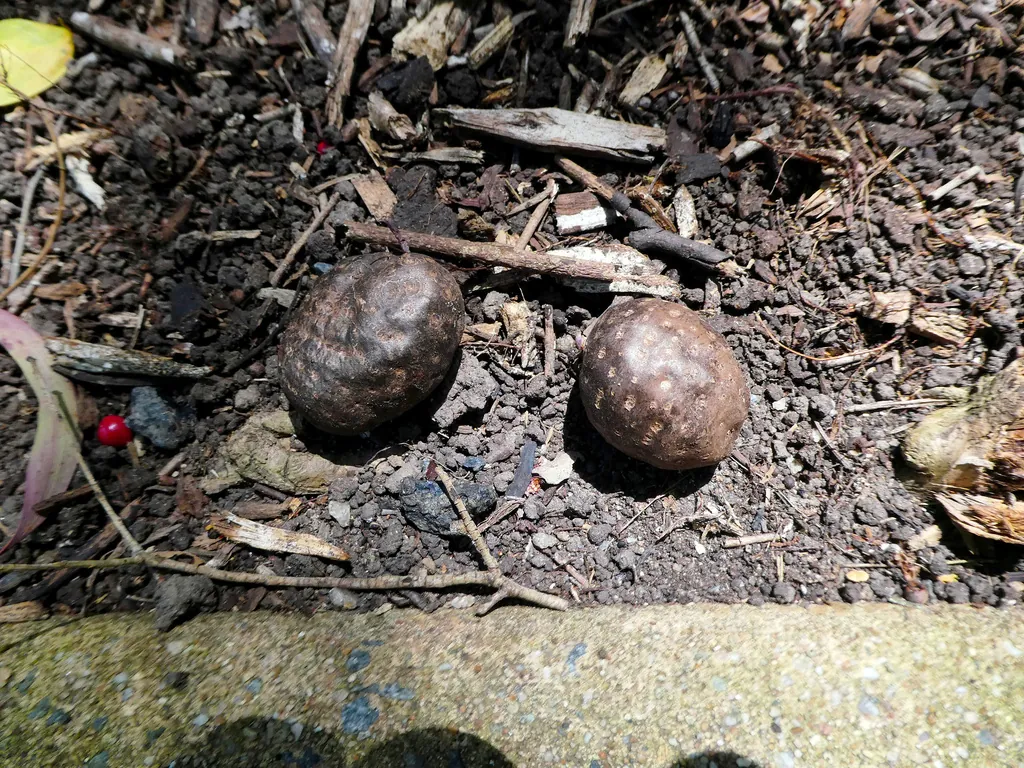
Most true yams (Dioscorea) are twining vines that store food in an underground tuber. Dioscorea bulbifera has large heart-shaped leaves, about 5–22 cm long, on twisted stalks, and often carries small aerial 'potatoes' (bulbils) 0.8–1.5 cm across along its leafy stems[7]. The long yam Dioscorea transversa is a slender vine with smaller heart-shaped leaves, 4.5–14 cm long, and three-winged fruits hanging in clusters[8].
Wild arrowroot (Tacca leontopetaloides) is not a vine. It sends up a few big, deeply divided leaves on stalks up to 1 m long, and a flower stalk about 1.5 m tall carrying an umbrella of about 20 flowers. Its tuber is very starchy[6].
Where they grow
On the Bloomfield, the hairy yam grew 'in the sandy-soiled, open forest country, on the edges of swamps and on the river and creek banks'[2]. Coastal people made seasonal trips up onto the coastal ranges for yams and other tubers[2]. Botanically, Dioscorea bulbifera grows from near sea level to 800 m in open forest, wet sclerophyll forest, vine thicket and rainforest[7]; D. transversa from sea level to 1100 m in open forest, rainforest and gallery forest[8]; and wild arrowroot in open forest, monsoon forest and the edges of lowland rainforest up to 900 m[6].
Yams belong to Western Yalanji country as much as to the coast. Anderson notes that tubers were most important 'especially in the inland area'[2]. Roth recorded Koko-yellanji names for both forms of the Dioscorea yam at Butcher's Hill (Boggy Creek), inland[3], and herbarium collections of the long yam D. transversa come from the ranges north of Mount Carbine[9]. On the Palmer River, Roth saw wild arrowroot prepared from its tubers[3].
Seasons
Anderson writes that most tubers and yams were available 'from the mid-dry season until November or so', with others in the wet; several kinds could be dug and kept unprocessed for two or three months into the wet season[2]. Roth's Bloomfield informant put the hairy yam's time 'from about the middle of February to about the middle of May, the approximate extent of the wet season, during which it constitutes the main article of diet'[3]. The wet season is kambar[1].
Uses
Food. Yams were a main plant food. Roth wrote that yams, roots, nuts and shellfish were generally prepared by women[3]. Both men and women could dig the hairy yam, but Roth recorded that if men prepared it, only males could eat it[3]; Anderson puts it as 'if dug by men then women could not eat them', and adds that in practice women supplied the bulk of it[2].
For children. The dictionary records that banjay was 'given to the child to make it talk'[1].
Tools. The digging stick and the palm-fibre dilly-bag were a woman's own personal property and would not normally be lent[2]. On the Bloomfield the sieve-bags were made from black palm fibre or from grass[4].
Still in use. In the late 1970s the hairy yam was still processed at Bloomfield, with steel digging sticks (often a shortened crowbar), flour drums for boiling and plastic buckets for settling, but still with palm-fibre dilly-bags for the first mashing[2].
How they were dug and prepared
Digging. Roth describes the digging stick as essentially a women's tool: a staff of strong, heavy wood 2–4 feet long with a flattened, spade-like tip, often hardened in the fire. Worked to and fro, it both loosens the soil and shovels it out[4]. At Bloomfield, Ion Idriess described one about 1.5 m long, of well-seasoned hardwood tapering to a point[2].
Wukay, the hairy yam. The Bloomfield method, from R. Hislop's account to Roth[3], with Anderson's details[2]:
- Dig out the tuber and take it to a processing place near a small, fast creek. Wash it carefully and remove all dirt and clinging roots.
- Bake it in a stone (earth) oven for about four hours, until soft. Let it cool.
- Mash it by hand inside a palm-fibre dilly-bag. Hold the bag over a bark trough and pour water through it. Keep mashing, pouring and straining until only the rough fibre and skin are left in the bag; throw that away.
- Fill the trough with water, stir, and let it stand a good half-hour, until the yam settles and the water clears. An oily scum rises to the top — people said this was the poison. Pour it off with the water.
- Add fresh water and repeat. Roth says it can take seven or eight waters, over several hours, before the bad taste is gone. Keep going until no more oil appears and nothing tastes bitter.
- Dig a hole in sand about the size of a washbasin (Anderson: about a metre across) and line it with clean white sand. Put a large rolled leaf in the bottom to carry the water away. Pour the mash in gently.
- When the water has drained off, it is ready: a porridge that Roth compared to preserved potato, eaten off leaf plates.
- Eat it the same day. It ferments quickly[3].
Kalkurr and kawu, the long yam. Roth's entry is short: the tuber is baked first, then roasted, and the skin removed[3]. Anderson notes that several Bloomfield yams needed nothing more than roasting on the fire[2].
Biyangkal (wild arrowroot). The dictionary: 'first roasted, then ground, then leached for a couple hours in many changes of water before it can be safely eaten'[1]. Roth's Bloomfield note is that the tuber was baked in the ashes, mashed, rolled in ginger leaves and baked again[3]; Anderson says it needed alternate roasting and pounding between two stones[2].
Banjay. The dictionary: roast in the fire, grind up and eat[1]. Roth describes the treatment of Typhonium brownii (no district named): roast the tubers a minute or two on the ashes, pound them between two stones, roast and pound again, and keep alternating for a good ten minutes or more, until they are like india-rubber[3].
Safety
Never eat a bitter yam raw. Dioscorea bulbifera 'may be poisonous'[7], and Anderson calls the hairy yam 'otherwise toxic' without its long leaching[2]. The dictionary is explicit that wukay and biyangkal must be cooked, ground and leached before eating[1]. Raw Typhonium brownii tubers 'produce a burning sensation like a chili'[3]. Different yams need very different treatment, from a quick roast to hours of washing, so knowing exactly which yam you have is the whole safety rule. Prepared hairy yam spoils fast and must be eaten the same day[3]. The steps above are a record of how it was done, not a tested recipe; learn it from people who know the plants.
On Country today
None of these yams is listed as threatened; as native plants they are 'least concern' wildlife under Queensland's Nature Conservation Act[10].
Much of Eastern Kuku Yalanji country is now Aboriginal land. On 29 September 2021 more than 160,000 ha, taking in the Daintree, Ngalba-bulal, Kalkajaka and Hope Islands national parks between Mossman and Cooktown, was handed back to the Eastern Kuku Yalanji people, to be jointly managed with the Queensland Government through the Queensland Parks and Wildlife Service[11]. Under section 211 of the Native Title Act 1993, native title holders do not need a licence or permit to hunt, fish or gather for their personal, domestic or non-commercial communal needs[12]. Everyone else needs the Traditional Owners' permission to take anything from country, and park rules apply.
Language
Words for this work: bakal 'dig'; juwal 'yam or digging stick'; kurrma 'earth oven'; dindal 'to roast on coals'; nyurrbal 'to grind'; ngabal 'soak, leach'; balji, a 'ladies' dilly bag, made from grass or black palm'; and kambar 'wet season'[1].
Images
References
- Hershberger, H. D. & Hershberger, R. (1982). Kuku-Yalanji Dictionary. Work Papers of SIL-AAB, Series B, Volume 7. With Toby Bloomfield, Roy Friday, Billy Roberts, Hector and Doris Sykes, Joe Walker and others. www.sil.org/resources/archives/18038
- Anderson, C. (1996). Traditional material culture of the Kuku-Yalanji of Bloomfield River, North Queensland. Records of the South Australian Museum 29(1): 63–83. — Gathering; 'Yam preparation'; personal property; material culture in the late 1970s hdl.handle.net/2440/13994
- Roth, W. E. (1901). North Queensland Ethnography, Bulletin No. 3: Food — its search, capture, and preparation. Brisbane: Government Printer. Bloomfield River information from R. Hislop. — Plant list: 'Dioscorea sativa' vars. elongata and rotunda, 'Tacca pinnatifida', 'Typhonium Brownii', 'Microstemma tuberosum'; sects. 1 and 3 archive.org/details/northqueensland00landgoog
- Roth, W. E. (1904). North Queensland Ethnography, Bulletin No. 7: Domestic implements, arts, and manufactures. Brisbane: Government Printer. Bloomfield River information from R. Hislop. — Sect. 39, digging-sticks; sect. 54, Bloomfield River dilly-bags archive.org/details/northqueensland00landgoog
- International Plant Names Index. Dioscorea bulbifera var. elongata (Bailey) Prain & Burkill; basionym Dioscorea sativa var. elongata F.M.Bailey. www.ipni.org/n/urn:lsid:ipni.org:names:70918-3
- Australian Tropical Rainforest Plants (RFK8), Tacca leontopetaloides. CSIRO / Lucidcentral. apps.lucidcentral.org/rainforest/text/entities/Tacca_leontopetaloides.htm
- Australian Tropical Rainforest Plants (RFK8), Dioscorea bulbifera var. bulbifera. CSIRO / Lucidcentral. apps.lucidcentral.org/rainforest/text/entities/dioscorea_bulbifera_var._bulbifera.htm
- Australian Tropical Rainforest Plants (RFK8), Dioscorea transversa. CSIRO / Lucidcentral. apps.lucidcentral.org/rainforest/text/entities/Dioscorea_transversa.htm
- Australian Tropical Herbarium specimen QRS 59883.1, Dioscorea transversa, collected 1979, State Forest Reserve 144 (Mount Windsor Tableland), about 16.28°S 145.08°E. Atlas of Living Australia. biocache.ala.org.au/occurrences/f1c7a1e4-9c85-471c-9e40-77cc7431ed84
- Nature Conservation (Plants) Regulation 2020 (Qld), current as at 22 May 2026. — Sch. 1 pt 2 div 7 s 25 (least concern wildlife); sch. 2 (special least concern plants) www.legislation.qld.gov.au/view/pdf/inforce/current/sl-2020-0137
- Australian Geographic (September 2021). Daintree handed back to Traditional Owners. www.australiangeographic.com.au/news/2021/09/daintree-handed-back-to-traditional-owners/
- Australian Law Reform Commission. Review of the Native Title Act 1993 (DP 82), ch. 8: Relevant provisions in the Native Title Act (s 211). www.alrc.gov.au/publication/review-of-the-native-title-act-1993-dp-82/8-the-nature-and-content-of-native-title/relevant-provisions-in-the-native-title-act/