Mammals
Platypus
wambijiOrnithorhynchus anatinus
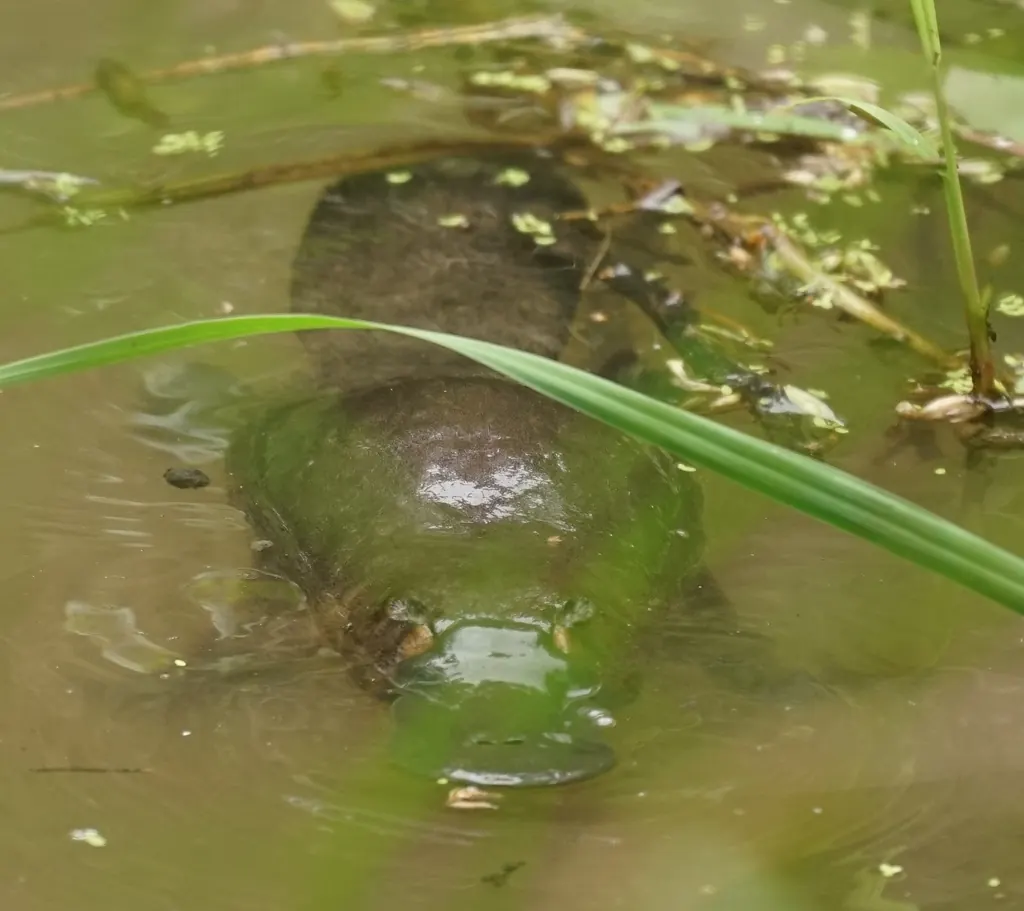
wambiji is the platypus[1]. 'The platypus is a semiaquatic, egg-laying mammal endemic to eastern Australia'; 'together with the four species of echidna, it is one of the five extant species of monotremes, mammals that lay eggs instead of giving birth to live young. Like other monotremes, the platypus has a sense of electrolocation, which it uses to detect prey in water while its eyes, ears and nostrils are closed. It is one of the few species of venomous mammals, as the male platypus has a spur on each hind foot that delivers an extremely painful venom'[2]. 'It is culturally significant to several Aboriginal peoples, who also used to hunt it for food', 'the platypus was hunted for its fur, but since 1912 it has been a legally protected species in all states where it is found', and it is 'near threatened', with numbers 'fallen by about thirty percent on average since European settlement'[2]. It 'requires permanent freshwater habitat', 'forages by probing along the bottom' for 'insect larvae, annelid worms, shrimp, crayfish' and the like, and lives in a burrow in the bank[2]. Its range reaches north only to about Cooktown[3]. Its neighbour in the same water is the rakali, which the old Darling River people thought the platypus was a cross with[4][2].
Hann River Cape York
Possum People's country on the upper river and Thaypan (Kuku Thaypan) country downstream: stringybark and bloodwood woodland and a spring-fed sandy river that runs north-east from the Great Dividing Range, past the Peninsula Developmental Road, into Rinyirru (Lakefield) and the North Kennedy. Not Kuku Yalanji country: the Kuku Yalanji words on this page are the dictionary's, not the Hann's own languages. Place guide
The platypus does not live on the Hann. Its range reaches north only to about Cooktown, on the other side of the Great Dividing Range[3], and the Atlas of Living Australia holds no platypus records in a box of about 90 × 85 km around the middle Hann, Laura and western Rinyirru[8]. Saltwater crocodiles and big wet-season floods may help hold it back in the north[3], and the Hann country has both.
Who lives in its place here
The Hann's clear, spring-fed holes look like platypus water, but the furred swimmer in them is the rakali, the water-rat: the Atlas holds 5 rakali records in the same box, from 1994 to 2021[8]. Use the lookalikes list above the other way round: on the Hann, a brown swimmer with whiskers and a white-tipped tail is a rakali.
People and the platypus here
With no platypus in this country, no record of it from the Possum or Thaypan peoples of the Hann has been published[9][10]. The general sections above are about the animal where it does live.
Upper Mitchell Western Yalanji
Western Yalanji country west of the Great Dividing Range: dry open woodland cut by the sandy, paperbark-lined upper Mitchell River, around Karma Waters and Mount Carbine. Place guide
On the upper Mitchell the platypus is rare if it is there at all: the Atlas has one record within 60 km of Karma Waters, and the clear headwater creeks of the Mitchell on the Tableland are its country, so a quiet pool at dawn on the upper river is worth watching[2][11].
Where to look here
On the Mitchell that is the Tableland headwaters and the permanent upper reaches; one Atlas record within 60 km of Karma Waters, and none within 30[11][12]. Choose a permanent, clear, quiet pool with earth banks on the upper river or a Tableland creek.
On country today
Whether the platypus lives in the Karma Waters pools or stays in the Tableland headwaters is an open question for the station's dawn watchers; the dictionary's word says the old people knew it[11][1]. The contribution box below is for a sighting. A platypus at Karma Waters would be a record worth having.
Eastern coast Eastern Kuku Yalanji
Eastern Kuku Yalanji country: rainforest, beaches, mangroves, reef and the short steep rivers from the Daintree to the Bloomfield and the Annan.
The east side of the Range is where the platypus reaches its northern limit[3]. The dictionary was made on the coast, where the platypus lives in the rainforest streams, and its word wambiji is a sign the animal was known[1]. The Atlas of Living Australia's most northerly platypus records, seven of them from 1948 to 2022, all come from the country 30–55 km south of Cooktown[13].
Where it lives here
The permanent, clear rainforest streams of the coast are its water; north of about Cooktown it is not recorded[3][13]. In these rivers it shares the water with the saltwater crocodile, one of the things thought to hold it back in the north[3].
Everywhere
Names
wambiji 'platypus'[1]. A Western Yalanji name is for the contribution box below. 'The platypus has been a subject in the Dreamtime stories of Aboriginal Australians, some of whom believed the animal was a hybrid of a duck and a water rat', and it 'is also featured as a totem for some Aboriginal peoples'; this page leaves the stories to the people who hold them[2].
Description
'Male platypuses have an average length of 50 cm and weight of 1,700 g, while females are smaller with an average length of 43 cm and weight of 900 g. The species follows Bergmann's rule, with individuals being larger the farther south they are', so the north's are the small ones[2]. 'The platypus has secondarily acquired electroreception. Its receptors are arranged in stripes on its bill, giving it high sensitivity to the sides and below; it makes quick turns of its head as it swims to detect prey'; 'the 40,000 electroreceptors are arranged in rows in the skin of the bill'[2]. 'Its swimming style is unique among mammals, propelling itself by alternating strokes of each front foot, while the webbed hind feet and tail are used for steering'[2]. 'Male platypuses are born with back ankle spurs ... The spurs of the male inject venom', 'composed largely of defensin-like proteins', 'an extremely painful venom'[2]. 'The unusual appearance of this egg-laying, duck-billed, beaver-tailed mammal at first baffled European naturalists. In 1799, the first scientists to examine a preserved platypus body judged it a fake made of several animals sewn together'[2].
Breeding. 'Platypuses are seasonal breeders, with the more southerly populations breeding later in the year than those further north'; the female lays her eggs in a nursery burrow, and 'during incubation and weaning, the mother initially leaves the burrow only for short periods to forage. She leaves behind her a number of thin soil plugs along the length of the burrow; pushing past these on her return squeezes water from her fur and allows the burrow to remain dry'[2].
Status. 'The platypus was hunted for its fur, but since 1912 it has been a legally protected species in all states where it is found. Captive breeding programs have had slight success, and it is vulnerable to pollution, bycatching and climate change. It is classified as a near-threatened species by the IUCN, but a November 2020 report has recommended that it be upgraded to threatened species under the federal EPBC Act, due to habitat destruction and declining numbers in all states'[2].
Platypus or rakali
- Platypus: a flat bill, a flat broad tail, a low silhouette, dives with a roll and surfaces with a ring of ripples, chewing at the surface; no visible ears[2].
- Rakali: a rat's head and whiskers, a long round tail with a white tip, swims with its head up, eats on a rock[4].
- Freshwater turtle: a head on a neck, no wake.
- A swimming brushtail possum or a water python: neither has a bill.
Signs
- A ring of ripples at dawn or dusk on a still pool, then a small brown back and a bill[2].
- A burrow entrance in a steep earth bank just above the water, under roots[2].
- Clear, permanent water with insect larvae and shrimp in it: the only water it lives in[2].
- No sign at all in the sand-bed pools of the late dry; it needs the permanent reaches.
Where it lives
'The platypus is native to the freshwaters of eastern Australia, from Queensland to Tasmania'; 'the platypus is semiaquatic and requires permanent freshwater habitat'[2]. Its current range runs along the east and south-east coast 'to about as far north as Cooktown in Queensland'. 'Predation by salt water crocodiles and severe flooding in the wet season may both contribute' to that northern limit[3].
The bottom-feeder of the clear pools
The platypus 'is a carnivore and forages by probing along the bottom. It feeds on insect larvae, annelid worms, shrimp, crayfish' and other small water animals, which it finds blind with the bill's electroreceptors[2]. That is the same food the small fish, the rakali and the turtles take, in the same clear water, and the cherabin and the mussels' beds are its hunting ground; the freshwater crocodile and the sea eagle are its dangers[2]. Like the echidna it lays eggs, 'one of the five extant species of monotremes'[2][5].
Seasons
The northern populations breed earlier in the year than the southern; the platypus keeps to the permanent pools through the dry and spreads with the wet; dawn and dusk are its hours all year[2]. See the year on country.
Uses
Seeing a platypus
- Choose a permanent, clear, quiet pool with earth banks not a sand-bed pool of the late dry[2].
- Sit still before first light or at dusk on the bank, downwind, and watch for the ripple-ring and the roll[2].
- Do not try to catch or handle one: protected since 1912, and the male's spur is 'extremely painful'[2].
- Report it: a sighting near the edge of its range is a record worth having; the contribution box below is the place.
Safety
- Protected wildlife under the Nature Conservation Act 1992 and 'a legally protected species in all states' since 1912[6][2].
- The male's ankle spurs inject a venom that causes severe pain; never pick one up[2].
- Its pools are crocodile pools; see Crocwise[7].
- Set nets and traps drown platypus, which is one reason set lines and nets are controlled; see the law page[2].
On Country today
The platypus has been protected everywhere it lives since 1912, and it is near threatened[2]. The dictionary's word says the old people knew it[1]. The contribution box below is for a sighting.
Language
wambiji 'platypus'; bana 'water'; yarru 'deep water hole'; yikin 'bank'[1].
References
- Hershberger, H. D. & Hershberger, R. (1982). Kuku-Yalanji Dictionary. Work Papers of SIL-AAB, Series B, Volume 7. With Toby Bloomfield, Roy Friday, Billy Roberts, Hector and Doris Sykes, Joe Walker and others. www.sil.org/resources/archives/18038
- Wikipedia. Platypus (Ornithorhynchus anatinus). en.wikipedia.org/wiki/Platypus
- Australian Platypus Conservancy. Platypus distribution (web page, accessed 28 October 2026). platypus.asn.au/distribution/
- Wikipedia. Rakali, the water-rat (Hydromys chrysogaster). en.wikipedia.org/wiki/Rakali
- Wikipedia. Short-beaked echidna. en.wikipedia.org/wiki/Short-beaked_echidna
- Queensland Government, State of the Environment. Nature Conservation Act 1992. www.stateoftheenvironment.des.qld.gov.au/biodiversity/management-responses/legislation/nature-conservation-act-1992
- Queensland Government. Be Crocwise top tips; Be Crocwise in Croc Country (web pages, accessed 5 October 2026). www.qld.gov.au/environment/plants-animals/animals/living-with/crocodiles/becrocwise/be-crocwise-top-tips
- Atlas of Living Australia. Occurrence records in a box of about 90 × 85 km around the middle Hann River, Laura and western Rinyirru (lat −15.6 to −14.8, long 143.5 to 144.3), queried 28 October 2026: no Ornithorhynchus anatinus; Hydromys chrysogaster (rakali) 5 records, 1994–2021. biocache.ala.org.au/occurrences/search?q=genus%3AOrnithorhynchus
- Ross on behalf of the Cape York United #1 Claim Group v State of Queensland (No 21) (Possum determination) [2023] FCA 1316 (Federal Court of Australia, 2 November 2023). — Determination area (upper Hann and Kennedy rivers); prescribed body corporate; affidavit evidence on hunting and fishing www.judgments.fedcourt.gov.au/judgments/Judgments/fca/single/2023/2023fca1316
- Ross on behalf of the Cape York United #1 Claim Group v State of Queensland (No 20) (Thaypan determination) [2023] FCA 1315 (Federal Court of Australia, 2 November 2023). — Determination area and waters; prescribed body corporate (Awu-Laya Indigenous Corporation); affidavit evidence on hunting www.judgments.fedcourt.gov.au/judgments/Judgments/fca/single/2023/2023fca1315
- Atlas of Living Australia. Occurrence records within 60 km of the Karma Waters homestead (16.62° S, 144.60° E), species counts for Animalia (accessed 10 October 2026). biocache.ala.org.au/occurrences/search?q=*:*&lat=-16.62&lon=144.60&radius=60
- Atlas of Living Australia. All occurrence records within 30 km of the Karma Waters homestead (16.618° S, 144.605° E), species facet, queried 5 October 2026 (4,053 records; 601 species). biocache.ala.org.au/occurrences/search?q=*:*&lat=-16.6179&lon=144.6047&radius=30
- Atlas of Living Australia. Occurrence records of Ornithorhynchus anatinus north of latitude 16° S, queried 28 October 2026: 7 records (1948–2022), all from the country 30–55 km south of Cooktown. biocache.ala.org.au/occurrences/search?q=genus%3AOrnithorhynchus
From the community
Know this one? Add the words you use for it, what it is for, how it is done, a correction, or a photo from country. It shows here straight away with your name on it. Please keep anything restricted or sacred off the site.
Loading…