Birds
Brolga and sarus crane (kulbal)
kulbalAntigone rubicunda; Antigone antigone
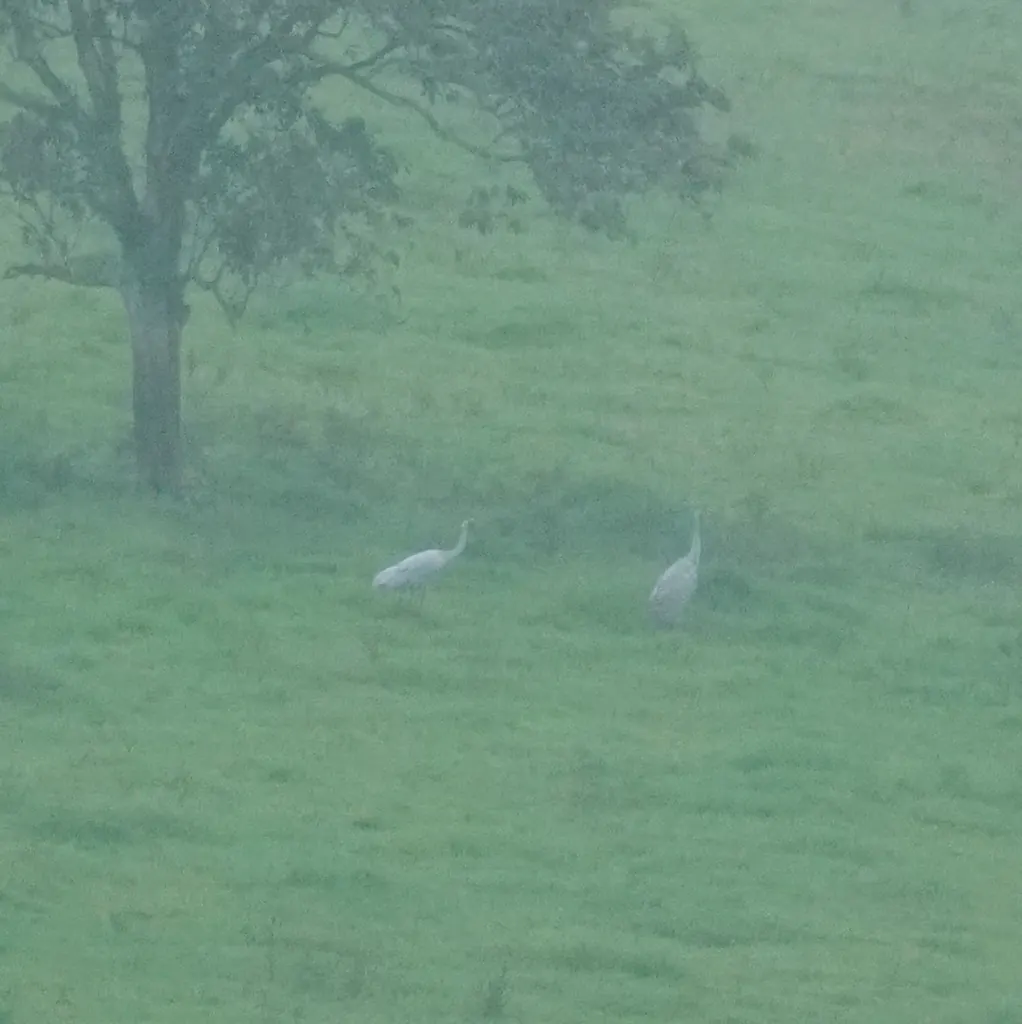
kulbal is the brolga, the grey crane with the red head that dances at the lagoons, 'a tall, upright bird with a small head, long beak, slender neck, and long legs', Queensland's emblem, found 'often abundant in north and north-east Australia' in flocks of up to a thousand[1][2]. It has a double: the sarus crane, 'the tallest of the flying birds', which reached Australia from Asia in the last ice age; the sarus has red running down its neck and the brolga's red stops at the head[3][2]. Both dig the wet ground for bulbs and roots, 'tear up the ground with their powerful beaks in search of bulbs and edible roots', and eat insects, crustaceans and frogs; both pair for life, hold a territory, and nest in the wet on a platform of reeds in the shallows[2][3]. Roth lists cranes with the ducks and divers that 'may be caught with sticks, etc., in the nesting season by sneaking upon them unawares' and that were 'stalked and speared' by the grass-hooded hunter[4]. The dance is the thing everyone knows: a bird 'picking up some grass and tossing it into the air before catching it in its bill', then jumping 'a metre into the air with outstretched wings', bowing, strutting, calling[2].
Nothing is written for the Eastern coast on this page yet. What follows is true across the country.
Hann River Cape York
Possum People's country on the upper river and Thaypan (Kuku Thaypan) country downstream: stringybark and bloodwood woodland and a spring-fed sandy river that runs north-east from the Great Dividing Range, past the Peninsula Developmental Road, into Rinyirru (Lakefield) and the North Kennedy. Not Kuku Yalanji country: the Kuku Yalanji words on this page are the dictionary's, not the Hann's own languages. Place guide
The Hann runs down to the lagoons of Rinyirru (Lakefield), where 'waterbirds include brolgas, sarus cranes, black-necked storks, magpie geese and ducks'[12]. The Atlas of Living Australia holds 688 brolga records (1967–2026) and 141 sarus crane records (1986–2026) in a box of about 90 × 85 km around the middle Hann, Laura and western Rinyirru, so here the brolga is much the commoner[13]. In Kuku Thaypan, the language of the Thaypan people of the middle and lower Hann, the brolga is Nhye geaba[14].
Where they live here
In Rinyirru, 'brolgas and sarus cranes can often be seen in pairs or family groups striding through the tall lilies searching for sedge tubers, which they dig up from underground with their long bills. Both birds perform dancing courtship displays with wings outstretched and heads bopping'[12]. The lagoons and swamps of the floodplain are their ground, more than the sandy channel of the Hann itself.
Their year here
Wet. From December to March the rivers flood out over the plains and 'animals disperse far and wide as food and water is plentiful'[12].
Dry. From April the floodplains and wetlands dry out, and 'by October the land is brown and parched'[12]. On the deep permanent waterholes, 'as water becomes scarce elsewhere, large numbers of wildlife congregate here for food and shelter'[12].
Fire. The Kuku Thaypan Elders burn their boxwood country cool and early. Most grasshoppers fly off ahead of a cool fire; 'those unfortunate enough to be too slow provide a food resource for brolgas'. Standley photographed brolgas foraging on a fresh burn in June 2007, and notes that 'a variety of burn times and mosaics are important for this species'[14].
How people dealt with them here
Stalking (hinterland of Princess Charlotte Bay, Roth about 1900). Ducks, geese 'and similar game are all stalked and speared — usually with the ordinary simple-point spear if on land, but commonly with a pronged one if on water'. The hunter covered his head with a collar of long grass and held leafy switches in front of him as he glided through the water[4]. Roth lists cranes with the birds taken this way and at the nest; the full method is under How-to on this page.
Kuku Thaypan Elders list Nhye geaba among the species of cultural significance in their country. They say bird numbers and kinds in their wetlands were higher when they were young, and brolgas are named among them[14]. A Kuku Thaypan story about the storm bird and a grey crane is recorded in Standley's thesis; it belongs to its custodians and is not retold here[14].
On country today
The upper Hann is the Possum People's country, and the middle and lower Hann are Thaypan country, under native title determinations of November 2023[15][16]. Rinyirru's Traditional Owners are the Lama Lama and Kuku Thaypan peoples, and the park is jointly managed[12]. Both cranes are protected; native title holders may hunt for personal, domestic and non-commercial communal needs without the licences others need[17].
Upper Mitchell Western Yalanji
Western Yalanji country west of the Great Dividing Range: dry open woodland cut by the sandy, paperbark-lined upper Mitchell River, around Karma Waters and Mount Carbine. Place guide
On the Western Yalanji Mitchell both cranes come to the lagoons, and the sarus is recorded five times within 30 km of Karma Waters to the brolga's two[18].
Where they live here
The waterhole and water lily pages describe the lagoons of the Mitchell where both dig[18].
On country today
Both cranes are on the Karma Waters lagoons, the sarus now the commoner in the records, which is a change within living memory on the Tableland and may be one here[18][3]. Whether the Western Yalanji had a second word for the second crane is for the contribution box below[1].
Everywhere
Names
kulbal 'brolga'[1]. kurrbal, 'plain turkey (native companion)', carries the brolga's old English name 'native companion' as well as the bustard's; this page follows the dictionary's kulbal for the brolga and leaves kurrbal to the bustard[1][2]. The sarus crane has no recorded Kuku Yalanji name; on the Atherton Tableland and the Gulf, where it is common, it is lately distinguished from the brolga and may once have gone under the same word[3].
The two cranes
Brolga. 'A common, gregarious wetland bird species of tropical and south-eastern Australia and New Guinea. It is a tall, upright bird with a small head, long beak, slender neck, and long legs. Its plumage is mainly grey, with black wing tips, and it has an orange-red band on its head.' 'The adult has a grey-green, skin-covered crown, and the face, cheeks, and throat pouch are also featherless and are coral red. Other parts of the head are olive green and clothed in dark bristles.' 'Brolgas are widespread and often abundant in north and north-east Australia, especially north-east Queensland ... The population in northern Australia is estimated at between 20,000 and 100,000 birds'. 'Queensland has the greatest numbers of brolgas, and sometimes flocks of over 1,000 individuals are seen ... Breeding pairs and flocks are distributed across several floodplains along the Gulf of Carpentaria.' 'In breeding areas, breeding pairs defend territories against other brolgas, and when breeding efforts are successful, they remain in territories with one or two chicks.' 'Brolgas are omnivorous and forage in wetlands, saltwater marshes, and farmlands. They tear up the ground with their powerful beaks in search of bulbs and edible roots. Northern populations have a very varied diet, with minimal contribution of vegetation'[2].
The dance. 'Brolgas are well known for their ritualised, intricate mating dances. The performance begins with a bird picking up some grass and tossing it into the air before catching it in its bill. The bird then jumps a metre into the air with outstretched wings and continues by stretching its neck, bowing, strutting around, calling, and bobbing its head up and down'[2].
Sarus crane. 'A large nonmigratory crane found in parts of the Indian subcontinent, Southeast Asia, and northern Australia. The tallest of the flying birds'. 'The sarus crane is easily distinguished from other cranes in the region by its overall grey colour and the contrasting red head and upper neck. They forage on marshes and shallow wetlands for roots, tubers, insects, crustaceans, and small vertebrate prey. Like other cranes, they form long-lasting pair bonds and maintain territories'. 'The main breeding season is during the wet season, when the pair builds an enormous nest "island," a circular platform of reeds and grasses nearly two meters in diameter and high enough to stay above the shallow water surrounding it.' Mitochondrial DNA suggests 'Australia was colonized only in the Late Pleistocene, some 35,000 years ago'[3].
Roth's note. 'Ducks, Cranes, Diver-birds, and others may be caught with sticks, etc., in the nesting season by sneaking upon them unawares'; in the hinterland of Princess Charlotte Bay and on the Palmer 'ducks, geese, and similar game are all stalked and speared', the hunter's head 'covered with a bundle of long grass' so that he 'looks for all the world like a tussock of grass floating down the stream'[4].
Brolga or sarus
- Brolga: the red is a band on the head only; a grey-green crown; dark grey legs; a dewlap under the chin[2].
- Sarus crane: the red runs down the upper neck; a paler crown; pinkish legs; taller[3].
- Both fly with the neck straight out and the legs trailing, unlike the herons, which fold the neck[5].
- Black-necked stork, the jabiru: black and white with a huge bill and red legs; not a crane[6].
- Bustard: brown and grey, no red, on dry ground[7].
Signs
- Dug ground at a lagoon edge, turned over for bulbs[2].
- The trumpeting call, carrying a long way at dawn, and the dance[2].
- A reed platform in shallow water in the wet[3].
- Pairs in the breeding season, flocks in the dry on the floodplain and the paddocks[2].
- Big four-toed tracks in the mud, the hind toe short.
Where they live
Lagoons, swamps, the margins of the big pools and the floodplain flats, and the station paddocks; the brolga 'forage[s] in wetlands, saltwater marshes, and farmlands', the sarus 'on marshes and shallow wetlands'[2][3]. See the waterhole and water lily pages for the lagoon's year.
The diggers of the lagoon
The cranes work the same mud as the water lilies and the magpie geese, digging for the bulbs and tubers of the sedges and lilies and taking the frogs, crayfish and insects as they go; they share the floodplain with the ducks and geese and the jabiru[2][3]. The chicks are prey for the eagles, the goannas and the dingo; the adults have few enemies but the drying of their lagoons[2]. See the waterhole page for the pool's year.
Seasons
Breeding in the wet, on a platform in the flooded shallows; pairs on territories then; flocks on the drying floodplain and the paddocks through the dry, and the dances before the rains[3][2]. See the year on country.
Uses
Approaching a crane
From Roth[4]:
- In the water, under grass: a collar of long grass round the head and a bunch of leafy switches held in front, gliding so slowly that 'viewed from the front, the individual so concealed looks for all the world like a tussock of grass floating down the stream'[4].
- On the plain, on all fours under the cover of bushes[4].
- Spear with the plain-pointed spear on land, the pronged spear on water[4].
- At the nest in the wet, 'by sneaking upon them unawares'[4].
- Leave a pair with chicks; a brolga pair raises one or two a year[2].
Safety
- Native birds are protected wildlife in Queensland under the Nature Conservation Act 1992; native title holders hunting for personal, domestic or non-commercial communal needs are covered by section 211 of the Native Title Act 1993, recognised in the Western Yalanji determinations[8][9][10].
- Lagoon mud and reeds are crocodile cover; Be Crocwise[11].
- The brolga is in decline in the south; the north's flocks depend on the wetlands being left wet[2].
On Country today
Both cranes are protected wildlife, and native title holders' rights differ from place to place: see each place above, and ask the Traditional Owners before hunting or taking eggs[8].
Language
kulbal 'brolga'; kurrbal 'plain turkey (native companion)'; dikal 'bird'; diwalngku 'migratory bird'; bana 'water'[1].
References
- Hershberger, H. D. & Hershberger, R. (1982). Kuku-Yalanji Dictionary. Work Papers of SIL-AAB, Series B, Volume 7. With Toby Bloomfield, Roy Friday, Billy Roberts, Hector and Doris Sykes, Joe Walker and others. www.sil.org/resources/archives/18038
- Wikipedia. Brolga (Antigone rubicunda). en.wikipedia.org/wiki/Brolga
- Wikipedia. Sarus crane (Antigone antigone), including its Australian population. en.wikipedia.org/wiki/Sarus_crane
- Roth, W. E. (1901). North Queensland Ethnography, Bulletin No. 3: Food — its search, capture, and preparation. Brisbane: Government Printer. Bloomfield River information from the Hislops. — Sect. 6 'Cooking'; plant list ('Castanospermum australe', 'Dioscorea sativa', 'Elettaria Scottiana', 'Nymphaea') archive.org/details/northqueensland00landgoog
- Wikipedia. White-necked heron (Ardea pacifica). en.wikipedia.org/wiki/White-necked_heron
- Wikipedia. Black-necked stork (Ephippiorhynchus asiaticus). en.wikipedia.org/wiki/Black-necked_stork
- Wikipedia. Australian bustard. en.wikipedia.org/wiki/Australian_bustard
- Queensland Government, State of the Environment. Nature Conservation Act 1992. www.stateoftheenvironment.des.qld.gov.au/biodiversity/management-responses/legislation/nature-conservation-act-1992
- Australian Law Reform Commission. Review of the Native Title Act 1993 (DP 82), ch. 8: Relevant provisions in the Native Title Act (s 211). www.alrc.gov.au/publication/review-of-the-native-title-act-1993-dp-82/8-the-nature-and-content-of-native-title/relevant-provisions-in-the-native-title-act/
- Western Yalanji Aboriginal Corporation & CRC for Developing Northern Australia (2020). Western Yalanji Land Use and Economic Diversification Plan. CC BY 4.0. — Native Title Determinations 1–4 (pp. 13–18); ‘Fire Management and Carbon Farming’ (pp. 32–33); ‘Pastoralists’ crcna.com.au/wp-content/uploads/2024/05/westernyalanjilanduseplan_nov2020.pdf
- Queensland Government. Be Crocwise top tips; Be Crocwise in Croc Country (web pages, accessed 5 October 2026). www.qld.gov.au/environment/plants-animals/animals/living-with/crocodiles/becrocwise/be-crocwise-top-tips
- Queensland Parks and Wildlife Service. Nature, culture and history: Rinyirru (Lakefield) National Park (CYPAL) (web page, last updated 1 July 2024; accessed 28 October 2026). parks.qld.gov.au/parks/rinyirru-lakefield/about/culture
- Atlas of Living Australia. Occurrence records of Antigone rubicunda (brolga: 688 records, 1967–2026) and Antigone antigone (sarus crane: 141 records, 1986–2026) in a box of about 90 × 85 km around the middle Hann River, Laura and western Rinyirru (lat −15.6 to −14.8, long 143.5 to 144.3), queried 28 October 2026. biocache.ala.org.au/occurrences/search?q=*:*&fq=decimalLatitude:%5B-15.6%20TO%20-14.8%5D&fq=decimalLongitude:%5B143.5%20TO%20144.3%5D
- Standley, P.-M. (2019). The importance of campfires to effective conservation. PhD thesis, James Cook University. Records the fire and country knowledge of Kuku Thaypan Elders Dr Tommy George and Dr George Musgrave. — Table 6.1 (Awu Alaya names of culturally significant species, p. 215); wetland birds (p. 294); boxwood country and Plate 9.31, brolgas foraging after a burn (pp. 427–428); storm bird story (p. 308) researchonline.jcu.edu.au/64274/
- Ross on behalf of the Cape York United #1 Claim Group v State of Queensland (No 21) (Possum determination) [2023] FCA 1316 (Federal Court of Australia, 2 November 2023). — Determination area (upper Hann and Kennedy rivers); prescribed body corporate; affidavit evidence on hunting and fishing www.judgments.fedcourt.gov.au/judgments/Judgments/fca/single/2023/2023fca1316
- Ross on behalf of the Cape York United #1 Claim Group v State of Queensland (No 20) (Thaypan determination) [2023] FCA 1315 (Federal Court of Australia, 2 November 2023). — Determination area and waters; prescribed body corporate (Awu-Laya Indigenous Corporation); affidavit evidence on hunting www.judgments.fedcourt.gov.au/judgments/Judgments/fca/single/2023/2023fca1315
- Native Title Act 1993 (Cth), section 211: preservation of certain native title rights and interests (hunting, fishing and gathering for personal, domestic or non-commercial communal needs). www.legislation.gov.au/C2004A04665/latest/text
- Atlas of Living Australia. Bird (Aves) occurrence records within 30 km of the Karma Waters homestead (16.62° S, 144.60° E), species counts (accessed 10 October 2026). biocache.ala.org.au/occurrences/search?q=*:*&lat=-16.62&lon=144.60&radius=30&fq=class:Aves
From the community
Know this one? Add the words you use for it, what it is for, how it is done, a correction, or a photo from country. It shows here straight away with your name on it. Please keep anything restricted or sacred off the site.
Loading…