Birds
Water birds of the river
dulku · biluwarra · birmba · kalmbangarr · kurrujuwa
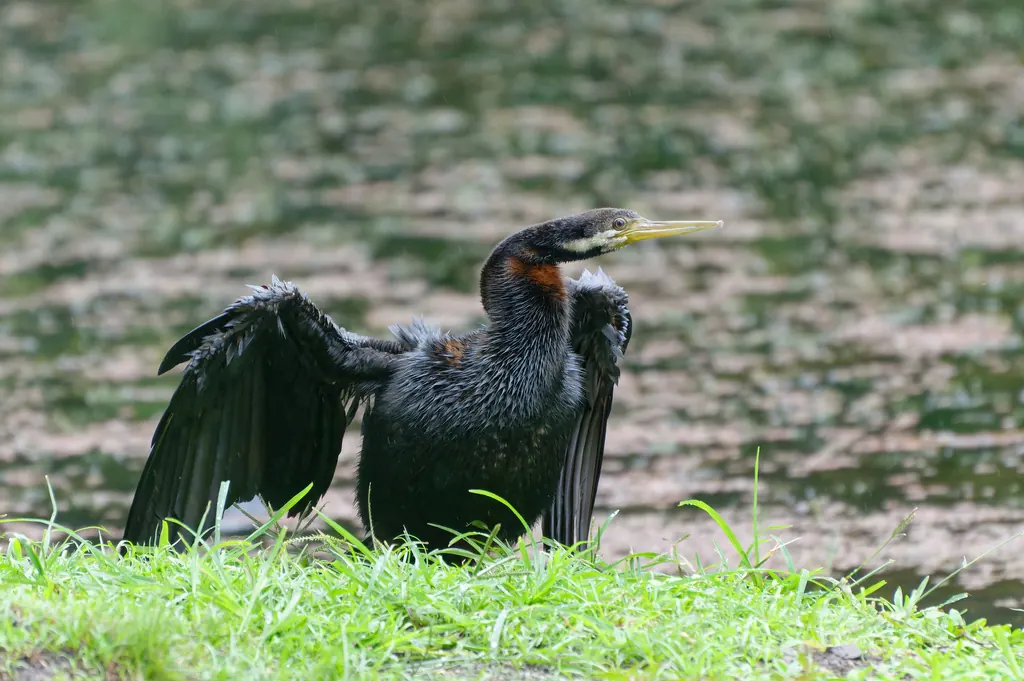
The dictionary names the water birds by what they do: dulku the 'white crane', which is the egret; biluwarra the 'spoon bill bird'; birmba the 'straw-necked ibis'; kalmbangarr the 'black diver bird', the cormorant or darter; juril-juril the 'seashore plover'; and kurrujuwa, the 'sentry bird which warns of crocodiles along the banks of the river'[1]. Each works a different depth and hour: the darter and cormorants under the water for fish, the egrets and herons stalking the edge by day, the night heron the same edge by night, the ibis and spoonbill the mud, the jabiru the deep shallows for the big fish, the pelican the open pool in a line[2][3][4][5][6][7]. Roth's hunters took them 'in the nesting season by sneaking upon them unawares', and at Boulia lured the pelican by throwing empty mussel shells on the water 'to some considerable distance' until the bird, thinking them jumping fish, swam within reach of a boomerang[8]. The sentry bird is the one to learn first.
Nothing is written for the Eastern coast on this page yet. What follows is true across the country.
Hann River Cape York
Possum People's country on the upper river and Thaypan (Kuku Thaypan) country downstream: stringybark and bloodwood woodland and a spring-fed sandy river that runs north-east from the Great Dividing Range, past the Peninsula Developmental Road, into Rinyirru (Lakefield) and the North Kennedy. Not Kuku Yalanji country: the Kuku Yalanji words on this page are the dictionary's, not the Hann's own languages. Place guide
The Hann runs down into Rinyirru (Lakefield) National Park, where 'Waterbirds include brolgas, sarus cranes, black-necked storks, magpie geese'[33]. The darter, the egrets, the ibises, the jacana and the jabiru are all common in the Atlas records around the middle Hann[34]. The people of this country stalked ducks and geese with a grass hat over the head, and the Kuku Thaypan have their own names for the water birds[8][35].
Where they are here
The Atlas of Living Australia holds thousands of water-bird records from a box of about 90 × 85 km around the middle Hann, Laura and western Rinyirru: masked lapwing 851, comb-crested jacana 693, brolga 688, great egret 660, green pygmy-goose 643, darter 632, straw-necked ibis 488, radjah shelduck 465, jabiru 462, magpie goose 428, little pied cormorant 384, royal spoonbill 204, sarus crane 144 and pelican 84, from 1948 to 2026[34]. That box takes in Rinyirru's lagoons and far more water than the Hann, so read it as 'these birds live in this country', not as a map of the river. The brolga and the sarus crane and the magpie goose and the ducks have their own pages.
Their year here
In the wet (December to March) the rivers flood across the plains, and 'animals disperse far and wide as food and water is plentiful'; from about April the floodplains and wetlands dry out, and by October 'the land is brown and parched'[33]. The Hann itself never stops: its gauge has not recorded a day without flow since 1968, and by the late dry it runs low and clear between deep holes[36][37]. That is when the birds that need water come back to the permanent holes and lagoons. Fire matters too. In the Kuku Thaypan Elders' cool burns most grasshoppers and other insects fly off the grass, and 'Those unfortunate enough to be too slow provide a food resource for brolgas'; Standley photographed brolgas foraging on a fresh burn[35].
How people hunted them here
Princess Charlotte Bay hinterland and the Palmer, c. 1900. Roth: 'ducks, geese, and similar game are all stalked and speared — usually with the ordinary simple-point spear if on land, but commonly with a pronged one if on water.' The hunter 'covers his head with a bundle of long grass, tied about near to its extremities into something like a horse-collar', holds a bunch of leafy switches in front, and glides through the water so that he 'looks for all the world like a tussock of grass floating down the stream'. On the plains he stalks on all fours behind the bushes instead[8].
Laura, c. 1900. 'In the neighbourhood of the Laura, also at Cape Bedford and elsewhere, ducks can be caught by silently diving under them in the water and pulling them down'[8].
Kuku Thaypan Elders, 2000s. The Elders remember that bird numbers and diversity were higher across their wetlands when they were young, and the signs of healthy country listed in Standley's fire research include 'an increase in flocks of Magpie Geese during migration and throughout the year'[35]. They tell stories about the jabiru, the ibises and other water birds; those stories belong to their custodians. Goose is one of the Thaypan clans[38].
On country today
The upper Hann is the Possum People's country[39]; the middle and lower Hann are Thaypan country, determined in November 2023[38]. Rinyirru is jointly managed by the Rinyirru Aboriginal Corporation and the Queensland Government[33]. Native birds are protected; native title holders may hunt for personal, domestic and non-commercial communal needs without the licences others need[40].
Language
Kuku Thaypan (Awu Alaya) names recorded with the Elders: Nhye geaba brolga, Nhye chiilpa jabiru, Nhye Wann magpie goose, Nhye Pulkin pelican, Nhye rou Pacific black duck, Nhye road 'Snake neck darter', Nhye woongara Burdekin duck (the radjah shelduck) and chiyen pygmy goose[35]. These are Kuku Thaypan words, not Kuku Yalanji.
Upper Mitchell Western Yalanji
Western Yalanji country west of the Great Dividing Range: dry open woodland cut by the sandy, paperbark-lined upper Mitchell River, around Karma Waters and Mount Carbine. Place guide
The pools of the Mitchell at Karma Waters carry the whole set: the pelican, fifteen records within 30 km, the darter and two cormorants, the great egret and three herons, the straw-necked and white ibises, the royal spoonbill, the black-necked stork or jabiru, the jacana walking the lily pads, the grebe, the coot, the masked lapwing and the dotterel on the sand[41].
The birds on the record here
Records within 30 km of Karma Waters. The Atlas of Living Australia list for the station's country: straw-necked ibis 37, the commonest water bird in the Karma Waters list; great egret 29; white-necked heron 28; white-faced heron 28; darter 27; masked lapwing 23; comb-crested jacana 22; little pied cormorant 19; coot 18; little black cormorant 17; pelican 15; white ibis 12; black-fronted dotterel 11; grebe 9; night heron 8; intermediate egret 8; royal spoonbill 7; jabiru 5[41].
Where they are here
The long dry-season pools of the Mitchell and the lagoons off it, the sand and mud edges, the snags, and the paperbark and gum fringe where the darter, the herons and the night heron roost and nest[42].
Hunting rules here
Section 211 of the Native Title Act 1993 is recognised in the Western Yalanji determinations[43].
On country today
The straw-necked ibis, the egret, the darter and the lapwing are on the Karma Waters pools every day of the dry, and the jabiru is on the big lagoons; the station's river camps look straight at them[41][44]. Which bird the Western Yalanji call the sentry, and their names for the rest, are for the contribution box below[1].
Everywhere
Names
dulku 'white crane', which is how the great egret and the other white egrets were named in English too. biluwarra 'spoon bill bird'. birmba 'straw-necked ibis', also bujil-yiran. kalmbangarr 'black diver bird', the cormorants and the darter. juril-juril 'seashore plover', the lapwings and dotterels of the sand. kurrujuwa 'sentry bird which warns of crocodiles along the banks of the river'; the dictionary does not say which bird, and the masked lapwing, which 'is always alert and, even though it rests, it never sleeps properly', and gives its 'warning call' at anything that moves on the bank, is the obvious candidate[1][9]. bidu-bidu 'bank bird'; dikal 'bird'; diwalngku 'migratory bird'[1].
The water birds
Pelican (Pelecanus conspicillatus). 'Medium-sized by pelican standards, with a wingspan of 2.3 to 2.6 m. Weight can range from 4 to 13 kg'; 'predominantly white in colour', the pouch pink and turning 'dark blue, pink and scarlet' in courtship. 'Australian pelicans occur primarily in large expanses of open water without dense aquatic vegetation ... large lakes, reservoirs, billabongs and rivers'; they 'follow no particular schedule of regular movement, simply following the availability of food supplies'[7]. Roth's Boulia method: the hunter 'will sit in the water, in ambush, under cover of the bushes or suitable overhanging tree, etc., and throw empty mussel shells one after another to some considerable distance in the water. The bird, thinking that these are fish "jumping" on the surface, comes closer to inspect: at the same time the concealed and otherwise immoveable individual taps the water with his fingers to mimic fish splashing ... and, when arrived close enough, is either hit with a boomerang or sometimes even caught with the hands'[8].
Darter (Anhinga novaehollandiae). 'A slim bird measuring 86–94 cm long with a snakelike slender neck. The male has black plumage with a white streak down the side of its head and neck, while the female has white underparts.' 'Typical habitat is freshwater or brackish wetlands more than 0.5 m deep with fallen trees or logs and vegetated banks'. 'The Australasian darter forages in water, often with only its head and neck exposed. Its feathers soak up water in spaces between them, allowing the bird to reduce its natural buoyancy and swim underwater. It eats a wide variety of fish such as Australian smelt, bony bream' and has been photographed 'eating a northern saratoga'[2].
Cormorants. The little pied cormorant (Microcarbo melanoleucos), 'a small cormorant measuring 56–58 cm', black above and white below, 'a benthic feeder, i.e. it finds its prey on the sea floor. It is a solitary feeder, normally diving in relatively shallow water, often near the shore. Dive times are short, around 15 to 20 seconds', and it takes a high proportion of crayfish and prawns[10][11]. The little black cormorant (Phalacrocorax sulcirostris), 'measuring 60–65 cm with all black plumage', 'more gregarious than other cormorants ... can be found in large flocks', 'feeds mainly on fish' and fishes as a flock, driving the shoals[12].
Herons and egrets. The great egret (Ardea alba, dulku), 'a large, widely distributed' white heron that stalks the shallows[13]. The white-necked heron (Ardea pacifica), 'a large, diurnal, long-legged waterbird ... mostly slate-grey to black with distinctive black spots in the centre of the lower fore-neck and throat', with 'an elongated neck and beak designed to reach out and catch fish, frogs, spiders and other food animals'; 'nomadic like most water birds in Australia, moving from one water source' to the next[3]. The white-faced heron (Egretta novaehollandiae), 'medium-sized, pale, slightly bluish-grey, with yellow legs and white facial markings', 'almost anywhere near shallow water, fresh or salt', 550 g and 60–70 cm[14]. The nankeen night heron (Nycticorax caledonicus), 'a medium-sized heron', 55–65 cm, rufous-backed with a black cap and 'a heavy black bill', which roosts in the river trees by day and fishes the edges by night[4].
Ibises and spoonbill. The straw-necked ibis (Threskiornis spinicollis, birmba): 'large birds, around 59–76 cm long, with a bare black head and a long, downcurved black bill. They have a distinctive, highly iridescent plumage', with straw-yellow plumes on the neck; 'found around shallow freshwater wetlands, cultivated pastures, edges of swamps and lagoons, and wet or dry grasslands ... extremely nomadic', and a famous grasshopper-eater of the paddocks[15]. The Australian white ibis (T. molucca), 'around 65–75 cm long and has a bald black head and neck and a long black downcurved beak', with 'a long croak'[16]. The royal spoonbill (Platalea regia, biluwarra), 'a large, white bird with a black, spoon-shaped bill ... approximately 80 cm tall', which feeds by 'sweeping its bill through shallow water and swallowing prey once detected', the bill 'open about 2 to 4 cm, sweeping an arc of around 100 degrees in front of the bird'[5].
Jabiru, the black-necked stork (Ephippiorhynchus asiaticus). 'A large bird, 110–137 cm tall having a 190–218 cm wingspan', black-and-white with an iridescent black neck and red legs, photographed in Queensland 'with a small barramundi'; it hunts the shallows for fish, eels, frogs and crabs and builds a big stick nest in a tall tree[17][6].
The small ones. The comb-crested jacana (Irediparra gallinacea), 'the lotusbird or lilytrotter', which 'eats seeds and aquatic insects gleaned from floating vegetation on the water surface'[18]. The Australasian grebe (Tachybaptus novaehollandiae), 'a small waterbird common on fresh water lakes and rivers', which 'if disturbed ... will dive and re-surface 10–15 metres away rather than fly' and carries its chicks on its back[19]. The Eurasian coot (Fulica atra), black with a white bill and shield, 'a noisy bird with a wide repertoire of crackling, explosive, or trumpeting calls, often given at night'[20]. The masked lapwing (Vanellus miles), 'a large, common and conspicuous bird' with 'a conspicuous yellow spur on the carpal joint of each wing', which 'spends most of its time on the ground searching for food such as insects and worms', nests on bare ground and 'has a wide range of calls which can be heard at any time of the day or night: the warning call, a loud defending call'[9]. The black-fronted dotterel (Elseyornis melanops), 16–18 cm, 'a distinct black face mask, forehead and v-shaped band across the chest', which 'live[s] along the edges of freshwater sources' and forages 'in a series of short running motions'[21].
Telling them at a distance
- Darter: swims with only the snake neck showing, spears fish, dries its wings spread on a snag; a long fan tail[2].
- Cormorants: swim low, dive from the surface, sit on snags with wings out; the pied one has a white front, the black one is black and fishes in flocks[10][12].
- Egrets: white, stalking; the great egret with a kinked neck as long as its body[13].
- White-necked heron: dark body, white neck, spotted throat; white-faced heron: blue-grey with a white face and yellow legs[3][14].
- Night heron: hunched, rufous and black-capped, in the trees by day[4].
- Ibises: a curved black bill; the straw-necked with a dark glossy back, the white ibis white[15][16].
- Spoonbill: white with a black spoon, sweeping[5].
- Jabiru: huge, black-and-white, red legs, alone[17].
- Cranes: grey with a red head, flying with the neck straight; the herons fold theirs[22].
- Jacana: walking on the lily pads on enormous toes; grebe: a small diver that vanishes; coot: black with a white bill; lapwing: yellow face and wing spurs, screaming; dotterel: tiny, running on the sand[18][19][20][9][21].
Signs
- The sentry bird's call on the bank, kurrujuwa: something is moving in the water or on the bank[1][9].
- Birds working one pool hard in the late dry: the fish are concentrated there; the cormorants and darter show where the spangled perch are[23].
- A darter spread-eagled on a snag drying its wings[2].
- A white egret at a crocodile's back, picking the insects; and an egret that will not go near one end of a pool[24].
- Mussel-shell piles opened by birds on a bank; see mussels[25].
- A stick nest the size of a table in a tall river tree: the jabiru[17].
- Night-heron croaks over the camp after dark[4].
Where they are
Open fresh water and its edges: deep water with snags for the darter, open water for the pelican, the shallow wetlands and swamp edges for the ibises, and shallow water anywhere for the herons[2][7][15][14]. The waterhole page has the pools' year; the straw-necked ibis and the lapwing are as much on the paddocks and burnt flats as on the water[15][9].
Who fishes when
The pool is fished in shifts. By day the darter and the cormorants are under it, taking bony bream, spangled perch, rainbowfish and small saratoga, the pied cormorant more prawns and cherabin; the egrets and herons stand the edge for small fish and frogs; the ibis and spoonbill work the mud for the insects, snails and crayfish; the jabiru takes the eels, the big fish and the turtles' hatchlings; the pelicans fish the open water in a line[2][10][3][5][6][7][26]. After dark the night heron takes the edge and the mouth almighty, the sleepy cod and the prawns come out under it[4]. The freshwater crocodile takes the birds that come too close, the sea eagle and the kites take the chicks and the injured, and the goanna takes the ground nests; the lapwing's spurs and screaming are against all three[9][27]. The late dry, when the pools shrink and the fish are crowded, is when every one of these birds is on the river at once, and the shrinking is why they are here[28].
Seasons
Nesting with the wet, in colonies in the river trees and reeds, which is 'the nesting season' of Roth's note; the birds spread across the flooded country then and come back to the pools as they shrink, until the late dry crowds them all together[8][28]. The nomads, the ibis, the white-necked heron and the pelican, come and go with the water across the north[15][3][7]. See the year on country.
Uses
- Meat and eggs, taken 'in the nesting season by sneaking upon them unawares'[8].
- The pelican, lured with mussel shells and taken with a boomerang or by hand[8].
- Feathers: the egret's plumes and the pelican's for ornament; the spear-decorating feathers of the camp[29].
- Fish-finders: the birds show where the fish are concentrated[23].
- Sentries: the lapwing's alarm is the crocodile warning the dictionary names[1].
Reading the water birds
- Listen to the sentry. When the kurrujuwa on the bank starts up and will not stop, look at the water before you look at anything else[1][9].
- Follow the cormorants to the fish; a flock of little black cormorants driving a pool is a shoal of spangled perch or bony bream in it[12].
- Watch the egrets' line: the shallows they stand in are the shallows the fish use at dusk, and where to set a trap[13].
- For a pelican, Roth's lure: sit still in cover and throw mussel shells out, farther then nearer, tapping the water; the bird comes to the 'jumping fish'[8].
- Eggs from the colony in the wet, leaving most; the colonies are small on an inland river[8].
- Never under a jabiru's tree in the breeding season; the bird is big and the nest is its own.
Safety
- Native birds are protected wildlife in Queensland under the Nature Conservation Act 1992; native title holders hunting for personal, domestic or non-commercial communal needs are covered by section 211 of the Native Title Act 1993[30][31].
- Water-bird country is crocodile country; the egret at the water's edge is not a sign that the edge is safe[24][32].
- A jabiru's bill and a pelican's are weapons; a cornered bird strikes at the eyes.
- The night heron croaking over the camp is not an omen; the lapwing screaming at 2 a.m. is usually a dingo.
On Country today
Which bird each community calls the sentry, and the local names of the rest, are for the contribution box below[1].
Language
dulku 'white crane'; biluwarra 'spoon bill bird'; birmba, bujil-yiran 'straw-necked ibis'; kalmbangarr 'black diver bird'; juril-juril 'seashore plover'; kurrujuwa 'sentry bird'; bidu-bidu 'bank bird'; dikal 'bird'; diwalngku 'migratory bird'; kulbal 'brolga'; nili-nili 'duck'; ngawurr-ngawun 'freshwater crocodile'[1].
References
- Hershberger, H. D. & Hershberger, R. (1982). Kuku-Yalanji Dictionary. Work Papers of SIL-AAB, Series B, Volume 7. With Toby Bloomfield, Roy Friday, Billy Roberts, Hector and Doris Sykes, Joe Walker and others. www.sil.org/resources/archives/18038
- Wikipedia. Australasian darter (Anhinga novaehollandiae). en.wikipedia.org/wiki/Australasian_darter
- Wikipedia. White-necked heron (Ardea pacifica). en.wikipedia.org/wiki/White-necked_heron
- Wikipedia. Nankeen night heron (Nycticorax caledonicus). en.wikipedia.org/wiki/Nankeen_night_heron
- Wikipedia. Royal spoonbill (Platalea regia). en.wikipedia.org/wiki/Royal_spoonbill
- Australian Museum. Black-necked Stork: feeding and diet. australian.museum/learn/animals/birds/black-necked-stork/
- Wikipedia. Australian pelican (Pelecanus conspicillatus). en.wikipedia.org/wiki/Australian_pelican
- Roth, W. E. (1901). North Queensland Ethnography, Bulletin No. 3: Food — its search, capture, and preparation. Brisbane: Government Printer. Bloomfield River information from the Hislops. — Sect. 6 'Cooking'; plant list ('Castanospermum australe', 'Dioscorea sativa', 'Elettaria Scottiana', 'Nymphaea') archive.org/details/northqueensland00landgoog
- Wikipedia. Masked lapwing (Vanellus miles). en.wikipedia.org/wiki/Masked_lapwing
- Wikipedia. Little pied cormorant (Microcarbo melanoleucos). en.wikipedia.org/wiki/Little_pied_cormorant
- Australian Museum. Little Pied Cormorant: feeding and diet. australian.museum/learn/animals/birds/little-pied-cormorant/
- Wikipedia. Little black cormorant (Phalacrocorax sulcirostris), citing Miller (1979), Wildlife Research 6: 79–95. en.wikipedia.org/wiki/Little_black_cormorant
- Wikipedia. Great egret (Ardea alba). en.wikipedia.org/wiki/Great_egret
- Wikipedia. White-faced heron (Egretta novaehollandiae). en.wikipedia.org/wiki/White-faced_heron
- Wikipedia. Straw-necked ibis (Threskiornis spinicollis). en.wikipedia.org/wiki/Straw-necked_ibis
- Wikipedia. Australian white ibis (Threskiornis molucca). en.wikipedia.org/wiki/Australian_white_ibis
- Wikipedia. Black-necked stork (Ephippiorhynchus asiaticus). en.wikipedia.org/wiki/Black-necked_stork
- Wikipedia. Comb-crested jacana (lotusbird, lilytrotter). en.wikipedia.org/wiki/Comb-crested_jacana
- Wikipedia. Australasian grebe (Tachybaptus novaehollandiae). en.wikipedia.org/wiki/Australasian_grebe
- Wikipedia. Eurasian coot (Fulica atra). en.wikipedia.org/wiki/Eurasian_coot
- Wikipedia. Black-fronted dotterel (Elseyornis melanops). en.wikipedia.org/wiki/Black-fronted_dotterel
- Wikipedia. Brolga (Antigone rubicunda). en.wikipedia.org/wiki/Brolga
- Lintermans, M. (2023). Fishes of the Murray–Darling Basin, second edition. Australian River Restoration Centre, Canberra. Species account: spangled perch, Leiopotherapon unicolor (extract at mdb.fish). www.mdb.fish/fish-fact-sheets/spangled-perch
- Queensland Government. Be Crocwise top tips; Be Crocwise in Croc Country (web pages, accessed 5 October 2026). www.qld.gov.au/environment/plants-animals/animals/living-with/crocodiles/becrocwise/be-crocwise-top-tips
- Wikipedia. Azure kingfisher (Ceyx azureus). en.wikipedia.org/wiki/Azure_kingfisher
- Jardine, T. D., Pettit, N. E., Warfe, D. M., Pusey, B. J., Ward, D. P., Douglas, M. M., Davies, P. M. & Bunn, S. E. (2012). Consumer–resource coupling in wet–dry tropical rivers. Journal of Animal Ecology 81: 310–322. Mitchell River sites sampled in the early dry season. doi.org/10.1111/j.1365-2656.2011.01925.x
- Wikipedia. Wedge-tailed eagle. en.wikipedia.org/wiki/Wedge-tailed_eagle
- Stewart-Koster, B., O'Mara, K., et al. (2021). Critical water needs to sustain freshwater ecosystems and aquatic biodiversity in Queensland's Mitchell River. Griffith University / NESP Northern Australia Environmental Resources Hub. era.dpi.qld.gov.au/id/eprint/8432/1/Critical-water-needs-for-the-Mitchell-River-final-report.pdf
- Anderson, C. (1996). Traditional material culture of the Kuku-Yalanji of Bloomfield River, North Queensland. Records of the South Australian Museum 29(1): 63–83. Based on fieldwork at Wujal Wujal in the late 1970s and early 1980s. — Hunting (spears, spear-throwers, harpoons); fishing (stupefacients); manufacturing (gums and resins); post-contact bush component archive.org/details/RecordsSouthAus29Sout
- Queensland Government, State of the Environment. Nature Conservation Act 1992. www.stateoftheenvironment.des.qld.gov.au/biodiversity/management-responses/legislation/nature-conservation-act-1992
- Australian Law Reform Commission. Review of the Native Title Act 1993 (DP 82), ch. 8: Relevant provisions in the Native Title Act (s 211). www.alrc.gov.au/publication/review-of-the-native-title-act-1993-dp-82/8-the-nature-and-content-of-native-title/relevant-provisions-in-the-native-title-act/
- Karma Waters Station. About: location, native title (web page, accessed 5 October 2026). www.karmawatersstation.com/about.html
- Queensland Parks and Wildlife Service. Nature, culture and history: Rinyirru (Lakefield) National Park (CYPAL) (web page, last updated 1 July 2024; accessed 28 October 2026). parks.qld.gov.au/parks/rinyirru-lakefield/about/culture
- Atlas of Living Australia. Occurrence records of water birds, by species: masked lapwing (Vanellus miles) 851 records (1958–2026); comb-crested jacana (Irediparra gallinacea) 693 (1958–2026); brolga (Antigone rubicunda) 688 and sarus crane (A. antigone) 144 (1967–2026); great egret (Ardea alba) 660 (herons and egrets 1958–2026); green pygmy-goose (Nettapus pulchellus) 643 and radjah shelduck (Radjah radjah) 465 (ducks and geese 1948–2026); darter (Anhinga novaehollandiae) 632 (1976–2026); straw-necked ibis (Threskiornis spinicollis) 488 and royal spoonbill (Platalea regia) 204 (ibises and spoonbills 1958–2025); jabiru (Ephippiorhynchus asiaticus) 462 (1963–2026); magpie goose (Anseranas semipalmata) 428 (1948–2026); little pied cormorant (Microcarbo melanoleucos) 384 (cormorants 1958–2025); pelican (Pelecanus conspicillatus) 84 (1977–2025) in a box of about 90 × 85 km around the middle Hann River, Laura and western Rinyirru (lat −15.6 to −14.8, long 143.5 to 144.3), queried 28 October 2026. biocache.ala.org.au/occurrences/search?q=class%3AAves&fq=decimalLatitude%3A%5B-15.6%20TO%20-14.8%5D&fq=decimalLongitude%3A%5B143.5%20TO%20144.3%5D
- Standley, P.-M. (2019). The importance of campfires to effective conservation. PhD thesis, James Cook University. Records the fire and country knowledge of Kuku Thaypan Elders Dr Tommy George and Dr George Musgrave. researchonline.jcu.edu.au/64274/
- Bureau of Meteorology, Water Data Online. Station 105001B, Hann River at Sandy Creek: daily and monthly mean discharge 1968–2026 (recent data provisional), retrieved 28 October 2026. No day of zero mean flow in 20,711 days of record; mean flow highest in February–March, lowest in September–November. www.bom.gov.au/waterdata/
- Queensland Government, WetlandInfo. Normanby catchment story: physical features (springs and base flow). wetlandinfo.detsi.qld.gov.au/wetlands/ecology/processes-systems/water/catchment-stories/normanby/norm-physical.html
- Ross on behalf of the Cape York United #1 Claim Group v State of Queensland (No 20) (Thaypan determination) [2023] FCA 1315 (Federal Court of Australia, 2 November 2023). — Determination area and waters; prescribed body corporate (Awu-Laya Indigenous Corporation); affidavit evidence on hunting www.judgments.fedcourt.gov.au/judgments/Judgments/fca/single/2023/2023fca1315
- Ross on behalf of the Cape York United #1 Claim Group v State of Queensland (No 21) (Possum determination) [2023] FCA 1316 (Federal Court of Australia, 2 November 2023). — Determination area (upper Hann and Kennedy rivers); prescribed body corporate; affidavit evidence on hunting and fishing www.judgments.fedcourt.gov.au/judgments/Judgments/fca/single/2023/2023fca1316
- Native Title Act 1993 (Cth), section 211: preservation of certain native title rights and interests (hunting, fishing and gathering for personal, domestic or non-commercial communal needs). www.legislation.gov.au/C2004A04665/latest/text
- Atlas of Living Australia. Bird (Aves) occurrence records within 30 km of the Karma Waters homestead (16.62° S, 144.60° E), species counts (accessed 10 October 2026). biocache.ala.org.au/occurrences/search?q=*:*&lat=-16.62&lon=144.60&radius=30&fq=class:Aves
- Queensland Herbarium, Regional Ecosystem 9.3.14 (Einasleigh Uplands): Melaleuca fringing woodland on channels and levees. Fire management guidelines. Queensland Government Regional Ecosystem Description Database. apps.des.qld.gov.au/regional-ecosystems/details/?re=9.3.14
- Western Yalanji Aboriginal Corporation & CRC for Developing Northern Australia (2020). Western Yalanji Land Use and Economic Diversification Plan. CC BY 4.0. — Native Title Determinations 1–4 (pp. 13–18); ‘Fire Management and Carbon Farming’ (pp. 32–33); ‘Pastoralists’ crcna.com.au/wp-content/uploads/2024/05/westernyalanjilanduseplan_nov2020.pdf
- Karma Waters Station. Bush Camping at Karma Waters Station (web page, accessed 5 October 2026). www.karmawatersstation.com/bush-camping.html
From the community
Know this one? Add the words you use for it, what it is for, how it is done, a correction, or a photo from country. It shows here straight away with your name on it. Please keep anything restricted or sacred off the site.
Loading…