Trees
Stinging tree
miliDendrocnide spp. (D. moroides, D. cordifolia, D. photinophylla)
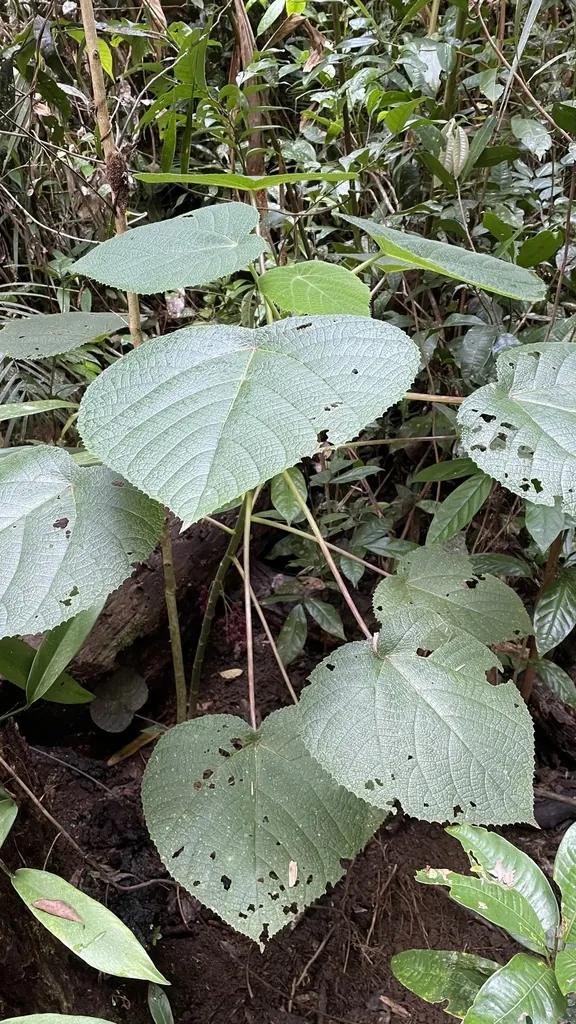
Mili is the stinging tree[1]: the Dendrocnide shrubs and trees of the rainforest, whose leaves and stems are covered in fine glassy hairs that inject a pain-causing toxin[2]. A bad sting from the gympie stinger 'can last for months'[3]. Kuku Yalanji use the same word for jellyfish, 'because they also burn'[1]. This page is mostly about knowing it, avoiding it and treating a sting. A 1975 film shows that Kuku Yalanji healers had their own treatment for it[4].
Names
The dictionary has mili twice, as 'sting tree' and as 'stinging tree', with the added sense 'jellyfish (because they also burn)'[1]. For jellyfish it also gives kulil and wuybur, listed as synonyms of mili. A related plant word is waji-waji 'stinging vine'[1]. The dictionary does not say which stinging-tree species mili covers. Most likely it covers all of them, since several grow on Kuku Yalanji country (see below).
Description
Stinging trees belong to the nettle family. Three kinds grow in the northern rainforests:
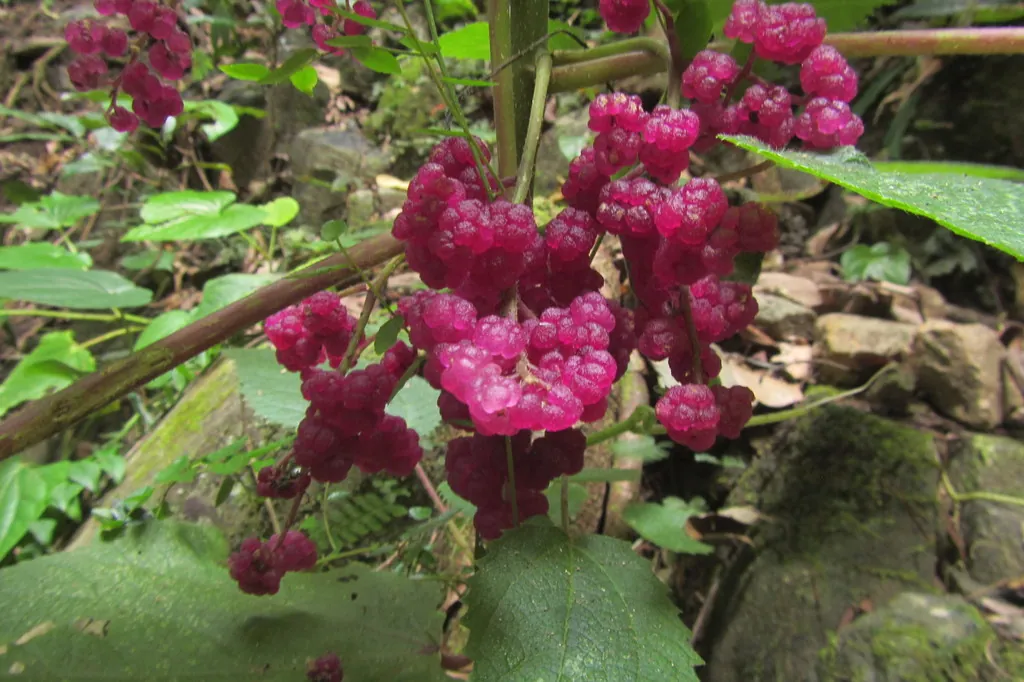
- Gympie stinger (Dendrocnide moroides). A shrub 1–3 m tall with big, roundish leaves 12–22 cm long. The leaf stalk joins the blade inside its edge. Twigs, stalks and both leaf surfaces are 'clothed in stinging hairs which inflict long-lasting pain'. The fruits are clusters of tiny nuts on swollen, watery, fleshy stalks[3].
- D. cordifolia. A shrub 1–4 m tall with large leaf blades about 16–22 cm across on long stalks. It is just as hairy and just as painful[5].
- Shining-leaved stinger (D. photinophylla). A tree with smaller leaves, 8–12 × 4–6 cm, and very soft, light wood. It has stinging hairs mostly on young trees, and its sting 'is not as bad as that of D. moroides or D. cordifolia and does not last very long'. Its fruit sits on a swollen white fleshy base[6].
The stinging hairs are hollow trichomes about 5 mm long that 'act like hypodermic needles' and inject toxins into the skin[2]. In 2020, University of Queensland scientists found that the main toxins, which they named gympietides, are small proteins folded like spider and cone-snail venoms. They act on the same pain nerves, which may explain why the pain lasts so long[2].
Where it grows
The gympie stinger grows from Cape York Peninsula to north-eastern New South Wales, from near sea level to 900 m. It is typically found in disturbed rainforest: gaps, tracks and ground torn up by logging[3]. D. cordifolia grows only in North East Queensland, between Townsville and Princess Charlotte Bay, at 100–1200 m. It too favours disturbed upland and mountain rainforest[5]. The shining-leaved stinger grows in well-developed rainforest but is 'probably more common in drier, more seasonal rain forest', from near sea level to 800 m in the north[6]. So on Kuku Yalanji country, expect stinging trees wherever rainforest has been opened up: track edges, creek banks after floods, treefall gaps and old logging ground.
Western Yalanji country. Stinging trees are rainforest plants. In the dry open woodland of the Mitchell and Palmer country they are absent[3][5]. You may meet them only in rainforest remnants and vine scrubs on the ranges and in sheltered gullies, where the shining-leaved stinger is the likeliest[6].
The gympie stinger is a food plant for the caterpillars of the White Nymph butterfly[3].
Uses and knowledge
For Bama the most important knowledge about mili is where it grows and how to keep clear of it. The dictionary's use of the same word for jellyfish shows how the burning sting itself defines the plant[1].
A 1975 documentary on bush cures still used by Kuku-Yalanji people shows a traditional doctor using the leaves of the six o'clock bush for ringworm, green ants for a cold, and 'the stinging tree to provide its own cure'[4]. The catalogue does not describe the method. It is knowledge to learn from Kuku Yalanji healers, not from a book.
No food, fibre or timber use of stinging trees appears in the Bloomfield records of Roth and Anderson[7].
How to avoid it, and what to do if stung
Avoiding it:
- Learn the look: broad, roundish, soft-looking leaves on long stalks, with every surface fuzzed with fine hairs[3][5].
- Take most care in gaps, track edges and disturbed ground, where the worst species grow[3].
- Never brush past, grab or slash it. Even disturbing the plant can set off fits of sneezing and a heavy runny nose[3].
- Watch children and dogs on rainforest tracks.
If you are stung (Australian Government first-aid advice)[8]:
- Do not scratch or rub the area. Rubbing breaks off the hairs and makes them very hard to remove.
- Pull the hairs out with hair-removal wax strips from a supermarket or chemist. Press on, then strip off. Repeat with fresh strips.
- Do not use liquid or hot wax directly on the skin. It breaks the hairs and makes the pain worse.
- See a doctor after any stinging-tree sting.
- Call 000 for trouble breathing, a swollen throat or ongoing dizziness.
Doctors at Cairns Hospital have studied stinging-tree cases, including whether dilute hydrochloric acid applied to the skin helps. That is a hospital treatment, not bush first aid[9]. Carrying wax strips is good sense anywhere stinging trees grow[8].
Safety
Treat every stinging tree as dangerous. The gympie stinger's sting can last for months. A big sting over a wide area can stop a person sleeping and make the skin weep fluid. Pain can spread to the lymph glands[3]. D. cordifolia is as bad: 'major stings cause the affected tissue to exude lymph and pains are experienced in lymph glands in the armpit or groin'[5]. Australian stinging trees can cause symptoms that last days or weeks, much longer than European nettles[2]. Only the shining-leaved stinger is milder[6]. Stings are common enough that Cairns Hospital has studied the cases it treats[9]. Mili also means the jellyfish that burn[1]. In the sea, follow local marine-stinger warnings.
On Country today
Stinging trees thrive along the opened-up edges of rainforest tracks[3]. Much of the Daintree and Mossman Gorge rainforest is now in national parks returned to Eastern Kuku Yalanji ownership on 29 September 2021 and jointly managed with the Queensland Government[10]. Walking on country with Kuku Yalanji guides is the safest way to learn where mili grows. Native title rights to gather and carry out cultural activities are protected by s 211 of the Native Title Act 1993[11]. Visitors need Traditional Owners' permission to go off track, and park rules apply.
Language
mili 'stinging tree; jellyfish'; kulil and wuybur 'jellyfish'; waji-waji 'stinging vine'; jalngkay 'itch'; bajaybajay 'painful'[1].
Images
References
- Hershberger, H. D. & Hershberger, R. (1982). Kuku-Yalanji Dictionary. Work Papers of SIL-AAB, Series B, Volume 7. With Toby Bloomfield, Roy Friday, Billy Roberts, Hector and Doris Sykes, Joe Walker and others. www.sil.org/resources/archives/18038
- Institute for Molecular Bioscience, University of Queensland (17 September 2020). 'Native stinging tree toxins match the pain of spiders and scorpions', reporting Gilding, E. K. et al. (2020), Science Advances. imb.uq.edu.au/article/2020/08/native-stinging-tree-toxins-match-pain-spiders-and-scorpions
- Australian Tropical Rainforest Plants (RFK8), Dendrocnide moroides (gympie stinger). CSIRO / Lucidcentral. apps.lucidcentral.org/rainforest/text/entities/dendrocnide_moroides.htm
- National Film and Sound Archive of Australia, catalogue record for a 1975 documentary on bush cures used by Kuku-Yalanji people of North Queensland (title 0FRV46ZB). pro.nfsa.gov.au/titles/0FRV46ZB
- Australian Tropical Rainforest Plants (RFK8), Dendrocnide cordifolia (stinger). CSIRO / Lucidcentral. apps.lucidcentral.org/rainforest/text/entities/dendrocnide_cordifolia.htm
- Australian Tropical Rainforest Plants (RFK8), Dendrocnide photinophylla (shining-leaved stinger). CSIRO / Lucidcentral. apps.lucidcentral.org/rainforest/text/entities/dendrocnide_photinophylla.htm
- Anderson, C. (1996). Traditional material culture of the Kuku-Yalanji of Bloomfield River, North Queensland. Records of the South Australian Museum 29(1): 63–83. Based on fieldwork at Wujal Wujal in the late 1970s and early 1980s. archive.org/details/RecordsSouthAus29Sout
- healthdirect Australia (Australian Government), 'Stinging plants': first aid for stinging tree (gympie-gympie) stings. www.healthdirect.gov.au/stinging-plants
- Young, R., Jackson, A., Ryan, F. & Little, M. (2023). STRETCH: Stinging tree exposures to Cairns Hospital. Emergency Medicine Australasia. dora.health.qld.gov.au/qldresearchjspui/handle/1/5126
- Queensland Government (29 September 2021). Ministerial media statement: Daintree, Ngalba-bulal, Kalkajaka and Hope Islands National Parks returned to Eastern Kuku Yalanji Traditional Owners as Cape York Peninsula Aboriginal Land, to be jointly managed. statements.qld.gov.au/statements/93360
- Australian Law Reform Commission (2014). Review of the Native Title Act 1993, Discussion Paper 82, ch. 8: Relevant provisions in the Native Title Act (s 211, preservation of native title hunting, fishing, gathering and cultural activities). www.alrc.gov.au/publication/review-of-the-native-title-act-1993-dp-82/8-the-nature-and-content-of-native-title/relevant-provisions-in-the-native-title-act/