Shellfish & crustaceans
Oysters
marrkabina · julul · juwarru · yulbaSaccostrea and other rock oysters
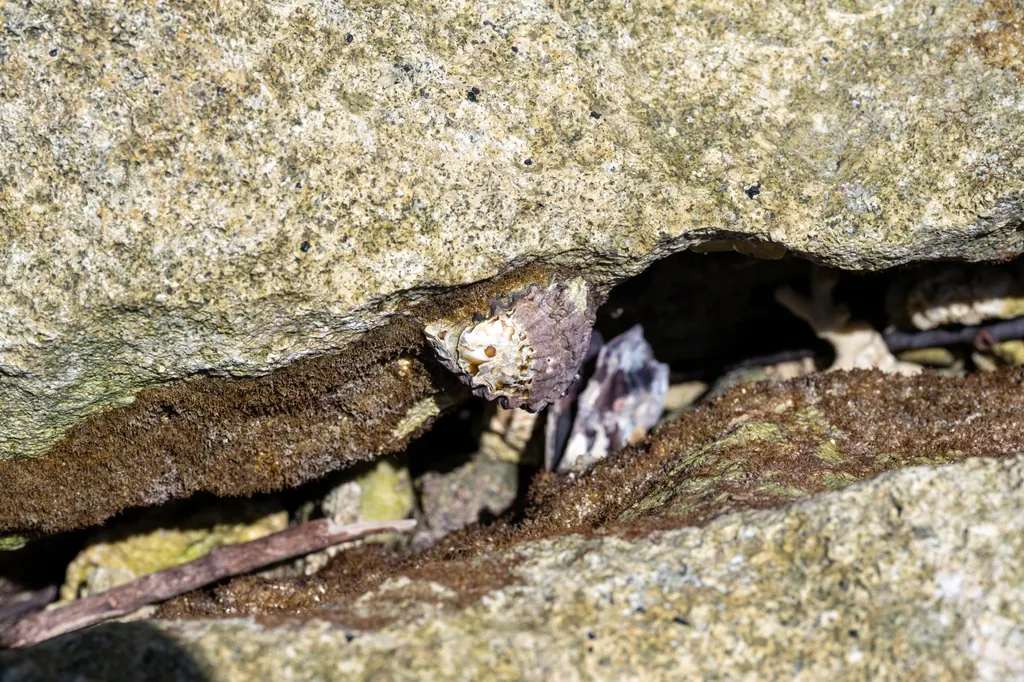
Seven words for oysters: marrkabina 'edible oyster'; julul 'kind of oyster, larger than juwarru'; juwarru 'mud oyster. It is like a barnacle, only it clings to rock and mangroves. Smaller and flatter than julul'; yulba 'large round oyster'; jirrum 'small oyster'; nikar 'species of shallow water oyster found on rock'; marku and marubu 'species of oyster'[1]. The rock oyster of this coast is Saccostrea, the hooded oyster, which 'cements itself to rocks or to the branches and roots of mangroves', grows to 8–12 cm in the Pacific, 'is a filter feeder' and 'is tolerant of a wide range of temperatures and salinities'[2]. Roth's rule for all shellfish was that 'the large majority of these shell-fish are roasted in the ashes: a few may be eaten raw', and that they were 'generally prepared by the women'; Anderson lists shellfish among the gathered foods at Bloomfield, with the oyster-growths of the reef and the creek mouths among the 'very important' areas of the Traditional Owners' plan[3][4][5]. This is a page of the sea country of the Eastern Kuku Yalanji, the Bloomfield and Daintree coast; it is a long way from Karma Waters on the upper Mitchell, and is here because the words, the trade and the tools reach inland.
Hann River Cape York
Possum People's country on the upper river and Thaypan (Kuku Thaypan) country downstream: stringybark and bloodwood woodland and a spring-fed sandy river that runs north-east from the Great Dividing Range, past the Peninsula Developmental Road, into Rinyirru (Lakefield) and the North Kennedy. Not Kuku Yalanji country: the Kuku Yalanji words on this page are the dictionary's, not the Hann's own languages. Place guide
No oysters live on the Hann. It is a freshwater river, and the Atlas of Living Australia holds no oyster records around the middle Hann[12]. The river's shellfish is the freshwater mussel: 'We get wallaby, barramundi, freshwater fish and turtles and mussels', a Thaypan man told the Federal Court[13].
The shellfish here
In a box of about 90 × 85 km around the middle Hann, Laura and western Rinyirru the Atlas holds just one bivalve record, a freshwater mussel (Velesunio angasi, 2000)[12]. Standley's work with the Kuku Thaypan Elders records that 'mussels were once larger and in high number across the entire wetland complex' of the Rinyirru lagoons, that they 'are periodically washed downstream during the wet', and that today 'mussels are no longer in abundant numbers'. Their signs of a healing lagoon include the 'Return of mussel numbers and increase in size'[14]. The rules about who may eat mussels from which places belong to the Elders' law and their families[14].
Down at the sea
The Hann's water reaches the sea in Princess Charlotte Bay[15], where mangroves fringe the coast: more than half of Cape York's low mangrove forest (regional ecosystem 3.1.2) grows in Rinyirru around the bay[16]. The shell mounds of the bay's mainland coast, between about 2,000 and 500 years old, are 'predominantly composed of the Anadara granosa shellfish species', the blood cockle, and older shell deposits in rock shelters go back about 4,700 years[17]. No published source names oysters among them.
Upper Mitchell Western Yalanji
Western Yalanji country west of the Great Dividing Range: dry open woodland cut by the sandy, paperbark-lined upper Mitchell River, around Karma Waters and Mount Carbine. Place guide
No oysters grow on the Western Yalanji Mitchell.
Here
There are no oysters at Karma Waters; the river's shellfish is the freshwater mussel.
Eastern coast Eastern Kuku Yalanji
Eastern Kuku Yalanji country: rainforest, beaches, mangroves, reef and the short steep rivers from the Daintree to the Bloomfield and the Annan.
The oysters of this page are the oysters of the Bloomfield and Daintree coast, the sea country of the Eastern Kuku Yalanji[5].
On country today
Oysters are gathered at low tide on the Bloomfield coast as they always were, and the eight dictionary words are a field guide waiting for its photographs; the contribution box below is for them[1].
Everywhere
Names
marrkabina 'edible oyster'; julul 'kind of oyster, larger than juwarru'; juwarru 'mud oyster ... clings to rock and mangroves. Smaller and flatter than julul'; yulba 'large round oyster'; jirrum 'small oyster'; nikar 'species of shallow water oyster found on rock'; marku 'species of oyster'; marubu 'species of oyster'; milbar 'generic term for shell'[1]. The dictionary sorts oysters by size and where they sit, which is how a gatherer sorts them.
The oyster
'The appearance and form of the hooded oyster is very variable. The shape is sometimes nearly circular or it may be oblong or roughly oval, often with an irregular outline. In the Mediterranean, it grows to 4 to 6 cm, but achieves double that size in the Pacific Ocean. The valves are thick and solid. The lower valve is convex and has no sculpturing near the umbo, which is fixed to the substrate. The upper valve is flat'. 'The hooded oyster is a filter feeder, pumping water through its gills and removing the phytoplankton. In polluted waters, it accumulates heavy metals in its tissues. For this reason it can be used as a bioindicator'. 'The hooded oyster is tolerant of a wide range of temperatures and salinities'. It 'cements itself to rocks or to the branches and roots of mangroves'[2].
On the Gulf islands Roth saw stone fish-weirs 'built of pieces of stone (subsequently locked together by oyster-growths)', which is how fast and how hard the oyster builds[3]. The estuary stingray 'has gained infamy for consuming farmed shellfish such as oysters', though it mainly eats crabs and worms[6].
Oyster, mussel, cockle
- Rock and mangrove oysters: cemented down, flat-lidded, irregular, in clusters[2].
- Saltwater mussels and the mangrove cockles (Geloina): two matching valves, held by threads in the mud or roots, not cemented[4].
- The big bailer and nautilus: not food on the rock but tools on the beach[7].
- Barnacles, which the dictionary's juwarru 'is like', are not shellfish at all[1].
Signs
Where they grow
Between the tides on rock and on mangrove roots, at creek mouths, on the headlands and the reef flats of the Bloomfield and Daintree coast and the islands; the Traditional Owners' plan names the reefs, mangroves and mudflats as the important areas[2][5].
The filter on the rock
The oyster filters the creek, cements the rocks and the weirs, and feeds the stingray, the crabs and the people; because it filters, it carries whatever is in the water, which is the one caution about eating it[2]. It sits in the mangroves' nursery with the mud crab, and the shell went into the earth oven ashes and the middens[3].
Seasons
Gathered at low tide in any season; the big spring low tides of the dry are the easiest; the shellfish 'generally prepared by the women'[3]. See the year on country.
Uses
Gathering oysters
From Roth and the dictionary[3][1]:
- Go at low tide (ngajal) to the rocks and mangrove roots at a creek mouth[1].
- Knock the big ones off with a stone or open them on the rock with a shell or a knife; the dictionary's julul and yulba are the ones worth the work[1].
- Roast them in the ashes until they open, 'the large majority of these shell-fish are roasted in the ashes', or eat the clean rock ones raw[3].
- Leave the small ones, jirrum, and the middens[1][8].
Safety
- Oysters concentrate what is in the water; none from a creek below a town, a drain or a boat ramp[2].
- Creek mouths and mangrove roots are crocodile country; Be Crocwise[9].
- Shell edges cut; boots and a glove.
- Taking shellfish on sea country comes under the Traditional Owners' plan, the Marine Park's traditional-use rules and the Fisheries Act 1994[5][10][11].
Language
marrkabina 'edible oyster'; julul, juwarru, yulba, jirrum, nikar, marku, marubu kinds of oyster; milbar 'shell'; ngajal 'low tide'[1].
References
- Hershberger, H. D. & Hershberger, R. (1982). Kuku-Yalanji Dictionary. Work Papers of SIL-AAB, Series B, Volume 7. With Toby Bloomfield, Roy Friday, Billy Roberts, Hector and Doris Sykes, Joe Walker and others. www.sil.org/resources/archives/18038
- Wikipedia. Saccostrea cucullata (hooded or rock oyster). en.wikipedia.org/wiki/Saccostrea_cucullata
- Roth, W. E. (1901). North Queensland Ethnography, Bulletin No. 3: Food — its search, capture, and preparation. Brisbane: Government Printer. Bloomfield River information from the Hislops. — Sect. 6 'Cooking'; plant list ('Castanospermum australe', 'Dioscorea sativa', 'Elettaria Scottiana', 'Nymphaea') archive.org/details/northqueensland00landgoog
- Anderson, C. (1996). Traditional material culture of the Kuku-Yalanji of Bloomfield River, North Queensland. Records of the South Australian Museum 29(1): 63–83. Based on fieldwork at Wujal Wujal in the late 1970s and early 1980s. — Hunting (spears, spear-throwers, harpoons); fishing (stupefacients); manufacturing (gums and resins); post-contact bush component archive.org/details/RecordsSouthAus29Sout
- Yalanjiwarra People & Jabalbina Yalanji Aboriginal Corporation (2016). Nganjinanga Bubu, Nganjinanga Jalun, Nganjinanga Bama Plan: Our Land, Our Sea, Our People Plan 2016–2021. Eastern Kuku Yalanji Indigenous Protected Area Management Plan, Stage 3. Mossman: Jabalbina. — Sections 4, 7.9 (Wrong fishing and sea hunting), 7.10 and Action 9.2 www.wettropicsplan.org.au/wp-content/uploads/2019/09/Eastern-Kuku-Yalanji-Indgenous-Protected-Area-Management-Plan-Stage-3-Yalanjiwarra-Land-and-Sea-Country.pdf
- Wikipedia. Estuary stingray (Hemitrygon fluviorum). en.wikipedia.org/wiki/Estuary_stingray
- Roth, W. E. (1904). North Queensland Ethnography, Bulletin No. 7: Domestic implements, arts, and manufactures. Brisbane: Government Printer. — Sect. 10 'Fire-tongs' archive.org/details/northqueensland00landgoog
- Aboriginal Cultural Heritage Act 2003 (Qld), sections 23–25 (cultural heritage duty of care; harming, excavating, relocating or taking away Aboriginal cultural heritage). www.legislation.qld.gov.au/view/html/inforce/current/act-2003-079
- Queensland Government. Be Crocwise top tips; Be Crocwise in Croc Country (web pages, accessed 5 October 2026). www.qld.gov.au/environment/plants-animals/animals/living-with/crocodiles/becrocwise/be-crocwise-top-tips
- Great Barrier Reef Marine Park Authority. Traditional use of the Marine Park; Traditional Use of Marine Resources Agreements (web pages, accessed 5 October 2026). www2.gbrmpa.gov.au/learn/traditional-owners/traditional-use-marine-resources-agreements
- Fisheries Act 1994 (Qld), current as at 27 April 2026: s 14 (defence for Aboriginal peoples and Torres Strait Islander peoples). www.legislation.qld.gov.au/view/html/inforce/current/act-1994-037
- Atlas of Living Australia. Occurrence records of oysters (family Ostreidae: no records) and all bivalves (1 record: the freshwater mussel Velesunio angasi, 2000) in a box of about 90 × 85 km around the middle Hann River, Laura and western Rinyirru (lat −15.6 to −14.8, long 143.5 to 144.3), queried 28 October 2026. biocache.ala.org.au/occurrences/search?q=*%3A*&fq=decimalLatitude%3A%5B-15.6%20TO%20-14.8%5D&fq=decimalLongitude%3A%5B143.5%20TO%20144.3%5D
- Ross on behalf of the Cape York United #1 Claim Group v State of Queensland (No 20) (Thaypan determination) [2023] FCA 1315 (Federal Court of Australia, 2 November 2023). — Determination area and waters; prescribed body corporate (Awu-Laya Indigenous Corporation); affidavit evidence on hunting www.judgments.fedcourt.gov.au/judgments/Judgments/fca/single/2023/2023fca1315
- Standley, P.-M. (2019). The importance of campfires to effective conservation. PhD thesis, James Cook University. Records the fire and country knowledge of Kuku Thaypan Elders Dr Tommy George and Dr George Musgrave. researchonline.jcu.edu.au/64274/
- Wikipedia. Hann River (Queensland) (accessed 28 October 2026). en.wikipedia.org/wiki/Hann_River_(Queensland)
- Queensland Parks and Wildlife Service (2013). Rinyirru (Lakefield) Aggregation Management Statement 2013. parks.desi.qld.gov.au/__data/assets/pdf_file/0027/165771/rinyirru.pdf
- Pama Language Centre. Princess Charlotte Bay (Language Points web page: archaeology of shell deposits and middens; accessed 28 October 2026). www.pamacentre.org.au/?p=7953
From the community
Know this one? Add the words you use for it, what it is for, how it is done, a correction, or a photo from country. It shows here straight away with your name on it. Please keep anything restricted or sacred off the site.
Loading…